
What's your interpretation? |
Non refereed |
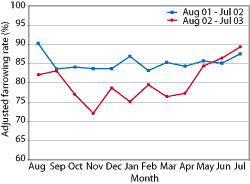
Question from the front cover... The graph shows a seasonal comparison of adjusted farrowing rate for a commercial sow herd over 2 years. Is this second year merely a particularly bad year for seasonal infertility, or is there a more complex problem? |
 |
Seasonal infertility or not?
Lisa Tokach, DVM, Diplomate ABVP
Abilene Animal Hospital, PA; 320 NE 14th Street, Abilene, KS 67410; Tel: 785-263-2301; Fax: 785-263-2925; Voice mail: 785-263-2398, ext 233; E-mail: ltokach@aahpa.com.
Every year about July in the Mid-west, when temperatures soar and day length begins to noticeably shorten, clients begin calling, or carefully scrutinized records begin to reflect prolonged weaning-to-estrus intervals, decreased conception rates, and the dreaded early autumn abortion syndrome. There is often a temptation on the part of the producer and the busy swine practitioner to dismiss these changes as inevitable side effects of seasonal infertility in swine. After all, Mother Nature designed the sow to produce only one litter per year in the spring, and it has only been through human intervention that we have been able to coax her reproductive performance to higher levels.
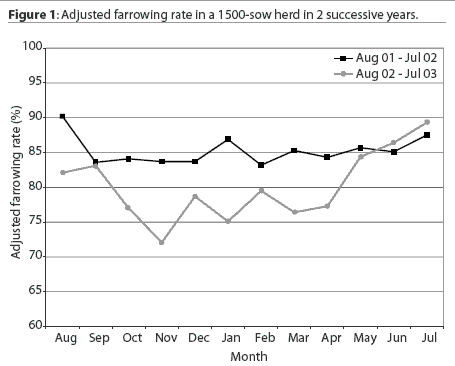
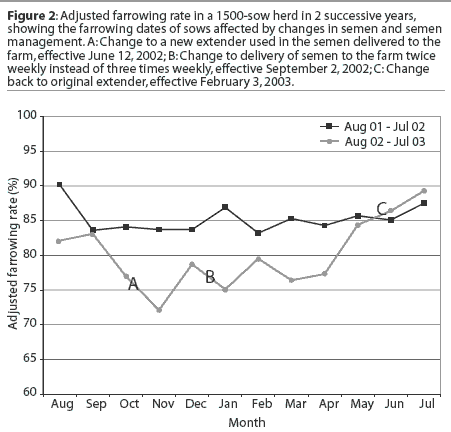
It is difficult to decide when and to what degree to pursue infectious or management causes of infertility not strictly related to season. My practitioner pendulum has swung both ways. On one hand, I have aggressively pursued diagnostics, submitting blood from infertile sows for serology, aborted fetuses of various stages for virology, and reproductive tracts from slaughter checks for microbiology. When diagnostic efforts are unsuccessful, it is ironic to me that the client is often disappointed. It seems that he or she would rather have a highly infectious pathogen in the herd than be unable to identify the problem. For this reason, it may seem inadequate to reassure your client that the positive side of spending a great deal of money on diagnostics is knowing what the problem is not (even though we can't identify it). On the other hand, reassuring the nervous producer who is vigilant about production records that the reproductive turn for the worse is just seasonal infertility and nothing else, and it will go away in December regardless of what we do, seems so lame. In this retrospective case, hindsight is 20-20. Figures 1 and 2 show the same data, but with additional information in Figure 2. In June, there was a change in the semen extender in the semen delivered to the farm.
It is difficult to pinpoint the cause of declining reproductive performance when there are so many factors to consider. In this case, nutrition, personnel, average parity distribution, and genetics remained relatively constant. To take a closer look, we compared the adjusted farrowing rate (AFR) for the 6 weeks before and after the change in semen extender. We then compared the AFR for the last 6 weeks when the new extender was used to the AFR during the first 6 weeks when the original extender was used again (Figure 3). Since a change in semen extender has its biggest impact on conception rate and total pigs born per litter, we also compared total pigs born per litter in the same fashion in Figure 4.
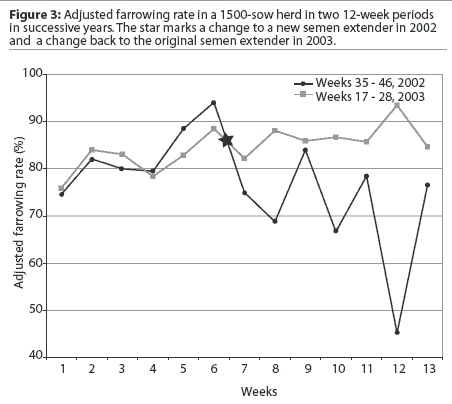
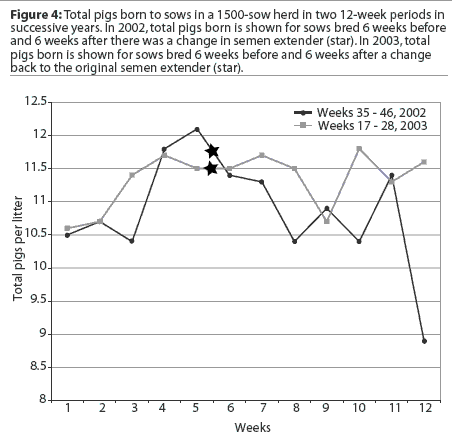
The end result was an average AFR of 83.1% for the 6 weeks prior to the change to the new semen extender, and 69.7% for the 6 weeks after the change. Total pigs per litter during the same time frame were 11.2 and 10.6 respectively. Conversely, when we switched back to the original extender, AFR was 82.1% for the last 6 weeks on the new extender and 87.4% for the first 6 weeks back on the original extender. Total pigs per litter during this time period averaged 11.2 and 11.4 respectively.
Although I still don't plan to submit every aborted fetus for a full diagnostic workup this fall, it is important not to become complacent and blame the ups and downs of reproduction on season alone.