
Annual Meeting report
Swine veterinarians get back to basics
Swine veterinarians gathered in Des Moines, Iowa, for the 35th Annual Meeting of the AASV. In a state where pigs outnumber people five to one, it was a fitting location to host this year's program, "Back to the basics." Dr John Waddell, Incoming President and Program Chair, choose this year's theme because "Disease is one area everyone concedes to veterinarians."
Howard Dunne Memorial Lecture
In a shift back to the traditional core of swine medicine, Dr Robert Desrosiers delivered the Howard Dunne Lecture, "Epidemiology, diagnosis and control of swine diseases." Not since 1988 has a Howard Dunne Memorial Lecture focused on diseases and pathogens. In selecting Dr Desrosiers as this year's lecturer, Dr Waddell said, "Dr Desrosiers is a walking, talking "Diseases of Swine" textbook. Ask him a very specific disease question, and he will cite literature from a decade ago, just off the top of his head."
Addressing the economic aspect, Dr Desrosiers said veterinarians need to help producer clients avoid losses associated with significant pathogens. To achieve this, Dr Desrosiers believes that veterinarians need to know the means by which these pathogens find their way into swine barns. In that respect, he suggests that the introduction of infected animals has been overemphasized in the epidemiology of swine diseases, whereas the importance of farm location, pig density, and indirect transmission has been largely underestimated. Using several examples to support his position, Dr Desrosiers recommends making the necessary efforts and investing adequate money to identify and quantify these indirect methods of transmission. Only then, he states, will it be possible to determine what preventive strategies are worth the investment.
Dr Desrosiers described several field cases showing how useful a good clinical evaluation and a proper understanding of serological results can be in diagnosing diseases. Using treatment of porcine pleuropneumonia as an example, Dr Desrosiers showed that when the right antimicrobial is used at the right time and at the right dosage, the losses associated with this bacterial disease are limited to almost none.
Looking into the future, Dr Desrosiers believes that swine veterinary research in the next 5 to 10 years should have a particular emphasis on epidemiology, because, he said, "We know that it makes more sense to raise healthy rather than sick pigs. We know how to produce pigs that are negative to many different pathogens. But what we don't know is how to maintain herds negative to these pathogens on a large-scale basis. And this will last as long as we do not have a better understanding of how these herds become infected to start with." Finally, Dr Desrosiers hopes that meeting and even exceeding expectations in the field of health and diseases will remain a priority of AASV for years to come.
AASV turns 35
To commemorate the AASV's 35th anniversary, Dr Ralph Vinson gave the Founder's Message during the general session. Reminiscing about the past 35 years of his professional career, he said that most of the things that turned out to be important involved other people.
One of those important people was Dr Al Leman, who died in 1992. "His leadership led to a revolutionary metamorphosis for Minnesota pork production," Dr Vinson said. "I valued his advice and knowledge more than any other of my colleagues'."
Dr Vinson credited AASV as the linchpin of the swine industry, although the best part of the association is its members, he said. "I received a lot of help from other people. If you are having a tough time with decisions, you have plenty of successful peers that can offer advice."
In closing, he said, "Take advantage of dumb luck. Chances are it's what brought you here today."
Awards
Three AASV members were recognized by their colleagues during the awards reception. Dr Bob Morrison, 2000 AASV president, presented the awards.
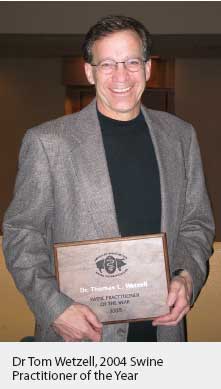
The AASV's highest honor, Swine Practitioner of the Year, went to Dr Tom Wetzell, Wells, Minnesota. Established in 1977, the award is given annually to a private practitioner who has demonstrated exceptional service to clients. In receiving the award, Dr Wetzell said, "I am honored and humbled to receive this award. Many thanks go to the clients I serve and my colleagues." Dr Wetzell is president of the South Central Veterinary Association clinic in Wells. His practice has six veterinarians who provide veterinary care to swine farms throughout the upper Midwest. He joined the clinic, owned by his father, after graduating from the University of Minnesota College of Veterinary Medicine in 1977.
|
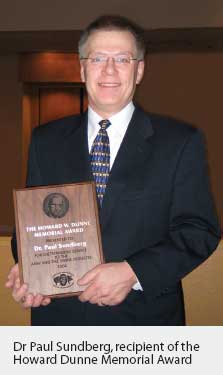
The Howard Dunne Memorial Award was presented to Dr Paul Sundberg, Ames, Iowa, for his outstanding service to the swine industry and the association. Dr Sundberg is the vice president of science and technology for the National Pork Board. He is a 1981 graduate of the Iowa State University College of Veterinary Medicine. Active in the US pork industry for over 10 years, Dr Sundberg has contributed to the development of the industry's animal welfare program. His recent project involves implementation of the Swine Welfare Assurance ProgramSM, the industry's standard for assessing swine welfare on the farm.
|
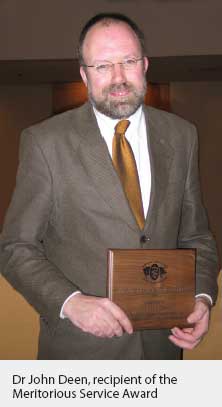
Dr John Deen, St Paul, Minnesota, received the Meritorious Service Award for his contributions to the AASV. His involvement in the association spans 20 years of dedicated service, where he currently chairs the AASV Welfare Committee and the Scholarships Committee of the AASV Foundation. He is also a member of the Communications Committee and the Education Committee. He served as a board member from 1990 to 1992, and was a trustee of the Foundation for 6 years. Dr Deen is an associate professor of Swine Health Management at the University of Minnesota, and director of the university's Swine Center.
|
Student seminar and scholarships
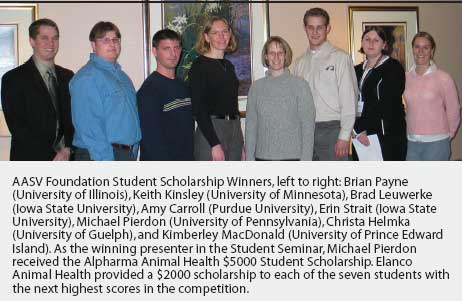 Michael Pierdon was awarded a $5000 scholarship by the AASV Foundation
for best presentation at the student seminar on Sunday, March 7. Michael is a
third-year veterinary student at the University of Pennsylvania. His presentation was
titled "Growth dynamics of two common
bacterial contaminants found in extended porcine semen." Alpharma Animal Health
provided the financial support for this award.
Michael Pierdon was awarded a $5000 scholarship by the AASV Foundation
for best presentation at the student seminar on Sunday, March 7. Michael is a
third-year veterinary student at the University of Pennsylvania. His presentation was
titled "Growth dynamics of two common
bacterial contaminants found in extended porcine semen." Alpharma Animal Health
provided the financial support for this award.
Seven veterinary student presenters received $2000 scholarships: Amy Carroll, Purdue University; Christa Helmka, University of Guelph; Keith Kinsley, University of Minnesota; Brad Leuwerke, Iowa State University; Kimberley MacDonald, University of Prince Edward Island; Brian Payne, University of Illinois; and Erin Strait, Iowa State University. Eli Lilly & Company Foundation, on behalf of Elanco Animal Health, provided financial support for those seven awards.
Fifteen students were selected to present during the annual meeting, from a pool of 27 who submitted abstracts for consideration. Each of those selected received a $500 travel stipend from Alpharma Animal Health to attend the annual meeting.
A panel of judges representing private practice, academia, and industry selected the recipients on the basis of communications skills in the writing of the abstract and the presentation of the case report, and on applicability of the research to swine medicine.
Luncheon
During the luncheon sponsored by Boehringer Ingelheim Vetmedica, Inc, Dr K. T. Wright, chair of the AASV Foundation, reported that as of December 1, 2003, the Foundation endowment had reached $311,000. He thanked AASV members for their support and contributions through participation in Foundation activities such as the golf outings, Leman Fellow Program, and Heritage Fellow Program.
Dr Cate Dewey, representing the Canadian swine veterinarians, encouraged everyone to attend next year's meeting in Toronto.
Preconference seminars
Swine veterinarians had many options for continuing education prior to the general sessions. Twelve seminars focusing on a range of topics were offered, including a Swine Welfare Assurance ProgramSM Educator Training session.
Practitioners could choose from several seminars geared toward practical tools and advice. Information included new ideas for facility design, techniques that address welfare and improve efficiency, tools for investigating and preventing outbreaks of porcine reproductive and respiratory syndrome, technologies to obtain optimum reproductive efficiency in breeding herds, and practical, on-farm pharmacology.
Additional seminars focused on hands-on application of research related to boar studs; the latest developments in postweaning multisystemic wasting syndrome; a review and update of foreign animal diseases; and a primer on quality control in feed mills. The preconference lineup also offered the popular business seminar for veterinary students.
Industrial partners and technical tables
A total of 53 concurrent industrial partner presentations were made to participants, as part of the conference activities. Representatives of commercial companies staffed 49 technical tables.
Organizational matters
The AASV Board of Directors convened during the Annual Meeting. Dr Rick Sibbel, President, presided over the half-day session. A number of issues were discussed and the board passed the following motions:
- To provide $40,000 over 2 years for a study to examine issues related to future demand for food animal veterinarians, and the recruitment and selection of veterinary students to food animal practice.
- To establish a task force charged with guiding the education of swine veterinarians in the science of auditing. The task force will make recommendations to the AASV Board and serve as a liaison between AASV and other groups on auditing issues.
- To approve Columbus, Ohio, as the site for the 2008 meeting, and Charlotte, North Carolina, as the 2009 meeting site.
Business breakfast
 During the annual business meeting and breakfast, Dr Sibbel gave a "State of
the Association" address. He reported that as
of February 2004, there are 1121 paid members and 141 student members.
Membership numbers are stabilizing, while student members are increasing. He thanked
the outgoing directors, Dr Angela Baysinger, Dr Jeff Blythe, and Dr R. C. Ebert, for
their service and leadership. Incoming board members are Dr Tom Fangman (District
3), Dr Pat Halbur (District 6), and Dr Ron Brodersen (District 8).
During the annual business meeting and breakfast, Dr Sibbel gave a "State of
the Association" address. He reported that as
of February 2004, there are 1121 paid members and 141 student members.
Membership numbers are stabilizing, while student members are increasing. He thanked
the outgoing directors, Dr Angela Baysinger, Dr Jeff Blythe, and Dr R. C. Ebert, for
their service and leadership. Incoming board members are Dr Tom Fangman (District
3), Dr Pat Halbur (District 6), and Dr Ron Brodersen (District 8).
Honored guest Dr Bonnie Beaver, AVMA President-Elect, gave the membership an update on AVMA activities. Dr Paul Sundberg, NPB, spoke about common activities of the AASV and NPB. He said, "The AASV's expertise, insight, and experience are key to helping committee members of the NPB direct the industry."
Foundation auction
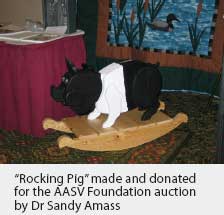 This year's silent and live auctions netted nearly $7000 for the AASV
Foundation. Performing the duties of auctioneers
were Dr Tom Burkgren and Dr Jon Witt. Both did an admirable job of cajoling
members into parting with their hard-earned money. Helping with the auction were Mrs
Betty (K. T.) Wright and Mrs Jean (Rod) Johnson.
This year's silent and live auctions netted nearly $7000 for the AASV
Foundation. Performing the duties of auctioneers
were Dr Tom Burkgren and Dr Jon Witt. Both did an admirable job of cajoling
members into parting with their hard-earned money. Helping with the auction were Mrs
Betty (K. T.) Wright and Mrs Jean (Rod) Johnson.
New officers
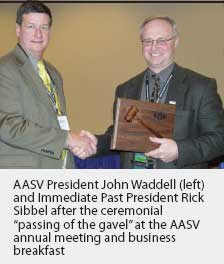
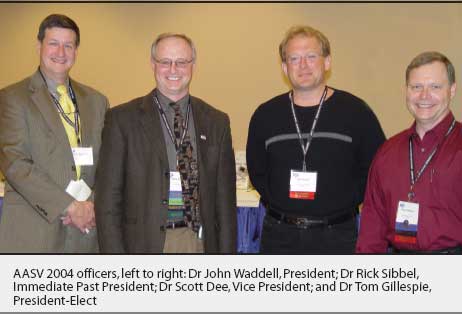
The 2004-2005 slate of officers was installed on March 9. Dr Rick Sibbel passed the gavel to Dr John Waddell, who assumed the presidency of the AASV. Dr Waddell thanked Dr Sibbel for his passion and leadership during his term as president. Joining Dr Waddell as officers are Dr Tom Gillespie, President-Elect, and Dr Scott Dee, Vice President. Dr Sibbel is the Immediate Past President.
Next meeting
In 2005, the AASV will meet March 5 to 8 in Toronto, Ontario, Canada.