Brief communication |
Peer reviewed |
Transmission of porcine reproductive and respiratory syndrome virus under field conditions during a putative increase in the fly population
Scott A. Dee, DVM, MS, PhD, Diplomate ACVM; Jennifer A. Schurrer, BA; Roger D. Moon, PhD; Eduardo Fano, DVM, MS; Carlos Trincado, DVM; Carlos Pijoan, DVM, PhD
SAD, JAS, EF, CT, CP: Swine Disease Eradication Center, University of Minnesota College of Veterinary Medicine, St Paul, Minnesota. RDM: Department of Entomology, University of Minnesota, St Paul, Minnesota. Corresponding author: Dr Scott A. Dee, Swine Disease Eradication Center, University of Minnesota College of Veterinary Medicine, Room 385C, 1988 Fitch Avenue, St Paul, MN 55108; Tel: 612-625-4786; Fax: 612-625-1210; E-mail: deexx004@umn.edu
Cite as: Dee SA, Schurrer JA, Moon RD, et al. Transmission of porcine reproductive and respiratory syndrome virus under field conditions during a putative increase in the fly population. J Swine Health Prod. 2004;12(5):242-245.
Also available as a PDF.
Summary
Indirect transmission of porcine reproductive and respiratory syndrome virus (PRRSV) is described, from an experimentally infected pig population to a group of negative controls housed 30 m apart. The episode appeared to involve an increase in PRRSV shedding and, concurrently, environmental changes favoring an increase in the fly population.
Keywords: swine, porcine
reproductive
and respiratory syndrome virus, insects, transmission
Search the AASV web site
for pages with similar keywords.
Received: November
7, 2003
Accepted: December
8, 2003
Mechanical transmission of porcine reproductive and respiratory syndrome virus (PRRSV) from infected to susceptible pigs by houseflies (Musca domestica) has been documented experimentally, and viable PRRSV has been detected in the intestinal tracts of houseflies for up to 12 hours after they fed on experimentally infected pigs.1,2 However, the outcomes of these studies were favorably influenced by artificial scarification of the pigs’ skin to promote access to infected blood, and houseflies were directly positioned on the scarified areas. Recently, recovery of PRRSV-positive flies 2.3 km from an experimentally infected finishing pig population was described.3 In this case, artificial scarification did not occur, and flies were likely to have been contaminated with PRRSV during contact with porcine saliva and oro-nasal secretions. Despite these efforts, no reports have been published proving transmission of PRRSV from infected to susceptible pigs by flies under field conditions. Therefore, the purpose of this brief communication is to describe a field case of PRRSV transmission from a population of infected pigs to a group of naive pigs during a putative increase in the fly population.
Materials and methods
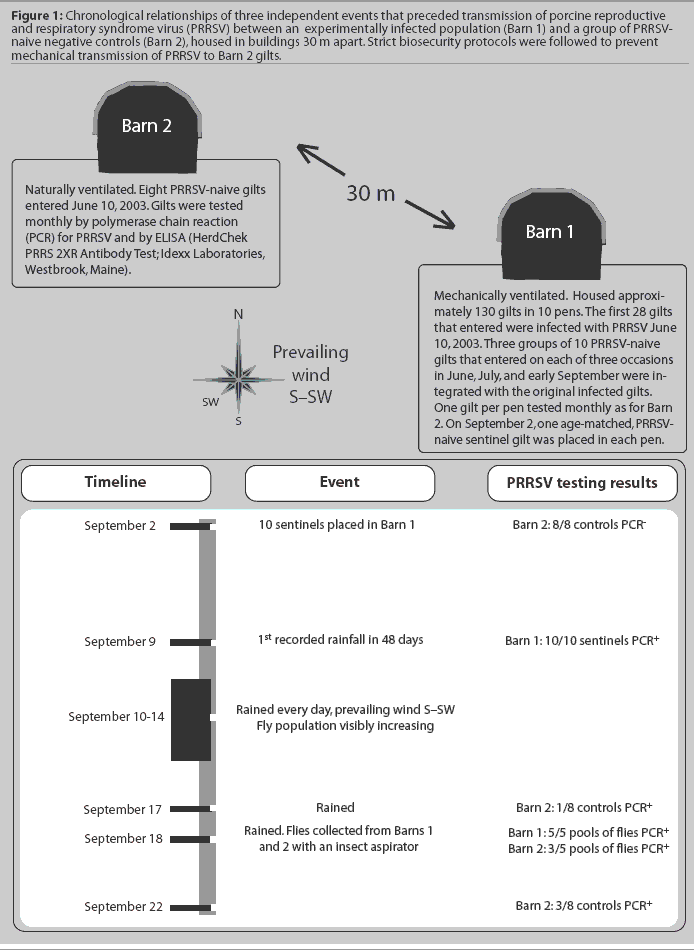
The case took place on the University of Minnesota Swine Disease Eradication Center research farm in west-central Minnesota and involved two facilities on this site. One facility was a mechanically ventilated finishing barn (Barn 1) that housed an experimentally infected population of PRRSV-positive pigs. The other facility (Barn 2), located 30 m northwest of Barn 1, was naturally ventilated and housed PRRSV-negative controls. The outcome (ie, infection of the negative controls with PRRSV) appeared to involve a coordinated sequence of three independent events, and occurred during the period of September 2 to 22, 2003. Figure 1 provides a summary of the chronological relationships among the three events.
First event
The first event was an episode of shedding of PRRSV within the infected population in Barn 1 during a time when it housed approximately 130 six-month-old gilts. Barn 1 contained 10 pens, with a maximum of 13 pigs housed per pen. The original group of 28 gilts had been experimentally infected on June 10, 2003. The strain of PRRSV used to infect the animals, MN 30-100, had been administered via the intranasal route at a total dose of 1 x 102.4 median cell culture infectious doses.4 These gilts were part of a study designed to evaluate PRRSV persistence and transmission. The study design allowed for continuous introduction of multiple groups of PRRSV-naive gilts placed in direct contact with experimentally infected pigs. Three groups of 10 PRRSV-naive gilts were integrated with the infected gilts on each of three occasions in June, July, and early September. This animal flow was designed to mimic the practice, common in commercial swine herds, of introducing naive replacement gilts into a continuous flow gilt developer facility. As a result, regular episodes of transmission of PRRSV between groups of pigs occurred throughout the summer.
A monitor group of 10 randomly selected pigs (1 pig per pen) were identified and tested monthly by the Idexx 2XR ELISA (HerdChek 2XR PRRS Antibody Test; Idexx, Westbrook, Maine) and TaqMan polymerase chain reaction (PCR) (Perkin-Elmer Applied Biosystems, Foster City, California), beginning 1 month after the experimental infection.
On June 10, 2003, eight age-matched negative control gilts were delivered to Barn 2, 30 m from Barn 1. These gilts came from a source population that had been verified as PRRSV-naive by regular blood testing, a lack of PRRS-related clinical signs, and evaluation of production data. Blood samples for testing by 2XR ELISA were collected monthly in the source herd from 60 sows, 30 nursery pigs 8 to 10 weeks old, and 30 finishing pigs 5 to 6 months old. After being placed in Barn 2, the control gilts were tested monthly by 2XR ELISA and PCR for PRRSV.
On September 2, a group of 10 age-matched, PRRSV-naive sentinel gilts were mixed with the infected population in Barn 1, with one sentinel per pen. On arrival, all 10 animals were PCR-negative and ELISA-negative.
Second event
The second event was a change in environmental conditions. Between July 23 and September 8, no measurable rainfall had been recorded in the area. This prolonged period of drought resulted in a marked reduction in the resident insect population. On September 9, the first rain in 48 days was recorded. Precipitation was then recorded daily September 10 to 14, September 17, and September 18, with daytime temperatures ranging from 18 to 29°C during this period.
Third event
Following the onset of warm, wet climactic conditions, there was an observed increase in the resident fly population. During the period between September 10 and 17, the population of flies inside and outside both facilities visibly increased, compared to that observed during the drought period, and the prevailing wind direction was from the south-southwest. While specific calculations of changes in the fly population were not made, the observed difference was striking. Increased numbers of flies were noted on the walls of the facilities, and 10 to 100 flies could be counted on each pig. Flies frequently fed upon and exacerbated a small number of previously existing mosquito bites, resulting in large, exudative wounds on the dorsal and lateral surfaces of the animals. Insects were collected as required in a hand-held insect aspirator (Insect Vac #2820A; Bioquip, Gardena, California).
Results
On September 8, 10 of 10 blood samples collected from the sentinels in Barn 1 were PRRSV-positive by the PCR assay. Nucleic acid sequencing of the ORF 5 region of PRRSV RNA recovered from sentinel pig sera indicated > 99.8% homology with the same region of strain MN 30-100. Monthly serum PCR and ELISA tests for PRRSV were negative for all eight negative controls in Barn 2 until September 17, when one control was serum PCR-positive. Upon receipt of these results (September 18), 150 flies were collected in the airspace of each facility (Barns 1 and 2) using the hand-held insect aspirator. The primary species collected included houseflies, stable flies (Stomoxys calcitrans), and black garbage flies (Hydrotaea ignava). Each sample of 150 flies was divided into pools of 30. Each pool was macerated in minimal essential medium, filtered, and tested for PRRSV RNA by PCR.3 Five of five pools collected from Barn 1 (housing infected pigs) and three of five pools collected from Barn 2 (housing negative control pigs) were PCR-positive.
Three of eight control pigs were PCR-positive when tested September 22. Nucleic acid sequencing of the ORF 5 region of PRRSV RNA recovered from pig sera and fly pools from both facilities indicated that the isolate was similar to the PRRSV MN 30-100 strain (> 99.8% homologous).
Discussion
This case summarizes an assumed episode of indirect transmission of PRRSV under field conditions, in which the route of virus entry to the control pig population cannot be conclusively proven. However, a number of potential routes may be ruled out.
Prior to the summer experiments, the entire site had been free of pigs for 6 months, and had been thoroughly washed, disinfected, and allowed to dry. All pigs used in the study were PCR-negative and ELISA-negative on arrival at the farm, and all originated from a PRRSV-naive source that has remained naive as of this writing. On the day the animals were delivered to the farm, the transport service made no other deliveries, and the vehicle had been washed, disinfected, and allowed to dry overnight prior to shipment. It was carefully inspected prior to leaving the transport center. No feed was delivered during the month of September, and the water source for the farm originated from a private well that was chlorinated. Furthermore, the control animals remained PRRSV-naive throughout the summer months.
Possible routes of transmission of PRRSV to the control pigs in Barn 2 from the infected pigs in Barn 1 might include mechanical transmission by study personnel or aerosols. However, the biosecurity protocol between the two barns had been used for the previous 2 years and had been efficacious for preventing mechanical transmission of PRRSV between groups of pigs.5 This protocol included use of dedicated personnel; 6.5% sodium hypochlorite boot baths in building entryways; changing boots, gloves, and coveralls between facilities; and caring for control pigs before entering the PRRSV-positive facility. It is the opinion of the authors that aerosol transmission is also an unlikely possibility, since it had been impossible to demonstrate transmission of PRRSV by aerosols in a number of attempts during the summer of 2003, as well as during the previous three summers.6,7 Finally, whether the insect aspirator might have accumulated PRRSV-laden aerosols and contaminated the flies cannot be determined, as swabs were not collected from the interior of the instrument or from aerosols from the pigs. Yet, in the authors’ opinion, it is unlikely that contamination of the insect aspirator with PRRSV from aerosols occurred, as numerous attempts to detect PRRSV in air samples collected by glass impingers have been unsuccessful.6,7
Finally, the presence of homologous PRRSV in samples obtained from pigs and fly pools from both facilities suggests insect transmission of PRRSV in this case; however, the potential role of insects other than flies is unknown and was not assessed. For example, mosquitoes might have been another possible source of infection; however, the number of mosquitoes on the farm during this period, assessed by visual observation, was low. On the basis of the authors’ experiences and observations made during insect-related studies, transmission of PRRSV by nonbiting flies may occur in the absence of open wounds.1-3 Flies readily feed upon lacrimal, salivary, and oro-nasal secretions of pigs. Infectious PRRSV has been recovered from the exterior surfaces and the gastrointestinal tracts of houseflies after feeding on an infected pig. With close observation, it is possible to watch flies regurgitate intestinal material and walk around the portals of exit for lacrimal, salivary, and oro-nasal secretions, resulting in potential exposure of insects to PRRSV and other pathogens. Therefore, while transmission of PRRSV by insects is an uncertainty under field conditions, this case suggests that under specific conditions, it may be considered.
An interesting aspect of this case is the fact that for the previous two summers, it had been possible to successfully house negative control pigs in Barn 2, 30 m from a PRRSV-positive population. Similarities among the experiments in the three summers included the source and age of the pigs, the strain of PRRSV, the inter-facility biosecurity protocol, and a resident insect population. Differences unique to the summer of 2003 included an experimental design that permitted PRRSV shedding to occur within the infected population, and the prolonged period of drought. In the 2001 and 2002 studies, an entire pig population was infected on a single day, and the population remained constant throughout the study period,8 in contrast to the continuous animal flow in the 2003 study. Furthermore, the prolonged period of drought in 2003, followed by favorable climactic conditions for insect hatching, resulted in drastic shifts in the resident insect population that were not evident in 2001 and 2002. The difference in the fly population in 2003 was striking. Many more flies were noted on the walls of the facilities, and the pigs were covered with flies, in numbers that one author (SAD) has never experienced in his 16 years as a veterinarian.
It must be remembered that this is a field case, lacking proper controls, and caution must be used in drawing conclusions from these observations. However, the outcome raises two interesting points. First, the historical ability to raise PRRSV-negative pigs 30 m from an infected population suggests that transmission of PRRSV by non-porcine vectors under field conditions is an infrequent event.9 Secondly, the outcome in 2003 suggests that, in order for such episodes of transmission to occur, a coordinated sequence of events may be required, including active shedding of the pathogen within an infected population and sudden environmental changes followed by an increase in the vector population. If this can be validated in commercial swine operations, the three events described may serve as risk factors for early detection of impending PRRSV spread within regions.
Implications
- On the basis of diagnostic data, and ruling out other known routes of PRRSV transmission, the outcome of this case suggests that flies may have served as mechanical vectors of PRRSV.
- Transmission of PRRSV by insect vectors in the field may require a coordinated sequence of events.
- Events critical for transmission to occur may include changes in PRRSV shedding patterns in an infected population of pigs, concurrent with changes in environmental conditions that influence a potential vector population.
References
1. Otake S, Dee SA, Rossow KD, Moon RD, Trincado C, Pijoan C. Transmission of porcine reproductive and respiratory syndrome virus by houseflies, (Musca domestica Linnaeus). Vet Rec. 2003;152:73-76.
2. Otake S, Dee SA, Moon RD, Rossow KD, Trincado C, Farnham M, Pijoan C. Survival of porcine reproductive and respiratory syndrome virus in houseflies (Musca domestica Linnaeus) Can J Vet Res. 2003;67:198-203.
*3. Boorman JA, Dee SA, Otake S, Moon RD. An assessment of insects as regional vectors of PRRSV. Proc AD Leman Conf. St Paul, Minnesota. 2003;35.
4. Bierk MD, Dee SA, Rossow KD, Collins JE, Guedes MI, Pijoan C, Molitor TW. A diagnostic investigation of chronic PRRS virus infection in a swine breeding herd. Vet Rec. 2001;148:687-690.
5. Otake S, Dee SA, Rossow KD, Deen J, Joo HS, Molitor TW, Pijoan C. Transmission of porcine reproductive and respiratory syndrome virus by fomites (boots and coveralls). Swine Health Prod. 2002;10:59-65.
6. Otake S, Dee SA, Jacobson L, Torremorell M, Pijoan C. Evaluation of aerosol transmission of porcine reproductive and respiratory syndrome virus under controlled field conditions. Vet Rec. 2002;150:804-808.
7. Trincado C, Dee SA, Jacobson L, Otake S, Pijoan C. New attempts to transmit porcine reproductive and respiratory syndrome virus by aerosols under controlled field conditions. Vet Rec. 2004;154:294-297.
8. Batista L, Dee SA, Rossow KD, Deen J, Pijoan C. An assessment of PRRSV persistence and shedding in a large population of breeding age female swine. Can J Vet Res. 2002;66:196-200.
9. Mortensen S, Stryhn H, Sorgaard R, Boklund A, Stark KD, Christensen J, Willeberg P. Risk factors for infection of sow herds with porcine reproductive and respiratory syndrome virus. Prev Vet Med. 2002;15:83-101.
* Non-refereed reference