
Original research |
Peer reviewed |
Effect of estrogen formulation and site of deposition on fertility of artificially inseminated sows treated with human chorionic gonadotrophin to induce ovulation
Glen Cassar, DVM, PhD; Roy N. Kirkwood, DVM, PhD, Diplomate ECAR; Zvonimir Poljak, DVM, MSc; Robert Friendship, DVM, MSc, Diplomate ABVP
GC, ZP, RF: Department of Population Medicine, University of Guelph, Guelph, Ontario, Canada. RNK: Department of Large Animal Clinical Sciences, Michigan State University, East Lansing, Michigan. Corresponding author: Dr Roy N. Kirkwood, Department of Large Animal Clinical Sciences, Michigan State University, East Lansing, MI 48824-1314; Tel: 517-432-5198; E-mail: kirkwood@cvm.msu.edu.
Cite as: Cassar G, Kirkwood RN, Poljak Z, et al. Effect of estrogen formulation and site of deposition on fertility of artificially inseminated sows treated with human chorionic gonadotrophin to induce ovulation. J Swine Health Prod. 2004;12(6):285-287.
Also available as a PDF.
Summary
Objective: To determine the effect of estradiol, either added to extended semen or deposited onto the vaginal mucosa, on the reproductive performance of artificially inseminated sows.
Materials and methods: At 80 hours after weaning, 227 mixed-parity sows received an intramuscular injection of 750 IU of human chorionic gonadotrophin (hCG) to induce ovulation. At 36 and 46 hours after hCG injection, sows exhibiting estrous behaviour (n = 198) were artificially inseminated with 3 x 10⁹ spermatozoa in 80 mL extender. At the time of insemination, sows were sequ;entially assigned to receive 25 mg estradiol dissolved in the semen dose (E-semen; n = 66), 25 mg estradiol in an oil solution deposited onto the anterior vaginal mucosa (E-vag; n = 66), or no estradiol (Control; n = 66). Real-time ultrasound was used to determine pregnancy status 26 to 30 days after insemination. Pregnancy rates, farrowing rates, and subsequent total-born litter sizes were recorded.
Results: Pregnancy rates were 97.0%, 92.4%, and 90.9%, farrowing rates were 89%, 92% and 89%, and litter sizes were 11.1, 10.8, and 10.5, for E-semen, E-vag, and Control, respectively. Differences were not significant (P > .5). These data indicate no benefit from supplemental estradiol at the time of insemination. However, any effect may have been masked by an improved performance of all treatment groups relative to the herd's historical farrowing rate (75.7%).
Implications: The breeding of sows following a controlled induction of ovulation may have the potential to improve sow fertility. However, under these conditions, supplemental estradiol provided no significant further benefit.
Keywords: swine, fertility,
estradiol,
semen, hCG
Search the AASV web site
for pages with similar keywords.
Received: December
8, 2003
Accepted: July
2, 2004
Often, sow fertility following artificial insemination appears to be poorer relative to that following natural breeding.1 Various factors may be involved in this apparently reduced fertility, including poor timing of insemination relative to ovulation.2 Natural breeding near the onset of estrus may advance the time of ovulation,3 an effect attributed to a seminal plasma protein and a high concentration of estrogen in the boar's ejaculate,4 constituents of seminal plasma diluted out from fresh extended semen. In sows bred naturally, it is likely that ovulation is advanced in females that would otherwise be late ovulators (eg, estrus-to-ovulation intervals > 40 hours). The consequence of this would be improved timing of sperm deposition relative to ovulation and, therefore, improved fertilization and farrowing rates.
In addition to potentially affecting the time of ovulation, estrogens are reported to stimulate myometrial contractions via an estrogen-induced local release of prostaglandin F2[alpha] (PGF).1,5 Increased myometrial contractility may result in improved transport of sperm towards the uterotubal junction, an increased functional sperm reservoir, and so improved sow fertility. Indeed, it is accepted that insemination of too few sperm, presumably due to the establishment of an inadequate functional sperm reservoir, compromises sow fertility.6,7 Interestingly, increased serum PGF metabolite concentrations persisted longer following natural service than following a uterine infusion of estrogen in saline.1 This suggests a more prolonged release of estrogen following a natural service, possibly due to initial stimulation by estrogen in seminal plasma being followed by a further release of estrogen nonspecifically attached to the sperm.1 Additionally, the gel component of the ejaculate is known to have a high estrogen content (G. R. Foxcroft, oral communication, 2004), which would also be expected to prolong hormone release. To date, the effects of estrogen-supplemented semen on sow fertility have been relatively small.8,9 However, it is possible that if a more prolonged release of estrogen were achieved, a greater improvement in sow fertility would ensue. Therefore, the objective of this experiment was to determine whether the sow response to estrogen supplementation at insemination is affected by estrogen formulation and route of administration.
Materials and methods
This study was performed during February to September 2003 on a 700-sow commercial facility. The target lactation length was 21 to 28 days. During an 11-week period, 227 mixed-parity sows were exposed daily to a boar for estrus detection beginning 24 hours after weaning. At 80 hours after weaning, sows received an intramuscular injection of 750 IU of human chorionic gonadotrophin (hCG; Chorulon; Intervet Canada, Whitby, Ontario) to induce ovulation. On the basis of literature evidence, ovulation was expected to occur approximately 42 hours after hCG injection.10,11 Sows exhibiting estrous behaviour were artificially inseminated 36 hours after hCG injection and again 10 hours later. Insemination doses were 80 mL fresh extended semen containing at least 3 x 10⁹ sperm derived from a pool from two boars, each with a recorded history of acceptable fertility.
At the time of insemination, sows were sequentially assigned to receive 25 mg estradiol dissolved in the semen dose (E-semen; n = 66), 25 mg estradiol in an oil solution deposited onto the anterior vaginal mucosa (E-vag; n = 66), or no estradiol (Control; n = 66). The estradiol dose was chosen on the basis of documented estrogen levels of up to 11.5 mg in seminal plasma and approximately the same amount nonspecifically attached to the sperm.1 All estradiol solutions were prepared by The Veterinary Pharmacy Inc, Guelph, Ontario. Pregnancy status of inseminated sows was determined by transabdominal real-time ultrasonography during the first trimester (26 to 30 days), and pregnant sows were allowed to go to term to determine farrowing rates and subsequent total-born litter sizes.
Statistical comparisons were performed using NCSS (Number Cruncher Statistical Systems, Kaysville, Utah). Treatment effects on pregnancy and farrowing rates were compared using a chi-squared test. Litter size data were subjected to general linear model analysis of variance with parity as a covariate. Differences between means at P < .05 were considered significant.
Results
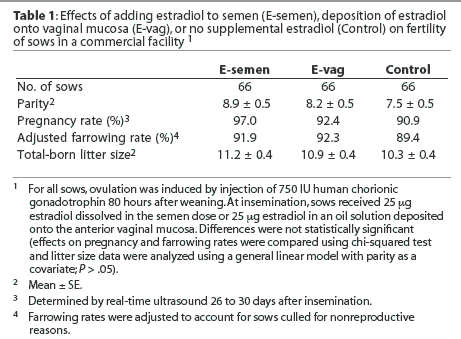
No sows were observed in estrus prior to hCG injection. Of the 227 hCG-treated sows, 198 (87.2%) exhibited estrus behaviour 36 hours following hCG treatment. There was no effect of treatment on pregnancy rates at 30 days after insemination (Table 1). Farrowing rates were adjusted to account for one E-vag sow and four E-semen sows that were culled for nonreproductive reasons. There was no effect of treatment on adjusted farrowing rates or total-born litter size (Table 1).
Discussion
This study detected no significant effect of estrogen supplementation on sow fertility. However, it is possible that any potential effect of estrogen was masked by an overall increase in sow fertility associated with the conduct of this experiment. For 370 sows inseminated immediately prior to this study, the farrowing rate to insemination at the first postweaning estrus was 75.7%. Further, in an analysis of 307 sows that farrowed after this study, 239 farrowed to insemination at their first estrus after weaning (77.9%). Compared to the historical herd data, farrowing rates during the study period for E-semen, E-vag, and Control sows improved by 16.2%, 16.6%, and 13.7%, respectively. The etiology of this general improvement in sow fertility was not determined, but it is reasonable to suggest an involvement of our protocol of controlled ovulation.
It is known that the optimal time for insemination of fresh extended semen is during the 24-hour period before ovulation,2,12 and by controlling the time of ovulation we greatly improved the chance of optimal timing of insemination relative to ovulation. An improved sow fertility associated with controlled ovulation has been observed earlier, where farrowing rates were increased from 78% to 95% when insemination was associated with controlled ovulation.13 Alternatively, we cannot discount an effect of improved overall management attention and the inseminations being performed by research personnel. However, in a current unrelated study performed on this farm by the same personnel, farrowing rates in non-hormone-treated sows remained below 80%. On the basis of the present data, we suggest that when insemination is appropriately timed relative to ovulation, supplemental estrogen will not improve sow fertility. However, further work is needed to determine whether an improvement would be evident under normal commercial conditions, ie, with no control of time of ovulation.
Implications
- Breeding to a controlled ovulation has the potential to significantly increase sow fertility.
- Under conditions of controlled ovulation, there is little effect of supplemental estrogen on sow fertility.
Acknowledgements
We gratefully acknowledge the financial support of Ontario Pork and the OMAF-University of Guelph Animal Research Program.
References
1. Claus R. Physiological role of seminal components in the reproductive tract of the female pig. J Reprod Fert. 1990; 40 (suppl):117-131.
2. Kemp B, Soede NM. Relationship of weaning-to-estrus interval to timing of ovulation and fertilization in sows. J Anim Sci. 1996;74:944-949.
3. Signoret JP, Du Mesnil du Buisson F, Mauleon P. Effect of mating on the onset and duration of ovulation in the sow. J Reprod Fertil. 1972;31:327-330.
4. Waberski D. Effects of semen components on ovulation and fertilization. J Reprod Fertil. 1997;52 (suppl):105-109.
5. Willenburg KL, Knox RV, Kirkwood RN. Effect of estrogen formulation and its site of deposition on serum PGFM concentrations, uterine contractility, and time of ovulation in artificially inseminated weaned sows. Anim Reprod Sci. 2004;80:147-156.
*6. Pedersen PN. Effect of number of sperm cells per insemination dose. Proc 2nd Int Conf Boar Semen Preserv. 1990:398.
7. Watson PF, Behan JR. Intrauterine insemination of sows with reduced sperm numbers: results of a commercially based field trial. Theriogenology. 2002;57:1683-1693.
8. Claus R, Moshammer T, Aumuller R, Weiler U. Replenishment of AI-doses with oestrogens in physiological amounts: effect on sow prolificacy in a field trial. J Vet Med A. 1989;36:797-800.
9. Kirkwood RN, Thacker PA. The influence of adding estradiol to semen on sow performance following artificial insemination. Can J Anim Sci. 1991;71:589-591.
10. Hunter RHF. Porcine ovulation after injection of human chorionic gonadotrophin. Vet Rec. 1967;81:21-23.
11. Soede NM, Kemp B. In synchronized pigs, the duration of ovulation is not affected by insemination and is not a determinant for early embryo diversity. Theriogenology. 1993;39:1043-1053.
12. Nissen AK, Soede NM, Hyttel P, Schmidt M, D'Hoore L. The influence of time of insemination relative to time of ovulation on farrowing frequency and litter size in sows, as investigated by ultrasonography. Theriogenology. 1997;47:1571-1582.
13. De Rensis F, Benedetti S, Silva P, Kirkwood RN. Fertility of sows following artificial insemination at a gonadotrophin-induced estrus coincident with weaning. Anim Reprod Sci. 2003;76:245-250.
* Non-refereed reference.