
Production tool |
Peer reviewed |
Reproductive performance in primiparous sows after postweaning treatment with a progestagen
Desempeño reproductivo en hembras primerizas después del tratamiento post destete con un progestágeno
La performance reproductrice dans les truies primipares après le traitement post-sevrage avec un progestagen
Lina Fernández, DVM, PhD; Carmen Díez, DVM, PhD; José María Ordóñez, DVM; Maite Carbajo, DVM, PhD
LF, MC: Reproducción y Obstetricia, Dpto Patología Animal (Sanidad Animal), Facultad de Veterinaria, Campus de Vegazana s/n, 24071 León, Spain; CD: Serida-Censyra, Camino de los Claveles 604, Somió, 33203 Gijón, Spain; JMO: Cooperativa Progatecsa, Valladolid, Spainl Corresponding author: Dr Lina Fernández, Reproducción y Obstetricia, Dpto Patología Animal (Sanidad Animal), Facultad de Veterinaria, Campus de Vegazana s/n, 24071 León, Spain; Tel: 34 987 291319; Fax: 34 987 291304; E-mail: dsaafc@unileon.es.
Cite as: Fernández L, Díez C, Ordóñez JM, et al. Reproductive performance in primiparous sows after postweaning treatment with a progestagen. J Swine Health Prod. 2005;13(1):28-30.
Also available as a PDF.
SummaryThe purpose of this study was to determine whether administration of altrenogest (Regumate; Roussel-Uclaf, París, France) to primiparous sows would improve estrus synchronization rate and reproductive efficiency of the herd, measured in terms of the weaning-to-estrus interval (WEI), the weaning-to-first-fertile-estrus-interval (WFEI), rate of sows repeating estrus, and conception rate at first estrus. First-parity sows (Landrace x Large White) from a commercial herd received altrenogest, 20 mg per sow per day, for 5 consecutive days starting the day after weaning. A group of untreated sows acted as controls. The percentage of sows showing estrus 4 to 7 days postweaning (controls; 65.6%) or 4 to 7 days after treatment ended (8 to 11 days postweaning) was higher (P < .05) in the altrenogest-treated group (86.2%). Sows were mated naturally twice at the first estrus after weaning and pregnancy was diagnosed by ultrasonography 23 to 24 days later. There were no differences between treated and control sows in means of WEI, WFEI, rate of sows repeating estrus, or conception rate to first service. Litter size at farrowing, number of live born piglets, number of stillborn piglets, preweaning mortality, and weaned litter size were also similar between groups. | ResumenEl propósito de este estudio fue determinar si la administración de altrenogest (Regumate; Roussel-Uclaf, París, France) en hembras primerizas mejoraría la sincronización de estros y la eficiencia reproductiva del hato, medido en términos del intervalo de destete a celo (WEI por sus siglas en inglés), el intervalo entre el destete y el primer celo fértil después del destete (WFEI por sus siglas en inglés), el índice de hembras con celo repetido y el índice de concepción a primer celo. Hembras primerizas (Landrace x Large White) de un hato comercial recibieron altrenogest, 20 mg por hembra por día, por 5 días consecutivos iniciando el Día 1, el día después del destete. Un grupo de hembras no tratadas actuaron como controles. El porcentaje de hembras que mostraron celo de 4 a 7 días después del destete (controles; 65%) o 4 a 7 días después de terminar el tratamiento (8 a 11 días después del destete) fue más alto (86.2%) en el grupo tratado con altrenogest. Las hembras se sirvieron con monta natural dos veces en el primer celo después del destete y la gestación se diagnosticó por ultrasonido 23 a 24 días después del servicio. No hubo diferencias entre las hembras control y las tratadas en WEI, WFEI, índice de hembras con repetición de celo, o en el índice de concepción a primer servicio. Los nacidos vivos y muertos, la mortalidad en la maternidad, así como el tamaño de camada destetada también fueron similares entre los dos grupos. | ResuméLe but de cette étude a été déterminer si la administration de altrenogest (Regumate; Roussel-Uclaf, Paris, France) a truies primipares améliorerait la taux de synchronisation et le bon efficacité reproductive du troupeau, mesurés en termes de l'intervalle de sevrage a chaleur (WEI par ses initiales en anglais), l'intervalle entre sevrage et le première chaleur fertile après sevrage (WFEI par ses initiales en anglais), le taux de truies en répétant le chaleur, et le taux de conception dans le premier chaleur. Truies de première parité (Landrace x Large White) d'un troupeau commercial ont reçu altrenogest, 20 mg par truie par jour, par 5 jours consécutifs en commençant le Jour 1, le jour après sevrage. Un groupe de truies sans traitement agit comme témoin. Le pourcentage de truies que montrent chaleur 4 à 7 jours post-sevrage (témoins; 65%) ou 4 à 7 jours après traitement a fini (8 a 11 jours post-sevrage) a été supérieur (86.2%) dans le group traité avec altrenogest. Les truies s'ont saille deux fois dans la première chaleur après sevrage et la gestation a été diagnostiquée par échographie 23 à 24 jours plus tard. Il n'y a pas de différences entre truies traités et ces de témoins en parlant de WEI, WFEI, taux de truies en répétant le chaleur, ou le taux de conception par le premier service. Le grandeur de la portée au gestation, nombre de porcelets nés morts, mortalité avant sevrage, et le grandeur de la portée sevrée ont été semblables entre les groupes. |
Keywords: swine, altrenogest,
primiparous, reproductive performance
Search the AASV web site
for pages with similar keywords.
Received: October
8, 2003
Accepted: June
22, 2004
Progesterone and synthetic progestagens have been used to control estrus and ovulation in domestic animals. Altrenogest (Regumate; Roussel-Uclaf, París, France) is a progestagen that suppresses estrus and results in a synchronized return to estrus following its withdrawal, without a reduction in fertility or litter size.1 Regumate is licensed for use in swine in Europe and in the United States. However, few studies have been conducted using this progestagen in primiparous sows, in which litter size is smaller and weaning-to-estrus interval (WEI) is longer than in multiparous sows.2 Administration of altrenogest to pri-miparous sows, starting the day of weaning or the day after weaning, prevents estrus, allowing the sows to recuperate from lactation. In a study by Koutsotheodoros et al,3 both the percentage of sows showing estrus after withdrawal of the product and subsequent fertility rates were higher than in the control sows. Therefore, an increase in conception rate and litter size in the farrowing following administration of altrenogest may be observed, depending on dosage and timing of progestagen administration.4 The purpose of this study was to test the hypothesis that administration of altrenogest to primiparous sows for 5 consecutive days, starting the day after weaning, would improve the reproductive efficiency of the herd, measured in terms of estrus synchronization rate, the interval between weaning and first estrus after weaning (WEI), the interval between weaning and first fertile estrus after weaning (WFEI), proportion of sows repeating estrus, and conception rate at first estrus.
Materials and methods
First-parity sows (Landrace x Large White) from a commercial herd were used in this study. The sows were examined for standing estrus twice daily at 9:00 am and 2:30 pm using a mature boar. Duration of estrus was not measured. Boars used for mating were randomly chosen from a group of 20 boars. Pigs were weaned at 21.8 +/- 0.01 days of age. Each sow was mated naturally at least twice, at the first postweaning or post-treatment estrus and 12 to 24 hours later. Sows showing standing estrus 12 hours after the second mating were mated once more. Pregnancy diagnosis was made by ultrasonography 23 to 24 days postmating.
Bred sows were penned in individual crates throughout the gestation period. Sows received 2.0 to 2.2 kg of a commercial ration once daily until 30 days before parturition. The ration was then increased to 3.0 kg per sow per day, and was reduced to 2.5 kg per sow per day for the last 5 days of gestation. On the day of parturition, sows were offered 3.0 kg of a lactation diet containing 13.8 MJ per kg of digestible energy and 180 g per kg of crude protein. During lactation and from weaning to mating, the ration was gradually increased and sows were allowed to eat and drink ad libitum.
A total of 90 sows and their litters were used concurrently in this experiment. Litter sizes were standardized (eight or nine piglets) within 48 hours of parturition, and sows and piglets were penned in individual crates throughout lactation. Sows were randomly assigned to one of two groups. The Altrenogest Group (n = 29) received orally a daily dose of 20 mg of altrenogest for 5 consecutive days, starting the day after weaning (Day 1). The Control Group (n = 61) were not treated with altrenogest.
Reproductive parameters analyzed were estrus synchronization rate (ESR), WEI, WFEI, proportion of sows repeating estrus (RE), conception rate at first estrus (CR), litter size at farrowing, number of live born piglets, number of stillborn piglets, preweaning mortality, and weaned litter size. The ESR was calculated as the percentage of sows showing estrus 4 to 7 days after weaning (Control sows) or after treatment ended (Altrenogest Group).
In order to demonstrate adequate management of the herd, reproductive data for the 3 years previous to the experiment was evaluated.
The ESR, RE, and CR were compared between treatment groups using chi-square analysis. Means of reproductive performance parameters were compared using Student's t test.
Results
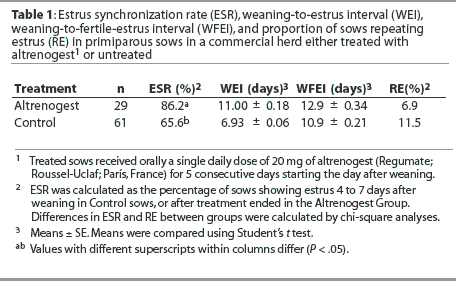
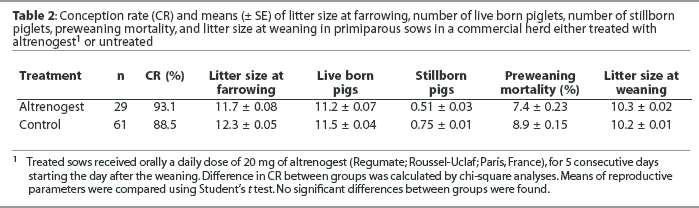
Measures of reproductive performance for the Control Group were comparable to those obtained for the herd during the previous 3 years (data not shown). The percentage of sows showing estrus Days 4 to 7 (8 to 11 days after weaning) was higher in treated sows (P < .05); however, there were no significant differences in WEI, WFEI, RE, or CR (Tables 1 and 2). The RE of the altrenogest-treated sows tended to be lower than that of the control group (P < .10). Litter size at farrowing, number of live born piglets, number of stillborn piglets, preweaning mortality, and weaned litter size were similar between groups.
Discussion
In this study, the percentage of treated sows showing estrus Days 4 to 7 after treatment ended was greater than the percentage of control sows showing estrus Days 4 to 7 after weaning. These results are consistent with the results of previous studies in which altrenogest was administered to weaned sows for 3 to 4 days.5 However, the ESR for treated sows in this study was lower than the rate observed in early weaned sows treated with progestagens for 7 days6 or 12 days3 and in postpubertal gilts treated with altrenogest for 18 days.7 The longer treatment periods in those studies may have accounted for the high synchronization rates recorded.
Other reproductive parameters analyzed in this study did not differ significantly between treatment groups (P > .05), although RE tended to be lower in the altrenogest-treated sows than in the control group (P < .10). Rate of RE is a parameter indicating reproductive failure in sows and is a measure of the efficiency of mating management. In breeding herds with "normal" reproductive performance, 8 to 14% of sows return to estrus after the first service,8 similar to what was observed in the control group in this study and comparable to data obtained during the previous 3 years in the herd (12.1%).
In previous reports, litter size was larger and there were more live born piglets in litters of sows treated with altrenogest for 3 days starting on the day of weaning5 or 7 days after weaning,6 compared to control sows. In those studies, body condition of the altrenogest-treated sows was better than that of untreated sows during the period from weaning to conception, and better embryo survival and more live born piglets might be attributed to nutritionally mediated advanced oocyte maturation, a concept described as nutritional "imprinting" of oocytes.9 Nutritional imprinting produces embryos with enhanced ability to develop and survive. However, in this study, the number of live born piglets was not greater in the sows treated with altrenogest than in the control sows.
Due to the commercial status of the herd that took part in this study, the number of animals in the Altrenogest Group was small. Future trials will include larger numbers of animals. It is important to note that altrenogest carries an extreme caution for people handling the product.
Implications
- Under the conditions of this study, administration of altrenogest was beneficial in synchronizing estrus of sows after their first litter.
- Further studies are needed to verify the positive effect of altrenogest and its safety for use in commercial herds.
References
1. Estienne MJ, Harper AF, Horsley BR, Estienne CE, Knight JW. Effect of P.G. 600 on the onset of estrus and ovulation rate in gilts treated with Regumate. J Anim Sci. 2001;79:2757-2761.
2. Tummaruk P, Lundeheim N, Einarsson S, Dalin AM. Effect of birth litter size, birth parity number, growth rate, backfat thickness and age at first mating of gilts on their reproductive performance as sows. Anim Reprod Sci. 2001;66:225-237.
3. Koutsotheodoros F, Hughes PE, Parr RA, Dunshea FR, Fry RC, Tilton JE. The effects of post-weaning progestagen treatment (Regumate") of early-weaned primiparous sows on subsequent reproductive performance. Anim Reprod Sci. 1998;52:71-79.
*4. Tilton JE, Weigl R. Regumate treatments to overcome second litter production depression. 16th Int Pig Vet Soc Congr. Melbourne, Australia; 2000:87.
*5. Baker DJ, Peter HR, Getting YG. Effect of Altrenogest on litter size in primiparous sows. Proc Brit Soc Anim Prod. 1994:171.
6. Bosch A. Utilization of zootechnical progestagen. Anaporc. 1998;179:97-104.
7. Martinat-Botte F, Bariteau F, Forgerit Y, Macar C, Poirier P, Terqui M. Synchronization of estrus in gilts with altrenogest: effects on ovulation rate and foetal survival. Anim Reprod Sci. 1998;39:267-274.
8. Tummaruk P, Lundeheim N, Einarsson S, Dalin AM. Repeat breeding and subsequent reproductive performance in Swedish Landrace and Swedish Yorkshire sows. Anim Reprod Sci. 2001;67:267-280.
9. Cosgrove JR. Nutrition/endocrine interactions. In: Wiseman J, Varley MA, Chadwick J, eds. Progress in Pig Science. Nottingham: Nottingham University Press; 1997:35-36.
* Non-refereed references.