
Diagnostic notes |
Non refereed |
Swine veterinarians and hearing loss: Summary of results of audiology testing at the 2002 AASV annual meeting
Leslie Kattelmann; William Epperson, DVM, MS, Diplomate ACVPM; Christopher Chase, DVM, PhD, Diplomate ACVM
LK, WE, CC: Department of Veterinary Science, South Dakota State University, Brookings, South Dakota; Dr Epperson is now with the Department of Veterinary Preventive Medicine, College of Veterinary Medicine, The Ohio State University, Columbus, Ohio; Corresponding author: Dr Christopher Chase, Department of Veterinary Science, South Dakota State University, Brookings SD 57007. Dr Chase is a member of the AASV Human Health Committee.
Cite as: Kattelmann L, Epperson W, Chase C. Swine veterinarians and hearing loss: Summary of results of audiology testing at the 2002 AASV annual meeting. J Swine Health Prod. 2005;13(1):34-37.
Also available as a PDF.
Swine veterinarians are exposed to sustained noise levels in swine confinement units, in which noise levels of 95 to 104 decibels (dBA) may be generated during feeding.1 Although research has documented noise-induced hearing loss in pig producers,2 no research has been done to measure the effect of occupational noise on hearing in swine veterinarians. Among the several studies in New York dairy farmers,2-4 two suggest that older males who work on livestock farms without hearing protection are at a higher risk of hearing loss.2,3
At the 2002 AASV annual meeting in Kansas City, Missouri, attendees were asked to participate in a hearing-loss study that included an evaluation by an audiologist and an extensive survey of each participant's history of exposure to loud noises. One hundred and twenty-three (123) veterinarians or veterinary students, 103 males and 19 females, participated in the study. Gender was not disclosed by one respondent. Ages ranged from 22 to 89 years, with an average age of 45. Age was not disclosed by one respondent. Participants had spent 0 to 35 years (average 12 years) working in confinement swine facilities. One respondent did not indicate the number of years of exposure. The amount of time spent in the barns ranged from 0 to 50 hours per week (average 13 hours per week). Most respondents reported that the number of hours per week spent in confinement swine facilities varied. Two respondents (< 40 years of age with normal hearing) did not list the hours of exposure per week. The audiologist tested each ear of each participant, and responses were measured at 500, 1000, 2000, 3000, 4000, 6000, and 8000 hertz (Hz).
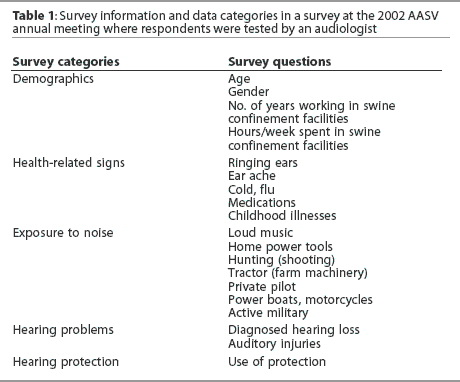
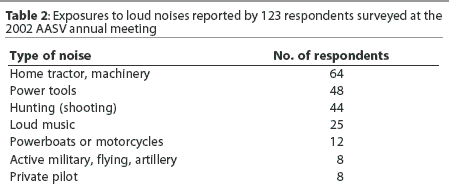
Participants were also asked to fill out a detailed survey about noise exposure and hearing problems (Table 1). Home tractor or machinery was listed by the highest number of individuals (> 50%) in response to the question on noise exposure (Table 2), followed by power tools and hunting (shooting). These noise exposures that were unrelated to swine confinement facilities led the authors to conclude that swine veterinarians enjoy farming, building, and hunting in their recreation time.
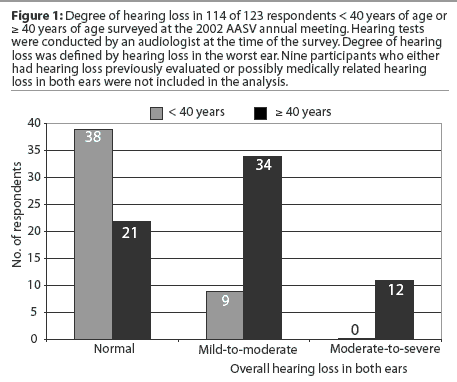
The amount of hearing loss was compared among participants of different ages (Figure 1). Age, determined by the birth dates of the participants, was broken into two categories: < 40 years old and >= 40 years old. After the hearing test, each ear of each participant was rated as normal hearing, mild-to-moderate hearing loss, moderate-to-severe hearing loss, previously evaluated hearing loss, or possibly medically related hearing loss. The participant was then placed in one of three groups (normal hearing, mild-to-moderate hearing loss, or moderate-to-severe hearing loss), depending on the overall rating of both ears. Overall hearing loss was determined by the worst ear. Nine participants who either had hearing loss previously evaluated or possibly medically related hearing loss in both ears were not included in the analysis. Age was then compared in participants with varying degrees of hearing loss. Results showed that age had an effect on hearing (Figure 1). The number of participants with abnormal hearing, mild-to-moderate hearing loss, and moderate-to-severe hearing loss increased with age, with 45 of the 55 with hearing loss in the >= 40 years age group (82%). Because age appeared to be an important factor in hearing loss, data were stratified into participants < 40 years of age and >= 40 years for further analyses.
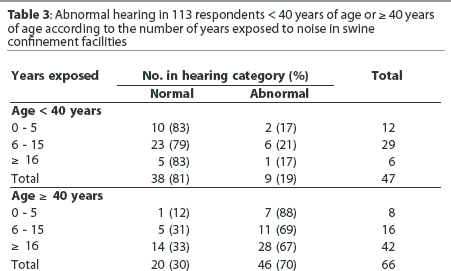
The number of years working in a swine facility, derived from the answer to the "number of years working in a swine facility" question on the survey, was tabulated with the amount of hearing loss (Table 3). The "years in a swine facility" was separated into the following categories: 0 to 5 years, 6 to 15 years, and >= 16 years. The number of years working in a swine facility was compared for respondents with normal and abnormal hearing, which included both mild-to-moderate and moderate-to-severe hearing loss. The number of respondents in each hearing-loss category for each age category was compared for the number of years working in a swine facility (Table 3). It was concluded that there is no relationship between the number of years working in a swine facility and the degree of hearing loss. If there were a relationship, the number of veterinarians in the normal category would be expected to decrease as the number of years working in a swine facility increased. In addition, the percent of people in the abnormal hearing category would be expected to increase as the years working in a swine facility increased. Neither of these trends occurred in either age category.
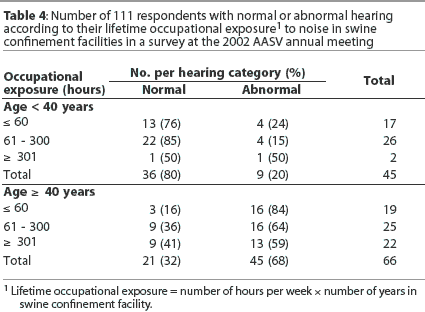
Numbers of respondents in both age categories with normal hearing or abnormal hearing were compared according to the lifetime occupational exposure of the respondents to noise in swine confinement facilities (Table 4). Lifetime occupational exposure was calculated by multiplying the hours per week in a swine facility (response on the survey) by the number of years working in a swine confinement facility. Lifetime occupational exposure categories were < 60 hours, 61 to 300 hours, and >= 301 hours. Hearing loss was categorized as normal or abnormal hearing. There was no relationship between the number of hours exposed to noise in a swine facility and hearing loss (Table 4). If there were a relationship, the number of people with abnormal hearing would be expected to increase as the number of hours exposed to noise in a swine facility increased. This comparison assumes that the participants had maintained a constant exposure over the number of years in the confined facility; however, it is most likely that the weekly exposure had varied over the years.
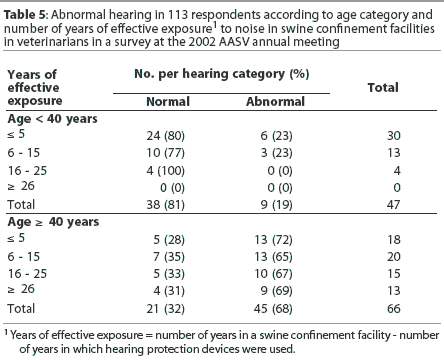
Numbers of respondents in both age categories with normal hearing or abnormal hearing were compared according to the number of years of effective exposure to noise in swine confinement facilities (Table 5). Effective exposure was calculated by the difference between the number of years working in a swine confinement facility and the number of years in which hearing protection devices were used. The number of years of hearing protection was determined by the response to a survey question on the number of years hearing protection devices were used in barns. The participants that did not answer this question were assumed never to have used hearing protection devices. The years of effective exposure categories included <= 5 years, 6 to 15 years, 16 to 25 years, and >= 26 years of exposure. There was no relationship between the number of years of effective exposure to noise in swine facilities and hearing loss (Table 5). If there were a relationship, the number of people with normal hearing would be expected to decrease as the number of years of noise exposure increased, and the percentage of people with abnormal hearing would be expected to increase as the number of years of noise exposure increased.
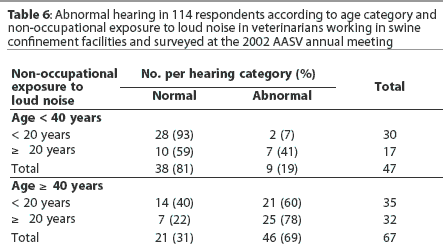
Numbers of respondents in both age categories with normal hearing or abnormal hearing were compared according to their non-occupational exposure to loud noise (Table 6). The amount of non-occupational exposure was determined by the response to the survey question concerning number of years of non-occupational exposure to loud noise. The participants were divided into those with < 20 years and >= 20 years of non-occupational exposure to any type of loud noise. There was no relationship between the years of non-occupational exposure to loud noise and hearing loss. In the older and younger age groups, more respondents who had >= 20 years of non-occupational exposure to loud noise had suffered hearing loss, compared to those exposed for a shorter period of time.
Overall, the results of this survey suggest that hearing loss is more age related than occupational. In a survey of New York farmers, hearing loss was also age related.2,3 The major non-age factors associated with hearing loss in that survey were years of farm equipment use and hunting.
Weaknesses of this study include the use of a voluntary survey, possible failures of recollection on exposure, variable exposures that are not accountable, and use of a descriptive analysis rather than a definitive analysis. However, a defined population was surveyed and the quality of the hearing test was standardized. No relationship between occupation and hearing loss could be established when number of respondents with hearing loss were compared using three variables: the number of years working in swine confinement facilities, lifetime occupational exposure to noise in swine facilities, and number of years of effective exposure to noise in swine facilities. Our results also suggest that non-occupational exposure to loud noise is more important to hearing loss than occupational exposure, although we do not intend to suggest that those working with swine should not use hearing protection.
Acknowledgements
The authors would like to thank Mary Wade for performing the audiology examinations.
References
1. Kristensen S, Gimsing S. Occupational hearing impairment in pig breeders. Scan Audiol. 1988;17:191-192.
2. Beckett WS, Chamberlain D, Hallman E, May J, Hwang S-A, Gomez M, Eberly S, Cox C, Stark A. Hearing conservation for farmers: source apportionment of occupational and environmental factors contributing to hearing loss. J Occup Environ Med. 2000;42:806-813.
3. Hwang SA, Gomez MI, Sobotova L, Stark ]AD, May JJ, Hallman EM. Predictors of hearing loss in New York farmers. Am J Ind Med 2001;40:23-31.
4. Marvel M, Pratt D, Marvel L, Regan M, May J. Occupational hearing loss in New York dairy farmers. Am J Ind Med. 1991;20:517-531.