Practice tip |
Non refereed |
A new obstetrical instrument and advanced method of veterinary obstetrics for sows
Hermann H. Schuh, DVM; Ekkehard T. G. Kurth, DVM
Veterinary clinic Dr Hermann Schuh, Oberndorf 45, 91472 Ipsheim, Germany
Cite as: Schuh HH, Kurth ETG. A new obstetrical instrument and advanced method of veterinary obstetrics for sows. J Swine Health Prod. 2005;13(2):99-101.
Preparation for parturition
Preparation for parturition starts late in pregnancy. Preferably 1 week prior to the estimated due date, sows are washed and put into a farrowing pen that has been washed, disinfected, and allowed to dry. The day previous to farrowing, drinkers, heaters, and ventilation are checked. The farrowing pen temperature should be approximately 20°C and the piglets’ nest area, 30 to 32°C. Canadian studies in 20021 reported a 20% reduction in piglet mortality when a second heat lamp behind the sow provided a zone at 31°C during farrowing. The quantity of gestation feed should be continuously reduced2 from 5 kg daily on the 110th day of gestation to 1 to 2 kg on the day of farrowing.
Farrowing problems
The farrowing process may take 1 to 5 hours, and piglets are usually delivered at 10-minute to 20-minute intervals, but there are wide variations. A short time period is preferable. Delayed delivery of the piglets is a sign of dystocia; the sow pants heavily and is obviously in distress, and there may be blood, mucus, or both at the vulva.3 Uterine inertia, breech presentation, calcium deficiency, obstruction of the birth canal, simultaneous presentation of two fetuses, downward deviation of the uterus, and oversized fetuses are the primary causes of dystocia.4 Obstetrical intervention is indicated when more than 30 minutes elapse after the last piglet’s birth and examination of the reproductive system shows one of the listed problems.
Obstetrical intervention
Veterinarians and pig producers should use strict hygiene during intervention and manipulation of dystocia. Before examination of the reproductive tract, wash the vulva of the sow with warm water and a mild disinfectant and dry with a clean towel. The investigator’s hand and arm should be thoroughly washed, and the fingernails must be short. Use a plastic obstetrical sleeve to reduce contamination from the hands and to protect the investigator against infection. Apply a special obstetrical lubricant before inserting the arm into the vagina. Hold the fingers of the hand together and progress past the cervix to the bifurcation of the uterus so that you can feel the entrance of each uterine horn.
If the birth canal is free of obstacles, there is probably uterine inertia due to calcium deficiency. An injection of calcium gluconate and oxytocin is indicated. Usually there is a piglet just beyond the cervix. If it is in an anterior presention, place the hand over the head of the piglet with the index and middle fingers behind the ears and the thumb under the mandible. If the piglet is presented in a breech or backward position, raise both hind legs and clamp the left leg between the index and middle fingers and the right leg between the middle and ring fingers. If you can grasp the piglet, it is usually possible to bring it easily out of the birth canal.
Occasionally a very large piglet is presented. Most large piglets can be delivered manually, but sometimes obstetrical instruments are required. Because of the high risk of injury to the piglets and the inner vaginal area, the use of obstetrical hooks or whelping forceps is contraindicated. Obstetrical instruments used for sows are shown in Figure 1.
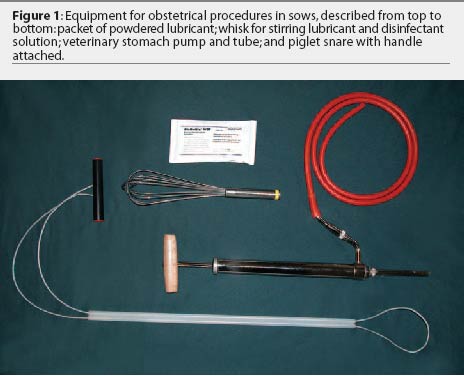
Large piglets may be delivered using an obstetrical snare (available from Tierservice Schuh, Oberndorf 45, 91472 Ipsheim, Germany; Tel: 0049-9846-1464; Fax: 0049-9846-1610).
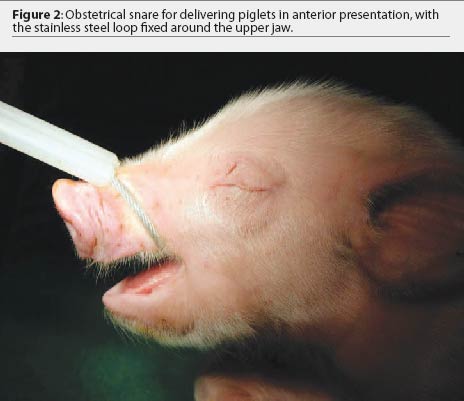
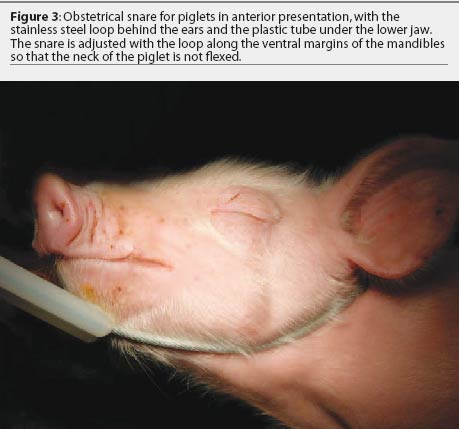
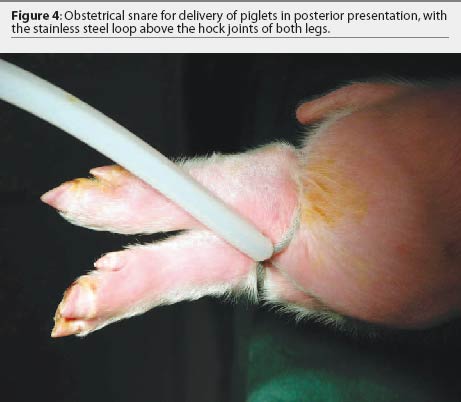
The obstetrical snare consists of two flexible plastic tubes fixed together over a stainless steel, plastic-jacketed wire doubled to form a loop on the top end of the snare (Figure 1). At the other end, the wire is attached to a plastic handle . The loop may be placed over the head, upper jaw, or hind legs of the piglet. For anterior presentations, the loop is placed round the upper jaw (Figure 2) or behind the ears. In this case, the top end of the plastic tube must be placed under the mandible (Figure 3) to avoid strong flexion of the neck during traction. The wire loop lies along the ventral margin of the mandible on each side, and the top of the plastic tube is adjusted under the piglet’s chin. For posterior presentations, the loop of the snare is fixed above the hocks (Figure 4). One person holds the handle of the snare and the other person (the veterinarian) fixes the loop around the head or legs of the piglet. Traction can then be applied in a downward movement to deliver the piglet.
Replacement of placental fluids is very important. A commercial lubricant powder is dissolved in approximately 5 L of warm water with a nonirritating disinfectant. An equine stomach tube is used with a pump to transfer the mixture into the uterus so that the birth canal is well lubricated. The pressure of the lubricant in the uterus stimulates further contractions, and the piglet is forced out of the birth canal. Lubrication of the birth canal is always indicated and ensures a gentle and strength-saving birth.
Care of the newborn piglet
As soon as the piglet is born, it should be dried with a towel and the navel clamped and disinfected. Alternatively or additionally, the piglet may be placed under a heat lamp in a container of bedding or sow feed. The dried piglet is then placed with the sow to start suckling. The neonatal piglet is born with limited energy reserves and is very sensitive to temperature changes. All its energy is needed to search for the udder and to suckle successfully. Weak piglets must be stimulated to breathe. The respiratory passages may be obstructed with placental fluid or lubricant. To remove this, swing the piglet by its hind legs like a clock pendulum to expel mucous from the back of the throat and the trachea, then press the thorax gently to stimulate circulation and breathing. Breathing may also be stimulated with 5 to 10 drops of doxapram hydrochloride on the tongue or in the cheek pouch.
Summary
Obstetrical intervention is indicated if 30 to 45 minutes have passed since the last piglet was born; if 24 hours have passed since the first signs of impending parturition were observed and no piglets have been born; or if the sow is not able to farrow despite strong uterine contractions.
Acknowledgment
We would like to extend our thanks to Alfred Gast for his suggestions and comments regarding the preparation of this manuscript.
References
*1. Best P, ed. Heat waves. Pig Int. 2004;34:35-36.
2. National Research Council. Energy. In: Nutrient Requirements of Swine; 10th ed. Washington, DC: National Academy of Sciences; 1998:3-15.
3. Muirhead MR, Alexander TJL. Managing and treating disease in the farrowing and sucking period. In: Muirhead MR, Alexander TJL, eds. Managing Pig Health and the Treatment of Disease. 1st ed. Sheffield, UK: 5M Enterprises Ltd; 1997:227-284.
4. Britt JH, Almond GW, Flowers WL. Diseases of the reproductive system. In: Straw BE, D´Allaire S, Mengeling WL, Taylor DJ, eds. Diseases of Swine. 8th ed. Ames, Iowa: Iowa State University Press; 1999:883-911.
* Non-refereed reference.