
President's message
What have you accomplished since Toronto?
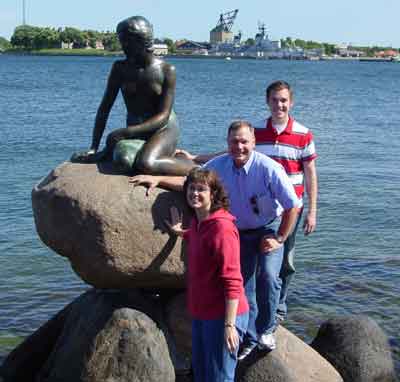 Tom and Denise Gillespie with their son Matt on a recent visit to the statue of the Little Mermaid in Copenhagen, Denmark |
In the 1836 fairy tale written by Hans Christian Andersen, entitled The Little Mermaid,1 the Little Mermaid set her goal on winning the Prince's heart. Although she did not accomplish her goal of marrying the Prince, she did win his heart! Her love for the Prince and her desire to have an immortal soul motivated her to action. One lesson of the story is that the Little Mermaid set a goal and with passion developed an action plan to accomplish her goal.
As you read this message, remember that the challenge placed upon us during the Toronto meeting was to evaluate ourselves and establish an action plan for improving existing skills or developing new ones. It seems like just yesterday that we were in Canada at the annual meeting, and the Monday speakers not only challenged us to improve, but also gave us personal examples. So the question is, what have you accomplished since Toronto?
Life is full for all of us! Even though summer is filled with family get-togethers, holidays, special times, and travels, now is a good time for self-evaluation and to look at goals each of us may have set back in March. The next step is to develop an action plan on how to improve and how to accomplish those goals. As in the story of the Little Mermaid, the ultimate outcome may not be what you have in mind, but it should be different from what you have today.
When reproductive efficiency becomes a farm's goal, numerous skills are utilized by a veterinarian in directing the unit's staff. Improving the number of pigs produced per inventoried female is a goal that continues to gain in popularity. Danish colleagues often mention 30 pigs weaned per female per year as attainable, but recently Dr Jesper Eriksen made me aware of a two-site nucleus sow unit marketing more than 30 pigs per sow per year. This is one area in which veterinarians can help train, motivate, and monitor a unit's staff to attain improvement. In addition, it requires a stable health status in the sow herd, correct management practices, and often an intense health monitoring program. The challenge is to train employees on proper techniques, beginning with replacement gilts. Veterinarians have the ability to "pull it all together" if the unit's goal is to become more efficient. Do you have the skills to help a unit achieve this type of efficiency?
Each of us must evaluate the skills required to help a unit achieve its goal. My personal list of needed skills includes better management of people and communications with individuals and groups (ie, staff meetings). An increasingly important skill for improved communications is speaking Spanish, especially for training purposes.
There is a need for the health program in every production system to evaluate and monitor for the activity of significant pathogens: veterinarians are usually very adept at accomplishing this goal. Less significant pathogens are often the immediate focus of the animal care providers. Veterinarians can incorporate the economic cost of a specific health control program into their decision-making process so they can advise the unit of the best program. An additional concern is the increasingly vital area of quantitative issues. Some developing diagnostic tests provide quantitative results to allow better understanding of the activity of the individual pathogen and its relationship with the clinical syndrome. At the recent World Pork Congress, the AASV sponsored a meeting for members to discuss regional control of porcine reproductive and respiratory (PRRS) virus. Examples of successful PRRS control and elimination were presented and discussed. So far, a specific need for better control and elimination of PRRS was required in only a few select cases, and veterinarians led by example.
This leads a person to begin thinking about quantitative biosecurity. Dr Peter Davies has developed a program for veterinarians to improve their skills and understanding of the epidemiology of pathogens. It is fascinating to think how this approach can change a person's problem-solving skills. Please keep in mind that Dr Larry Firkins' revitalization of the Executive Veterinary Program in Swine Health Management (University of Illinois at Urbana-Champaign College of Veterinary Medicine) will include focusing on people skills in several different situations. The steps to improve may not always take a major commitment of time and money. A skill of improving critical reading and evaluation does not require leaving your easy chair. Once again, I ask you, "Do you have the skills needed in your situation to meet the demands you face?"
It is time to critique yourself, first to see if you need to "brush up" a skill or if you need a plan on how to accomplish a particular improvement. The swine industry and pathogens continue to change, and so must we! The self-evaluation approach will enhance our knowledge, sharpen our skills, and add value for our clients and employees. This president is very interested in hearing from those challenged during our March meeting who set a goal and may be participating in the enhancement plan. Just as the Little Mermaid had a passion for reaching her goals, let each of us persevere in reaching a goal to advance our abilities as swine veterinarians.
Reference
1. Andersen HC. The Little Mermaid. Available at: hca.gilead.org.il/. Accessed July 12, 2005.
-- Tom Gillespie