
Original research |
Peer reviewed |
Effects of ractopamine HCl on growth performance and within-pen weight variation in finishing pigs
Efectos del HCI de ractopamina en el desempeño del crecimiento y la variación del peso dentro de corral en cerdos de finalización
Effets du HCl de ractopamine sur la performance de la croissance et la variation du poids en les parcs de cochons de finition
Matt R. Barker, MS; Steve S. Dritz, DVM, PhD; Mike D. Tokach, PhD; Robert D. Goodband, PhD; Crystal N. Grosebeck, MS
MRB, MDT, RDG, CNG: Department of Animal Sciences and Industry, Kansas State University, Manhattan, Kansas. SSD: Food Animal Health and Management Center, College of Veterinary Medicine, Kansas State University, Manhattan, Kansas. Corresponding author: Dr R. D. Goodband, Kansas State University, 242 Weber Hall, Manhattan, KS 66506; Tel: 785-532-1228; Fax: 785-532-7059; E-mail: Goodband@ksu.edu.
Cite as: Barker MR, Dritz SS, Tokach MD, et al. Effects of ractopamine HCl on growth performance and within-pen weight variation in finishing pigs. J Swine Health Prod. 2005;13(6):318-321.
Also available as a PDF.
SummaryObjective: To determine if ractopamine HCl added to finishing pig diets during the final 21 days to market affects within-pen variation and growth performance. Methods: A total of 336 pigs (12 pigs per pen, 14 pens per treatment) were weighed and assigned to treatment groups (diets with or without ractopamine) in a randomized complete block design so that, within gender, mean weight and degree of weight variation were the same in each pen. Diets were based on sorghum and soybean meal and formulated to contain 1.00% total lysine, with or without 10 mg per kg of ractopamine HCl. Pigs were weighed and feed intake was measured every 7 days during the 21-day experiment to determine average daily gain (ADG), average daily feed intake (ADFI), feed efficiency (G:F), and pen coefficient of weight variation (CV). Results: In pigs fed ractopamine HCl, compared to control pigs, ADG was greater, G:F was better, and final weight was greater at the end of the 21-day trial, but ADFI and CV did not differ between dietary treatments. Implications: These findings suggest that, under the conditions of this study, ractopamine supplementation results in better growth performance and feed efficiency. The greater gain associated with ractopamine supplementation affects all pigs proportionally, with no impact on final weight variation within a pen. | ResumenObjetivo: Determinar si agregar HCI de ractopamina a la dieta de cerdos en finalización durante los últimos 21 días antes de la venta afecta el desempeño del crecimiento y la variación dentro del corral. Métodos: Un total de 336 cerdos (12 cerdos por corral, 14 corrales por tratamiento) se pesaron y se asignaron a grupos de tratamiento (dietas con o sin ractopamina) en un diseño al azar de bloque completo de manera que, el sexo, peso promedio y grado de variación de peso fueran los mismos dentro de cada corral. Las dietas se basaron en sorgo y harina de soya y fueron formuladas para contener 1.00% total de lisina, con ó sin 10 mg por kg de HCI de ractopamina. Se pesaron los cerdos y se midió el consumo de alimento cada 7 días durante los 21 días del experimento, para determinar la ganancia diaria promedio (ADG por sus siglas en inglés), el consumo diario promedio de alimento (ADFI por sus siglas en inglés), la eficiencia alimenticia (G:F por sus siglas en inglés) y el coeficiente de variación de peso por corral (CV por sus siglas en inglés). Resultados: En los cerdos alimentados con HCI de ractopamina, comparados con los cerdos control, la ADG fue mayor, la G:F fue mejor, y el peso final fue mayor al final de los 21 días de prueba, pero el ADFI y el CV no difirieron entre los tratamientos dietéticos. Implicaciones: Estos hallazgos sugieren que, bajo las condiciones de este estudio, el suplemento con ractopamina resulta en un mejor desempeño del crecimiento y eficiencia alimenticia. La mayor ganancia asociada con el suplemento de ractopamina afecta a todos los cerdos de manera proporcional, sin tener un impacto en la variación final del peso dentro de un mismo corral. | ResuméObjectif : Déterminer si le HCl de ractopamine qui a été ajouté a la moulée du cochon de finition pendant les 21 jours avant la vente affecte la variation en les parcs et la croissance. Méthodes: Un total de 336 cochons (12 cochons par parc, 14 parcs par traitement) a été pesé et assigné aux groupes du traitement (moulée avec ou sans ractopamine) dans un dessin randomisé du bloc complet afin que le genre, poids moyen et degré de variation du poids étaient les mêmes dans chaque parcs. La moulée ont été basées sur sorgho et farine de soja et ont été formulées pour contenir 1.00% de lysine totaux, avec ou sans 10 mg par kg de HCl de ractopamine. Les cochons ont été pesés et la ration a été mesurée chaque 7 jours pendant les 21 jours de l'expérience pour déterminer la gain journalier moyen (ADG par ses sigles en anglais), la consumation de aliment journalier moyenne (ADFI para ses sigles en anglais), l'efficacité de l'alimentation (G:F par ses sigles en anglais), et le coefficient de la variation du poids (CV para ses sigles en anglais) entre le parc. Résultats: Dans les cochons qui ont été nourris avec le HCI de ractopamine, comparé a les cochons contrôle, le ADG a été plus grand, le G:F a été meilleur, et le poids final a été plus grand à la fin du 21 jours, mais le ADFI et le CV n'ont pas différés entre les traitements. Implications: Ces résultats suggèrent que, sous les conditions de cette étude, la supplémentation du ractopamine résulte en une meilleure performance de la croissance et l'efficacité alimentaire. Le plus grande augmentation associée avec la supplémentation du ractopamine affecte tous les cochons proportionnellement, sans impact sur la variation du poids en un parc. |
Keywords: swine, finishing
pigs, growth, ractopamine, coefficient of weight variation
Search the AASV web site
for pages with similar keywords.
Received: July
9, 2004
Accepted: October
12, 2004
Swine producers are continually look- ing for methods to reduce the num- ber of lightweight pigs at marketing. Lightweight pigs in all-in, all-out (AIAO) facilities either incur packer penalties or increase cost of production by necessitating use of the facility to provide more time for the lightweight pigs to gain weight.1 Reducing body weight variation would result in fewer lightweight pigs at market. Sorting pigs into uniform body-weight groups is thought to reduce the number of lightweight pigs at marketing by reducing body weight variation. However, sorting pigs into pens of similar size had no effect on final variation of individual body weights, and not sorting by weight may actually increase overall pork produced and reduce turnaround time within the barn.2 Ractopamine HCl (Paylean; Elanco, Indianapolis, Indiana), a [beta]-adrenergic agonist, is an effective growth promotant in swine. Ractopamine HCl supplementation increases average daily gain, improves feed conversion, and increases dressing percentage.3-5 Additionally, field observations suggested that body weight variation was reduced when pigs were fed ractopamine. Therefore, our objective was to determine if ractopamine HCl supplementation during the final 21 days before market would affect within-pen weight variation and growth performance of finishing pigs.
Materials and methods
Animals and housing
Experimental procedures were approved by the Kansas State University Institutional Animal Care and Use Committee. The experiment was divided into two trials conducted in May and July of 2002 at the Kansas State University Swine Teaching and Research Center. A total of 336 finishing pigs (PIC L327 x 1050 genetics; 168 barrows and 168 gilts), initially weighing 110.5 kg +/- 2.2 kg, were housed 12 per pen in 28 pens, allowing 0.74 m2 space per pig. Pigs were free of clinical signs of enteric or respiratory disease for the 2 weeks prior to the trials.
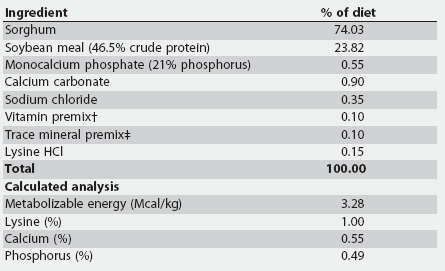
Pigs were housed in a modified open-front finishing barn with partially-slatted pens (1.8 m x 4.9 m; 50% slatted), operated AIAO by group. Each pen contained a single nipple waterer and a two-hole self-feeder to allow ad libitum access to water and feed. Diets were based on sorghum and soybean meal and formulated to contain 1.00% total lysine, with or without 10 mg per kg of ractopamine HCl (Table 1).
Table 1: Composition of diet (as-fed) for 336 finishing pigs in a 21-day trial*
* Equal numbers of pigs were fed the base diet with or without ractopamine (Paylean; Elanco, Indianapolis, Indiana) added at 0.05% (providing 10 mg/kg ractopamine HCl). † Provided per kg of complete diet: vitamin A, 4409 IU; vitamin D3, 661 IU; vitamin E, 18 IU; vitamin K, 1.8 mg; vitamin B12, 0.02 mg; riboflavin, 3.3 mg; pantothenic acid, 11 mg; and niacin, 20 mg. ‡ Provided per kg of complete diet: manganese, 27 mg; iron, 110 mg; zinc, 110 mg; copper, 11 mg; iodine, 0.2 mg; and selenium, 0.2 mg. |
Experimental Design
Pens were randomly assigned to one of two treatments (Control or Ractopamine) in a randomized complete block design with trial and gender as blocking factors. Each treatment consisted of 14 replicates (pens), with seven replicates per gender (four in Trial 1 and three in Trial 2). Individual pigs within gender and trial were then randomly assigned to pens so that mean weight and coefficient of body weight variation did not differ across treatment.
Response criteria
At 7-day intervals during the 21-day experiment, pigs were weighed individually and feed intake was measured for determination of average daily gain (ADG), average daily feed intake (ADFI), feed efficiency (gain-to-feed ratio: G:F), and pen coefficient of weight variation (CV). The CV was determined by dividing the standard deviation of pig weights in the pen by the mean weight of the pigs in that pen.
Statistical analysis
Treatment differences were evaluated using an analysis of variance mixed model for a randomized complete block design with the fixed effect of treatment and random effects of gender and trial.6 Pen was the experimental unit for the analysis of variance. Data were analyzed using the Proc Mixed procedure of SAS version 8.1 (SAS Institute, Cary, North Carolina).
A secondary analysis was performed using pig as the experimental unit. For this analysis, a frequency distribution histogram of individual pig weights by either Control or Ractopamine treatment was first developed, then the association between initial pig weight and subsequent ADG over the 21-day experiment was examined using the Proc Mixed procedure of SAS to develop two regression models. The first model contained the fixed effects of treatment, initial weight as a covariate, the treatment-by-initial-weight interaction term, and the random effects of gender and trial. The second model was the same without the interaction term.
Results
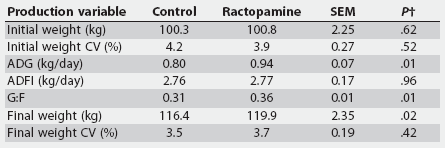
Pigs were free of clinical signs of enteric or respiratory disease during the trials. The Ractopamine pigs had greater ADG (P < .01) and better feed efficiency than the Control pigs; however, ADFI was not affected by dietary treatment (Table 2). As a result of the greater ADG, final weight was heavier for the Ractopamine pigs. Pen CV decreased between the start and the finish of the 21-day trial for both the Control and Ractopamine pigs, and neither starting nor final CV differed between dietary treatments (P > .05). Average pen CV for Control pigs was 3.5%: thus, 68% of these pigs weighed between 112.3 and 120.5 kg, a range of 8.2 kg. Average pen CV for Ractopamine pigs was 3.7%: thus 68% of these pigs weighed between 115.5 and 124.3 kg, a range of 8.9 kg.
Table 2: Growth performance and weight variation in 336 finishing pigs fed either a diet containing ractopamine or a control diet for 21 days*
* Equal numbers of pigs were fed the control sorghum-soybean diet or the same diet containing ractopamine (10 mg/kg). At 7-day intervals during the trial, feed intake was measured and all pigs were weighed individually. Two trials were conducted, with four replicates per gender in Trial 1 and three in Trial 2. Values represent the least squares means for 14 pens (replicates) per treatment, with seven pens of barrows, seven pens of gilts, and 12 pigs per pen. Average daily gain (ADG) was calculated as pen weight gain total pig days; average daily feed intake (ADFI) was calculated as pen feed intake total pig days; feed efficiency (G:F) was calculated as individual pen ADG individual pen ADFI; and pen coefficient of weight variation (CV) was calculated as within-pen weight standard deviation pen mean average pig weight. † A mixed model analysis of variance was used to determine statistical significance, with treatment a fixed effect and gender and trial as random effects. |
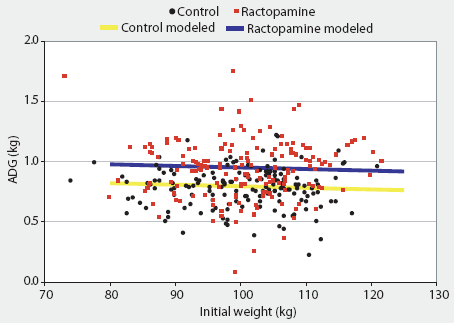
The secondary analysis of the frequency distribution of final weights showed that the distribution was shifted to the right for the Ractopamine pigs (Figure 1). In the first regression model, the initial weight-by-interaction term was not significant (P = .81). In the second regression model, there was no evidence of an effect of initial weight on ADG, ie, the slope of the relationship did not differ from zero (P = .27). However, the intercepts of the relationship were different (P < .01) because AGD was higher for the Ractopamine pigs compared to the Control pigs (Figure 2).
Figure 1: Frequency distribution of final weights for treatment groups of pigs fed the same diet either with 10 mg/kg ractopamine HCl (Ractopamine) or without ractopamine (Control). A total of 336 pigs (96 barrows and 96 gilts in Trial 1 and 72 barrows and 72 gilts in Trial 2) were fed for 21 days prior to obtaining the final weight.
|
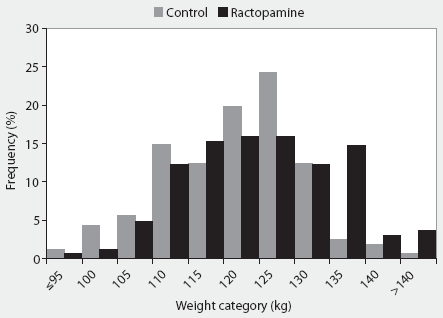
Figure 2: Regression analysis of initial weight and subsequent average daily gain (ADG) for pigs fed the same diet either with 10 mg/kg ractopamine HCl (Ractopamine) or without ractopamine (Control). A total of 336 pigs (96 barrows and 96 gilts in Trial 1 and 72 barrows and 72 gilts in Trial 2) were fed for 21 days. The regression model contained the fixed effects of treatment, initial weight as a covariate, and the random effects of gender and trial. There was no evidence for a relationship between initial weight and ADG, ie, there was no evidence (P = .27) that the slope of the relationship was different from zero. The regression equations were ADG (kg) = -0.00131 x initial weight (kg) + 0.9264 (Control pigs) and ADG (kg) = -0.00131 x initial weight (kg) + 1.0824 (Ractopamine pigs).
|
Discussion
Ractopamine HCl, a phenethanolamine, alters the manner in which nutrients are directed toward fat deposition and muscle accretion. Adipose tissue is reduced through a decrease in lipogenesis, and protein accretion is increased.7 The 16% higher ADG in the Ractopamine pigs in this study is consistent with results of recent research.4,8,9 Studies on ractopamine supplementation of finishing diets have shown either no effect on feed intake or a decrease in feed intake,3,5,10 in agreement with the present study, and the 16% higher G:F in the Ractopamine pigs in this study is also in agreement with previous results.3,11
The lack of a significant interaction term in the regression analysis of initial weight and subsequent ADG suggests that there is no evidence that the relationship between initial weight and subsequent ADG was different in Control and Ractopamine pigs. Thus, on the basis of the results of this experiment, we believe that the reduction in number of lightweight pigs that is associated with ractopamine HCl supplementation, from our field observations, is a result of a shift to the right of the weights of the whole population of pigs. If the smaller number of lightweight pigs had been due to a smaller weight variation, we would have expected to observe a significantly lower within-pen CV in the Ractopamine pigs. Further support is provided by the lack of interaction between treatment and initial weight and lack of influence of initial weight on subsequent ADG. In order for a smaller CV to be responsible for the smaller number of lightweight pigs, we would expect lightweight Ractopamine pigs to have had a higher ADG than lightweight Control pigs. The lack of association or interaction indicates that this is not the case.
Implications
- Under the conditions of this study, ractopamine HCl supplementation for 21 days before marketing finisher pigs results in better gain and feed efficiency.
- The greater gain associated with ractopamine supplementation affects all pigs proportionally, with no impact on final weight variation within a pen.
Acknowledgements
The authors thank Tim Keegan, Sam Hanni, Chad Hastad, Kelly Lawrence, and Malachy Young for assistance in data collection.
Contribution no. 04-446-J from the Kansas Agricultural Experimental Station, Manhattan, KS 66506.
References
*1. Dritz SS. Marketing strategies for packer matrixes. Swine Profitability Conf. Kansas State University, Manhatten, Kansas. 2003;25-35.
2. O'Quinn PR, Dritz SS, Goodband RD, Tokach MD, Swanson JC, Nelssen JL, Musser RE. Sorting growing-finishing pigs by weight fails to improve growth performance or weight variation. Swine Health Prod. 2001;9:11-16.
3. Crome PK, McKeith FK, Carr TR, Jones DJ, Mowrey DH, Cannon JE. Effect of ractopamine on growth performance, carcass composition, and cutting yields of pigs slaughtered at 107 and 125 kilograms. J Anim Sci. 1996;74:709-716.
4. Williams NH, Cline TR, Schinckel AP, Jones DJ. The impact of ractopamine, energy intake, and dietary fat on finisher pig growth performance and carcass merit. J Anim Sci. 1994;72:3152-3162.
5. Dunshea FR, King RH, Campbell RG, Sainz RD, Kim YS. Interrelationships between sex and ractopamine on protein and lipid deposition in rapidly growing pigs. J Anim Sci. 1993;71:2919-2930.
6. Littell RC, Milliken GA, Stroup WW, Wolfinger RD. SAS System for Mixed Models. Cary, North Carolina: SAS Institute Inc. 1996: 2-14.
7. Mills SE. Biological basis of the ractopamine response. J Anim Sci. 2002;80(E Suppl 2):E28-E32.
*8. Main RG, Dritz SS, Tokach MD, Goodband RD, Nelssen JL. Effects of feeding graded levels of ractopamine (Paylean) on pig performance in a commercial finishing facility. Kansas State University, Report of Progress. 2001;859:74-76.
9. Schinckel AP, Li N, Richert BT, Preckel PV, Einstein ME. Development of a model to describe the compositional growth and dietary lysine requirements of pigs fed ractopamine. J Anim Sci. 2003;81:1106-1119.
10. Uttaro BE, Ball RO, Dick P, Rae W, Vessie G, Jeremiah LE. Effect of ractopamine and sex on growth, carcass characteristics, processing yield, and meat quality characteristics of crossbred swine. J Anim Sci. 1993;71:2439-2449.
11. Watkins LE, Jones DJ, Mowrey DH, Anderson DB, Veenhuizen EL. The effect of various levels of ractopamine hydrochloride on the performance and carcass characteristics of finishing swine. J Anim Sci. 1990;68:3588-3595.
*Non-refereed references.