
Case report |
Peer reviewed |
Injuries, lameness, and cleanliness of sows in four group-housing gestation facilities in Ontario
Comparación de lesiones, cojera, y limpieza de hembras en cuatro instalaciones de gestación en grupo en Ontario
Comparaison des blessures, des boiteries, et de la propreté de truies logées en groupe dans quatre fermes de maternité en Ontario
Katherine Zurbrigg, RVT, BSc, MSc; Timothy Blackwell, DVM, MSc, PhD
Ontario Ministry of Agriculture and Food, Wellington Place, Fergus, Ontario, Canada. Corresponding author: Katherine Zurbrigg, Ontario Ministry of Agriculture and Food, Wellington Place, Fergus, Ontario, Canada N1M 2W3; Tel: 519-846-3418; Fax: 519-846-8101; E-mail: kathy.zurbrigg@omaf.gov.on.ca.
Cite as: Zurbrigg K, Blackwell T. Injuries, lameness, and cleanliness of sows in four group-housing gestation facilities in Ontario. J Swine Health Prod. 2006;14(4):202-206.
Also available as a PDF.
SummaryThis study compared proportion of animals with shoulder and vulvar lesions and scores for cleanliness, body condition, and lameness in sows housed in four different group-housing facilities. Inspectors visited each herd once per month and scored sows for each parameter. All farms housed gestating sows in groups, but pen designs and management differed on each farm. Differences among herds were identified for severity of lameness, vulvar lesions 2 and 3 (small and severe bite wounds), mild shoulder lacerations, and cleanliness scores of 1 (clean) and 3 (hooves and 50% of legs and body soiled). No differences in body condition scores were observed among herds. Newly mixed sows often fight to establish a social hierarchy. In this case study, different herds demonstrated differences in parameters that represent aggressive encounters, ie, degrees of lameness, injury, and cleanliness. Pen design and management factors may be associated with aggressive encounters among newly mixed sows. Different group-housing systems are capable of maintaining acceptable body condition scores in sows. | ResumenEste studio comparó la proporción de animales con lesiones de hombro y vulva y puntaciones por limpieza, condición corporal, y cojera en hembras alojadas en cuatro diferentes instalaciones de alojamiento en grupo. Los inspectores visitaron cada piara una vez al mes y calificaron a las hembras para cada parámetro. Todas las granjas alojaban a las hembras en gestación en grupo, pero el diseno de los corrales y la administración eran diferentes en cada granja. Las diferencias entre las piaras se identificaron según la severidad de la cojera, lesiones en la vulva 2 y 3 (heridas de mordedura pequenas o severas), laceraciones de hombro leves, y puntuación de limpieza de 1 (limpia) y 3 (pezunas y 50% de las piernas y cuerpo sucios). No se encontraron diferencias de puntuación de condición corporal entre las piaras. Las hembras recién mezcladas pelean frecuentemente para establecer una jerarquía social. En este estudio de caso, las diferentes piaras mostraron diferencias en parámetros que representan encuentros agresivos, vg, grado de cojera, lesióón, o limpieza. El diseno del corral y el manejo pueden estar asociados con los encuentros agresivos entre las hembras recién mezcladas. Los diferentes sistemas de alojamiento en grupo permiten mantener puntuaciones aceptables de condición corporal de las hembras. | ResuméDans la présente étude, nous avons comparé la proportion d'animaux avec des lésions aux épaules et à la vulve et le pointage obtenu pour la propreté, l'état de chair, et la présence de boiterie chez des truies logées en groupe dans quatre fermes différentes. Un inspecteur a visité chaque troupeau une fois par mois et a noté les truies pour chacun des paramètres. Toutes les fermes logeaient les truies gestantes en groupe, mais l'aménagement et la gestion des parcs différaient d'une ferme à l'autre. Des différences dans la sévérité des boiteries, les lésions vulvaires 2 et 3 (blessures par morsure petites et sévères), des lacérations légères aux épaules, et les pointages de propreté de 1 (propre) et 3 (onglons et 50% des pattes et corps souillés) ont été notées entre les troupeaux. Aucune différence dans le pointage de l'état de chair ne fut notée entre les troupeaux. Lors de nouveaux regroupements de truies il y a souvent des luttes pour établir une hiérarchie sociale. Dans la présente étude, nous avons pu démontrer dans les différents troupeaux des différences dans des paramètres associés avec des rencontres agressives, ie, degré de boiterie, blessures, et propreté des animaux. Des facteurs liés au design et à des facteurs de régie peuvent être associés avec des rencontres agressives entre des truies nouvellement mélangées. Les différents systèmes d'hébergement en groupe des truies étudiés ont permis d'obtenir des pointages de condition de chair acceptables chez ces animaux. |
Keywords: swine, group
housing, gestation, injury, body condition
Search the AASV web site
for pages with similar keywords.
Received: April
19, 2005
Accepted: October
7, 2005
Swine gestation housing is a widely recognized and debated animal wel- fare issue.1 There is little agreement on whether the welfare of a gestating sow is better when she is housed in a gestation stall or in a pen. Most gestating sows in Ontario are housed in 61-cm ´ 213-cm individual stalls; however, some producers house sows in group pens during gestation.2 The natural hierarchical social system of pigs leads to fighting when sows are first grouped together in a pen. This fighting usually lasts for 2 to 3 days post mixing.3 Social hierarchy is then established and fighting decreases both in frequency and intensity.4,5 Those who support group housing believe that the freedom of movement available to sows kept in pens during gestation outweighs the negative effects of aggression experienced within the first few days after mixing.
While making routine farm visits, the researcher observed different levels of animal comfort among various types of group gestation housing. This case study compares the types and severity of injuries that may be caused by fighting in four different group-housing systems. Penning, feeding, and management techniques differed on the four farms, and sows on all farms experienced fighting-related injuries. Prevalence and severity of injuries in each herd were analyzed in an attempt to determine which factors had the greatest impact on sow comfort. Factors affecting the level of aggression in group-housed sows are discussed.
Study farms
Four farrow-to-finish swine farms that utilized group housing for gestating sows and that had observed fighting at the time of mixing were asked to participate in the study. Upon owner consent, regular visits to the farms commenced. Farms were visited approximately every 4 weeks starting in August of 2002, for a total of 12 visits for Farms A and C and seven visits for Farms B and D. At the first visit, descriptive information regarding pen size and layout, feeding schedule and methods, and farm protocols for mixing gestating sows were recorded (Table 1). All four farms were of conventional health status and none used a standard lighting cycle. Lights were turned on when the producers entered their barns (6 to 8 am) and were turned off when they left for the day (3 to 5 pm). Herd size was 300 sows on Farms A and B, 100 sows on Farm C, and 800 sows on Farm D. Barns on Farms B and C had natural ventilation with partial-curtain walls, while Farms A and D used fan ventilation. Farm A used a sprinkler system over the slatted portion of the pens to cool sows in the summer, while the other three farms did not have cooling systems. Weaning age in the four herds varied from 16 to 25 days.
Table 1: Pen sizes, mean numbers of sows per pen and space per sow,* and specific management practices for four herds using group housing for bred sows
* Pen sizes and numbers of sows per pen varied within herds. † Percent of pen floor that was slatted. ‡ Feed dropped on the floor either automatically or manually in Herds A, B, and C. § Hay fed instead of the regular ration on alternate days. ¶ Feeder space subtracted for pen size calculation. |

Hazard identification and sow scoring
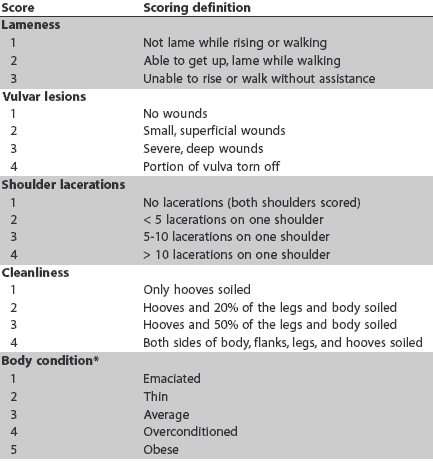
Pens were inspected for hazards that might cause injuries similar to those that were being scored on the sows. Hazards identified were repaired during the first visit. Producers were asked to watch for and repair new hazards during the study period, and record sow mortalities and culls from the group pens. During each subsequent visit, all sows in randomly selected gestation pens were inspected and scored for lameness, vulvar injuries, shoulder lacerations, cleanliness, and body condition. Definitions for each category within a parameter are listed in Table 2. Three inspectors were trained and participated in scoring the sows. An inspector walked through a pen, scoring a sow, then placing a mark on her back, until the observations for every sow in the pen were recorded. Date of the visit, sow breeding date, number of sows per pen, and date when sows were mixed in the pen were also recorded.
Table 2: Definitions of scored parameters and levels of severity for bred sows in four herds using group housing
* Detailed descriptions and pictures of pelvic, loin, and rib areas were used to score body condition (Weng et al6). If a sow's body condition fell between two categories, 0.5 was added to the lower of the two body-condition categories. |
Scoring system validation
To ensure consistency in scoring among inspectors, concise definitions and drawings were used for each level within a parameter. Consistency in scoring was validated in two training sessions in which two inspectors scored the same group of sows (with sows individually identified) and results were compared. Discrepancies in scoring were identified and agreement reached as to the score to be assigned.
Data analysis
Information was entered and organized in an Excel spreadsheet (Microsoft Inc, Redmond, Washington). If a specific sow group was scored on more than one farm visit, only the scores from the first visit were analyzed. Data were first analyzed using the Kruskil-Wallis nonparametric analysis of variance (ANOVA), with farm as the treatment variable and percent of sows in a group with a particular score as the outcome variable (eg, the percent of sows in Herd C with a lameness score of 3). Data were also analyzed using a two-way nonparametric ANOVA with herd and "week of mixing" as treatment variables and using the same outcome variable as previously stated. In some herds, few data points were recorded in specific shoulder categories. In order to test for a significant difference among herds for shoulder lacerations, shoulder scores 1 and 2 were combined to form a shoulder laceration score of "Mild," and scores 3 and 4 were combined to form a laceration score of "Moderate" in all analyses.
Participating herds
On all farms, pens contained mixed parities and sizes of sows. Two farms (B and D) dropped out of the study after 6 months, due to a change in management on one and poor health of the producer on the other. In total, data from 2600 sows were recorded for this study. After eliminating incomplete data or data repeated for a specific group of sows within the same gestation cycle on a farm, data from 1600 sows were analyzed. Numbers of sows included in each herd were as follows: Herd A, 454 sows; Herd B, 200 sows; Herd C, 346 sows; and Herd D, 600 sows.
Mortality
Although producers had been asked to record sow mortalities and culls from the pens during the study period, only sow mortality was recorded. In Herds B, C, and D, total sow mortalities, including mortalities in farrowing rooms and gestation crates prior to sows being mixed into group housing, were 5%, 2.7%, and 3.6%, respectively. In Herd A, sow mortality in group housing was 0.6% during the study period.
Distribution of scores
For each herd, average proportion of sows with a particular score is shown in Table 3. Herds differed in all three levels of lameness, with Herd D having the greatest proportion of sows with lameness score 3 (P < .05). Herds differed in proportions of sows with vulva scores of 2 or 3 (small and severe bite wounds) (P < .05), with Herd B having the highest proportions of sows with vulva scores 2 and 3. Herds also differed in the percentages of sows with mild shoulder lacerations (both left and right) (P < .05). Cleanliness scores 1 and 3 differed among herds (P < .05): Herd C had the highest proportion of clean sows (cleanliness score 1) and Herd B had the highest proportion of sows with cleanliness score 3. Herds did not differ within body score categories (P > .05).
Table 3: Proportion of sows with each score for lameness, vulvar and shoulder lacerations, cleanliness, and body condition in four sow herds using group-housing gestation facilities*
* Data for 1600 sows were assessed and scored as described in Table 2. Included were data for 454 sows in Herd A, 200 sows in Herd B, 346 sows in Herd C, and 600 sows in Herd D. Herds were visitied 12 times (Herds A and C) or seven times (Herds B and D) at monthly intervals. † Kruskil-Wallis nonparametric ANOVA. ‡ In some herds, few data points were recorded in specific shoulder categories. To test for differences among herds for shoulder lacerations, shoulder scores 1 and 2 were combined to form a shoulder laceration score of "Mild," while scores 3 and 4 were combined to form a laceration score of "Moderate" in all analyses. ab Values within a row with no common superscript differ (P < .05). NA = not applicable |
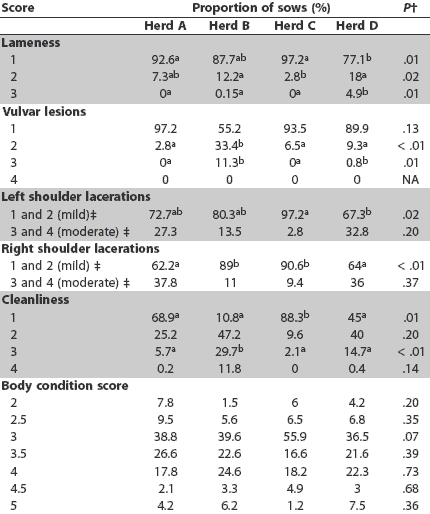
When the variable "weeks after mixing" was added to the nonparametric ANOVA as a second treatment variable, no differences among herds were identified.
Discussion
Most Ontario swine farms do not use group gestation housing.2 Among those that do, there is no standard pen design. The four herds in this study were chosen to represent a range of systems in use in Ontario at the present. As most group-housing systems in Ontario are owner designed, it is difficult to identify large numbers of farms with similar pen designs and features. Therefore, specific husbandry variables such as floor space per sow, flooring type, and feeding system could not be tested among farms with similar pen designs. Herd was a significant treatment variable to test for differences in the outcome variables of sow lameness, shoulder lacerations, body condition, and cleanliness. However, specific farm factors of interest could not be tested due to the small sample size.
The proportion of sows in each of the three categories of lameness (none, mild, and severe) varied significantly between herds. One possible explanation for the large variation in proportions of lame sows in Herds C and D might be flooring type. Lameness has many causes; however, slatted flooring is one factor associated with lameness. Studies in finishing pigs and sows have shown that there is a higher incidence of lameness when pigs are housed on slats compared to outdoor or straw-bedded solid-floor pens.7,8 Pens on Farm C (least lameness) had solid floors while on Farm D (most lameness), pens were fully slatted. Pens on Farms A and B were partially slatted. A second possible explanation for differences in lameness might be the feeding systems. During the study, Farm D had problems with the mechanical aspects of the electronic sow feeders. Frustration due to inability to access their feed and competition for feed once it became available might have increased aggressive encounters among sows in this herd, resulting in more lameness. Arey9 found that aggression between sows took longer to stabilize when there was competition for food. In addition, groups in a pen were dynamic rather than stable only in Herd D. Either removal of sows from an established group, or addition of sows to the group, creates the need to re-establish the social hierarchy, causing more fighting with each change. Simmins10 reported more aggression in sows in dynamic groups than in static groups. The potential for a greater amount of fighting in Herd D might have contibuted to more injuries and lameness.
Injuries that sows commonly sustain as a result of aggressive encounters are associated with different behaviours depending on the location of the injury. Wounds or aggressive attacks directed on the neck and shoulders are correlated with social ranking aggression.11,12 Wounds on the hindquarters, including vulvar lesions, are associated with competition for food or water and restriction (ie, due to pen design) of the flight behaviour of sows being attacked.13
Incidence of vulvar lesions was low except in Herd B (44.7% of sows affected), which had the smallest amount of space per sow (1.8 m2 per sow). Limited feeding space per sow and limited area for submissive sows to escape their attackers may have contributed to the greater number of vulvar lesions in this herd. In the herd with the next highest proportion of sows with vulvar lesions (10%, Herd D), the incidence was significantly lower. Herd D had an electronic sow feeder system, which has been associated with vulvar lesions,13 and also a high stocking density of 1.9 m2 per sow. Herd A, which had the smallest proportion of sows with vulvar lesions (2.8%), had barriers or partition walls (partial walls built within the pen) that allow sows to escape from attackers. In this herd, numerous feed drops spread throughout the pen created more feeding space per sow, resulting in less competition during feeding. Several studies have demonstrated the usefulness of barriers or partitions in group sow housing. Edwards et al14 found that barriers helped to lessen fighting among sows during the first 12 hours after mixing.
Laceration scores on the shoulders of sows have been correlated with the number of aggressive encounters at mixing.15 Mild lacerations on the left and right shoulders varied significantly from herd to herd. Herd C had the smallest proportion of sows with moderate shoulder lacerations. In this herd, a variety of management techniques were used to reduce aggression during the first 2 to 3 days after mixing. Sows were mixed at the end of the day and the lights were then turned off. The newly mixed sows were given a double feeding on the first night and were then fed the regular feed one day and hay on the alternate days. Previous studies have shown that ad lib feeding at mixing reduced aggression for 12-hour, 24-hour,14 and 48-hour16 intervals post mixing. In Herd C, hay was also fed on the "non-feed" days. Other distractions include use of recreational straw at one end of the pen and placement of a boar in the pen at the time of mixing. Luescher et al12 found that the presence of a boar in the sow pen had little affect on fighting; however, Grandin and Bruning17 found that the presence of a boar reduced fighting among finishing pigs and that some boars were more effective than others at reducing aggression in the pen.
Finally, Herd C allowed the greatest amount of space per sow (approximately 2.79 m2 per sow). Studies can be found that both support and dispute the idea that space per sow affects the amount of aggression at mixing.6,13,18 This suggests that other factors affect the frequency, duration, and intensity of fighting among sows kept in groups. The optimum space per sow may vary, depending on feeding system, pen design, and management and environmental enrichment factors.
While degree of cleanliness does not directly indicate a welfare problem, it may indicate problems with barn or pen design. Cleanliness scores of 1 (only hooves dirty) and 3 (50% of sow soiled) varied significantly among herds. Herd B had the largest proportion of dirty sows (in both cleanliness score categories 3 and 4). Possible explanations for this might be chronically wet floors due to an inadequate slope of the solid flooring, not enough slatted area for the number of sows in the pen (approximately 0.3 m2 per sow), or the narrow width of the slot opening in the slats (5-cm slat with 1.9-cm gap). The Canadian Plan Service19 recommends a 2.5-cm to 3.2-cm slot opening for sow housing. Space per sow may also affect cleanliness. If space is limited and walking to the dunging area involves disturbing resting sows, a sow may choose to avoid an altercation and eliminate inappropriately. Herds B and D had the highest proportions of dirty sows and also had the least amount of space per sow.
Often fully slatted floors are associated with cleaner pens and pigs. In this study, the farm with the fully slatted pens (Farm D) had a higher percentage of dirty sows than Farm C with its completely solid floors. The location of the electronic sow feeder stations in Farm D pens may have contributed to uneven traffic flow through the slatted pens, which kept the manure from being pushed through the slats and might have caused accumulations along walls and partitions where sows prefer to lie.
Cleanliness may be an indirect indicator of welfare. Lame sows spend more time lying down and therefore become dirtier. In this study, the highest percentage of dirty sows and the highest proportion of lame sows were in Herds B and D.
One advantage often listed for gestation crates or electronic sow feeding systems is the ability to individually feed sows to an optimal body condition. However, no differences in body-condition score distributions were seen between the group-housed floor-fed sows and the group-housed individually fed sows in this study. There were also no significant differences found for the proportion of sows within a body condition score category when the variable "weeks after mixing" was added to the analysis. However, these results may be confounded by sows in different herds being in various stages of gestation at a given week after mixing.
Feeding schedules and amounts should be designed to maximize the number of sows at the preferred body condition score. The proportion of sows in each body-condition category was similar in all four herds, suggesting that the ability to individually feed sows (eg, in Herd D with an electronic sow feeder) may not impact the range of sow body-condition scores in a herd as much as might have been expected.
Implications
- The large variety of pen designs and feeding systems used in group-housed gestating sows makes it difficult to study specific management practices that impact lameness, injury, and cleanliness in sows.
- Pen design and management factors may be associated with aggressive encounters among newly mixed sows.
- Short-term aggressive encounters in group-housed sows vary in severity and intensity among herds.
- Different group-housing systems are capable of maintaining acceptable body condition scores in sows.
Acknowledgements
The authors wish to thank the producers and staff of the four farms who participated in this study for providing information and allowing us into their barns to score the sows. We would also like to thank Dr Tina Widowski, Monica Seguin, and Frank Kains for their assistance with this project.
References
1. Pajor, E. Sow housing: Science, behaviour and values. JAVMA. 2005;226:1340-1344.
*2. Gunn H, Friendship R. Gestation sow housing in Ontario. Proc AASV . Orlando, Florida. 2003;61-65.
3. Dolf C. Agonistic behaviour of dry sows in single stalls and group housing with special reference to the risk of resulting lesions. Appl Anim Behav Sci. 1986;15:193-194.
4. Meese G, Ewbank R. The establishment and nature of the dominance hierarchy in the domesticated pig. Anim Behav. 1973;21:326-334.
5. Mount N, Seabrook M. A study of aggression when group housed sows are mixed. Appl Anim Behav Sci. 1993;36:377-383.
6. Weng R, Edwards S, English P. Behavioural, social interactions and lesion scores of group housed sows in relation to floor space allowance. Appl Anim Behav Sci. 1998;59:307-316.
7. Guy JH, Rowlinson P, Chadwick JP, Ellis M. Health conditions of two genotypes of growing-finishing pig in three different housing systems: implications for welfare. Livest Prod Sci. 2002;75:233-243.
*8. Ministry of Agriculture, Food and Fisheries (MAFF). Injuries caused by flooring: a survey in pig health scheme herds. Proc Pig Vet Soc. 1981;8:119-125.
9. Arey DS. Time course for the formation and disruption of social organization in group-housed sows. Appl Anim Behav Sci. 1999;62:199-207.
10. Simmins PH. Reproductive performance of sows entering stable and dynamic groups after mating. Anim Prod. 1993;57:293-298.
11. Jensen P, Wood-Gush DGM. Social interactions in a group of free-ranging sows. Appl Anim Behav Sci. 1984;12:327-337.
12. Luescher UA, Friendship RM, McKeown DB. Evaluation of methods to reduce fighting among regrouped gilts. Can J Anim Sci. 1990;70:363-370.
13. Leeb B, Leeb C, Troxler J, Schuh M. Skin lesions and callosities in group-housed pregnant sows: animal-related welfare indicators. Acta Agric Scand Sect A. 2001;51(Suppl 30):82-87.
*14. Edwards SA, Mauchline S, Marston GC, Stewart AH. Agonistic behaviour amongst newly mixed sows and the effects of pen design and feeding method[Abstract]. Appl Anim Behav Sci. 1994;41:272.
15. Barnett JL, Hemsworth PH, Cronin GM, Newman EA, McCallum TH, Chilton D. Effects of pen size, partial stalls and method of feeding on welfare-related behavioural and physiological responses of group-housed pigs. Appl Anim Behav Sci. 1992;34:207-220.
16. Barnett JL, Cronin GM, McCallum TH, Newman EA. Effects of food and time of day on aggression when grouping unfamiliar adult pigs. Appl Anim Behav Sci. 1994;39:339-347.
17. Grandin T, Bruning J. Boar presence reduces fighting in mixed slaughter-weight pigs. Appl Anim Behav Sci. 1992;33:273-296.
18. Jensen P. Effects of confinement on social interaction patterns in dry sows. Appl Anim Behav Sci. 1984;12:93-101.
19.Gorman C, Turnball J. Canadian Plan Service-Swine Barn Construction and Services. Plan M-3003. Available at: http://www.cps.gov.on.ca/english/plans/E3000/3003/M-3003L.pdf . Accessed April 6, 2006.
*Non-refereed references.