
Brief Communication |
Peer reviewed |
Ovarian follicular development, estrus, and ovulation in seasonally anestrous sows treated seven days post weaning with equine and human chorionic gonadotropins
Desarrollo folicular de los ovarios, estro, y ovulación en hembras estacionalmente anestricas tratadas siete días después del destete con gonadotropina coriónica equina y humana
Développement folliculaire ovarien, oestrus, et ovulation chez des truies en anoestrus traitées sept jours post-sevrage avec de la gonadotrophine chorionique équine et humaine
C. J. Bracken, PhD; J. S. Seaman-Bridges, MSc; T. J. Safranski, PhD; M. C. Lucy, PhD
Division of Animal Sciences, University of Missouri, Columbia, Missouri. Corresponding author: Dr Matthew C. Lucy, 158 ASRC, Division of Animal Sciences, University of Missouri, Columbia, MO 65211; Tel: 573-882-9897; Fax: 573-882-6827; E-mail: lucym@missouri.edu.
Cite as: Bracken CJ, Seaman-Bridges JS, Safranski TJ, et al. Ovarian follicular development, estrus, and ovulation in seasonally anestrous sows treated seven days post weaning with equine and human chorionic gonadotropins. J Swine Health Prod. 2006;14(4):207-209.
Also available as a PDF.
SummarySeasonally anestrous sows were identified on day 7 after weaning and treated either with equine and human chorionic gonad-otropins or saline (control). Gonadotropin treatment stimulated ovarian follicular development, and more treated sows than controls expressed estrus, were inseminated, ovulated, and became pregnant within 1 week after treatment. | ResumenLas hembras estacionalmente anestricas se identificaron en el día 7 después del destete y se trataron con gonadotropina coriónica humana y equina o solución salina (control). El tratamiento de gonadotropina estimuló el desarrollo folicular de los ovarios, y más hembras tratadas que de control expresaron estro, fueron inseminadas, ovularon, y quedaron gestantes en 1 semana después del tratamiento. | ResuméDes truies en anoestrus ont été identifiées au jour 7 post-sevrage et traitées avec soit de la gonadotrophine chorionique équine et humaine ou avec de la saline (témoin). Le traitement à la gonadotrophine a stimulé le développement folliculaire ovarien. Également, plus de truies traitées que de truies témoins ont présenté un oestrus, furent inséminées, ont ovulé, et sont devenues gestantes 1 semaine ou moins après le traitement. |
Keywords: swine, seasonal
anestrus, equine chorionic gonadotropin, human chorionic gonadotropin
Search the AASV web site
for pages with similar keywords.
Received: June
8, 2005
Accepted: September
12, 2005
A rapid return to estrus after wean- ing maximizes productivity in sow herds. Return to estrus is influenced by season and production factors (eg, parity and body condition).1-4 The effects of season and production factors on postweaning interval to estrus are mediated by ovarian follicular development.5,6 Sows with small follicles (< 4 mm) at day 3 after weaning were more likely to experience anestrus or delayed estrus compared to sows with larger follicles.5 High ambient temperature during lactation was associated with suppressed follicular growth and delayed the return of normal follicular populations after weaning.7 Restoring compromised follicular growth in anestrous sows should improve the percentage of sows in estrus after weaning. An injectable mixture of equine chorionic gonadotropin (eCG; 400 IU per mL) and human chorionic gonadotropin (hCG; 200 IU per mL) was developed specifically for the purpose of stimulating follicular growth in sows and gilts (P.G. 600; Intervet, Millsboro, Delaware). This application is widely used on swine farms.8,9
Current swine industry practices include injecting P.G. 600 to induce estrus and ovulation in sows exhibiting seasonal anestrus. Delaying P.G. 600 injection until day 7 after weaning may provide an economic advantage, because sows coming into estus can be identified during the first 7 days and anestrous sows can be treated after day 7. This approach avoids blanket treatment of all sows with P.G. 600. The objective of this study was to examine average follicular diameter, expression of estrus, and pregnancy in sows managed by injecting anestrous sows with P.G. 600 on day 7 after weaning. Injection of saline served as a control for the P.G. 600 treatment.
Materials and methods
Animals, facilities, and experimental design
The animal protocol for this study was approved by the Animal Care and Use Committee of the University of Missouri. Crossbred sows from three consecutive farrowing groups in a commercial swine herd in Missouri were used during August (Group One in early August, Group Two in mid-August, and Group Three in late August). The herd historically experienced seasonal infertility in August and was therefore selected for the study. The average outdoor daytime high ambient temperature and relative humidity during the experiment were 29.5 degrees C +/- 0.6 degrees C and 74.6% +/- 1.1%, respectively. All sows were housed in stalls in the same environmentally controlled buildings with drippers (farrowing rooms) and cool cells (breeding and gestation areas) to moderate temperature. Estrus detection was conducted once daily in the morning beginning on Day 3 (weaning = Day 0) and continued until Day 13 (end of experiment). A trained farm technician performed estrus detection by using the back-pressure test with fence-line boar contact. Sows were considered to be in estrus when they exhibited a standing reflex in the presence of a boar. Sows that were not detected in estrus by Day 7 after weaning (approximately 25% of each farrowing group) were assigned randomly to receive either P.G. 600 (5 mL IM; n = 29) or saline (5 mL IM; control; n = 28). The P.G. 600 and saline groups included 11 and 10 first parity sows, 10 and 8 second parity sows, and 8 and 10 third or greater parity sows, respectively. Average lactation length was 15.2 +/- 0.4 days and 15.4 +/- 0.4 days for P.G. 600 and saline groups, respectively. Transrectal ultrasonography was performed once daily beginning on the day of treatment (Day 7) and continuing daily for 6 days. Sows were artificially inseminated in the afternoon of the first and second days of estrus and were not moved after mating. Sows that were not inseminated by Day 13 were removed from the farrowing group.
Ultrasonography
An Aloka 500V ultrasound machine (Corometrics Medical Systems Inc, Wallingford, Connecticutt) and a 7.5-MHz linear transducer were used for measuring ovarian follicles. The transducer was attached to a handle as previously described.5 The ovaries were located 35 to 45 cm cranial to the anal sphincter, anterior to the urinary bladder. Ovarian images were recorded on videotape, and follicles ³ 2 mm diameter were measured. An average follicular diameter was calculated for the measured follicles (approximately 10 per sow on each day). Day of ovulation was defined as the day of disappearance of preovulatory follicles (> 6 mm diameter).
Calculations and statistical analyses
Intervals from treatment to onset of estrus and treatment to ovulation were calculated from breeding and ultrasonographic records. Data were analyzed using the general linear models procedure (PROC GLM) of the Statistical Analysis System (SAS Institute Inc, Cary, North Carolina). The PROC GLM procedure used the method of least squares to fit general linear models. Average follicular diameter was tested for the effects of treatment, farrowing group, treatment by farrowing group, sow nested within treatment by farrowing group (error term for the preceding effects), day, treatment by day, farrowing group by day, and treatment by farrowing group by day. The categorical models procedure of SAS (Proc Catmod) was used to test categorical data. The PROC CATMOD procedure fits linear models to functions of response frequencies. The effect of treatment on the rates of estrus expression, insemination, ovulation, and pregnancy was tested. Rate was defined as the number experiencing the event divided by the total number of treated sows. Type 1 error levels (P values) of < .05 were considered significant.
Results
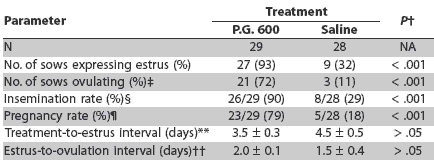
Data are presented as least squares means +/- SEM. Follicular diameter was larger in sows treated with P.G. 600 (5.2 +/- 0.1 mm) compared to sows treated with saline (4.0 +/- 0.1 mm) (P < .001). The response was affected by farrowing group (P < .05): average follicular diameter after treatment depended on the farrowing group that was treated. Average follicular diameters for P.G. 600 sows were 4.8 +/- 0.2 mm, 5.2 +/- 0.2 mm, and 5.4 +/- 0.3 mm in Groups One, Two, and Three, respectively, and for saline control sows, average follicular diameters were 3.6 +/- 0.2 mm, 4.4 +/- 0.2 mm, and 4.0 +/- 0.2 mm in Groups One, Two, and Three, respectively. Number of sows in estrus and ovulating was greater for P.G. 600 sows compared to saline controls (all farrowing groups combined; Table 1). There was no effect of farrowing group on the number of sows in estrus, but there was a tendency for an effect of group on the number of sows ovulating, because numerically fewer sows ovulated in Group One compared to Groups Two or Three (20%, 54%, and 44% for Groups One, Two, and Three, respectively, P < .10). Average interval to estrus and ovulation for both treatments was similar for sows showing estrus and ovulating during the 6-day period (Table 1). Compared to control sows, a greater number of P.G. 600 sows were inseminated and a greater number became pregnant (Table 1). All pregnant sows farrowed a subsequent litter.
Table 1: Numbers of sows expressing estrus, ovulating, inseminated, and pregnant for anestrous sows treated with either P.G. 600* or saline 7 days after weaning, and least squares means (+/- SEM) for treatment-to-estrus and estrus-to-ovulation intervals
* P.G. 600 (Intervet, Millsboro, Delaware) is an injectable mixture of equine chorionic gonadotropin (400 IU/mL) and human chorionic gonadotropin (200 IU/mL). † Numbers and percentages of sows expressing estrus, ovulating, inseminated, and pregnant were analyzed by linear models that were fit to response frequencies. Treatment-to-estrus and estrus-to-ovulation intervals were analyzed by the method of least squares. ‡ Number of sows ovulating is less than number of sows in estrus, as ovulation occurs approximately 2 days after estrus, and ultrasound examinations on postweaning days 7 to 13 may not detect ovulation in sows expressing estrus after day 11. § Number inseminated/total number. ¶ Number pregnant/total number. ** Based on the numbers of sows expressing estrus in each treatment group. †† Based on the numbers of sows ovulating in each treatment group. NA = not applicable. |
Discussion
In this study, the benefits of P.G. 600 treatment were demonstrated in sows diagnosed anestrus by testing for 7 days post weaning using back pressure and fence-line contact with a boar. Sows treated with P.G. 600 had larger follicles than control sows, and therefore more P.G. 600 sows expressed estrus, were inseminated, ovulated, and became pregnant. The P.G. 600 treatment apparently stimulates follicular growth in sows whose productivity would otherwise be compromised by seasonal infertility.
Infertility in sows (anestrus, delayed onset of estrus, irregular estrous cycles, lower farrowing rates and smaller litter sizes) occurs in summer when temperature and humidity are high and photoperiod is long.1,3,4 Some effects of heat stress on reproduction may be mediated by reduced feed intake in hyperthermic sows.2-4 The daytime high outside ambient temperature during the present study approached 30 degrees C, a temperature associated with seasonal infertility and anestrus. Seasonal infertility is associated with small and nongrowing follicles,7 and the current results support an association between small and nongrowing follicles and anestrus. The sows enrolled in this study had 4-mm follicular populations at the start of treatment, and follicles failed to develop further in control sows. The P.G. 600 treatment apparently restored estrus and ovulation in sows that would have been anestrous without treatment. Thus, the mechanisms preventing follicular growth in heat-stressed sows are efficiently overcome by an injectable mixture eCG and hCG.
Follicles were larger in P.G. 600-treated sows in each of the three farrowing groups. There was, however, an effect of farrowing group on the follicle-size response. We believe that this effect may have been caused by a slightly cooler ambient temperature (approximately 2 centigrade degrees lower) for Groups Two and Three, which was associated with slightly larger follicles in the control sows in these farrowing groups.
In a previous study,10 we observed ovulation before estrus in P.G. 600-treated sows. That study did not include a control. Thus, one of the objectives of the present study was to include an appropriate control (saline) for P.G. 600 treatment in anestrus sows. We found no evidence of premature ovulation in this study. The estrus-to-ovulation interval was approximately 2 days for both P.G. 600 and control treatments. The previous study10 was conducted in the same herd, later in the year, with sows that had more mature follicles. Perhaps greater follicular maturity at P.G. 600 treatment influences the time of ovulation relative to estrus.
Implications
- Administering P.G. 600 to anestrous sows on day 7 after weaning increases ovarian follicular growth and the number of sows expressing estrus and ovulating within 1 week of treatment.
- Under the conditions of this study, sows treated with P.G. 600, compared to saline treatment, are more likely to express estrus and ovulate, and this is associated with a greater number of inseminations and pregnancies.
- Delaying P.G. 600 treatment until day 7 after weaning has the advantage that only anestrous sows are treated.
Acknowledgements
The authors thank Hamhill Farms of Marshall, Missouri, for providing access to their facilities and use of their sows for this study. This research was, in part, supported by the Missouri Agricultural Experiment Station, Project Number ASFC0503.
References
1. Bassett JM, Bray CJ, Sharpe CE. Reproductive seasonality in domestic sows kept outdoors without boars. Reproduction. 2001;121:613-629.
2. Koketsu Y, Dial GD. Factors influencing the postweaning reproductive performance of sows on commercial farms. Theriogenology. 1997;47:1445-1461.
3. Prunier A, Quesnel H. Influence of the nutritional status on ovarian development in female pigs. Anim Reprod Sci. 2000;185-197.
4. Xue JL, Dial GD, Marsh WE, Davies PR. Multiple manifestations of season on reproductive performance of commercial swine. JAVMA. 1994;204:1486-1489.
5. Bracken CJ, Lamberson WR, Safranski TJ, Lucy MC. Factors affecting follicular populations on day 3 post-weaning and interval to ovulation in a commercial sow herd. Theriogenology. 2003;60:11-20.
6. Soede NM, Hazeleger W, Kemp B. Follicle size and the process of ovulation in sows as studied with ultrasound. Reprod Domest Anim. 1998;33:239-244.
7. Lucy MC, Liu J, Boyd CK, Bracken CJ. Ovarian follicular growth in sows. J Reprod Fertil Suppl. 2001;58:31-45.
8. Estienne MJ, Harper AF, Horsley BR, Estienne CE, Knight JW. Effects of P.G. 600 on the onset of estrus and ovulation rate in gilts treated with regumate. J Anim Sci. 2001;79:2757-2761.
9. Knox RV, Rodriguez-Zas SL, Miller GM, Willenburg KL, Robb JA. Administration of P.G. 600 to sows at weaning and the time of ovulation as determined by transrectal ultrasound. J Anim Sci. 2001;79:796-802.
*10. Bracken CJ, Lamberson WR, Safranski TJ. Factors associated with incidence of P.G. 600 intervention in weaned sows [abstract]. J Anim Sci. 1999;77(suppl 1):128.
* Non-referred reference.