
From the Editor
Malaria and typhoid impact field research in western Kenya
First, I would like to thank Dr Sandy Amass, who was the interim executive editor for the Journal of Swine Health and Production off and on this year as I have been conducting research in Kenya. Dr Amass is a valued member of the editorial board. She takes her responsibilities as a lead reviewer very seriously and returns the reviews in a prompt and timely manner. I am sure this comes as no surprise for those of you who have had the pleasure of working with Dr Amass. I was so pleased when she agreed to fill in for me when my schedule precluded completion of my executive editor responsibilities. Dr Amass deserves a huge amount of credit for this edition of the journal, as she was responsible for doing most of the editorial work on the final copies of the manuscripts in this issue. Thank you so much, Sandy, for your willingness to step forward and fill in when I was not available. In particular, thank you for the work that you did on this September issue.
I have been conducting research in western Kenya where I am working with subsistence farmers who live in abject poverty.1 They raise pigs as a means of improving their opportunities in life. Pigs are sold to pay for school fees, emergencies, health care, food, and other household expenses. Hence, pigs are sold at a variety of weights. Farmers often do not know the weight of the pig, so they are given what the pig buyer offers. There is also a concern about pigs being infected with Taenia solium, which leads to tapeworm infections and epilepsy in people. Neither the farmers nor the local health-care workers are aware of this disease cycle.
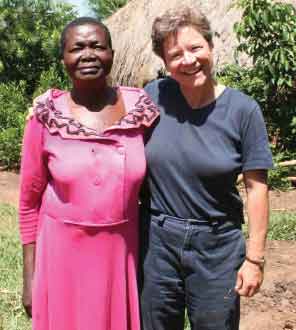
Two moms. Cate and this Kenyan pig farmer share some common ground: both have 18-year-old last-born sons.
|
In February, the farmers looked hungry; they did not have enough food to eat. The pigs were eating grass, leaves, dirt, and whatever else they could scrounge. There were pregnant sows that I would have placed in a grower barn. This is a combination of lack of food and genetics. Pigs are crosses between improved European and indigenous breeds. The pigs with the best body condition were those running loose in town where they access garbage. These are also the pigs most likely to become contaminated with T solium.
The purpose of the research is to improve the livelihood and health of pig farmers. We interviewed farmers about what they feed their pigs so we can encourage other farmers to do the same. We modeled the relationship between pig weight and length and girth, so farmers can use an inexpensive tape measure to estimate their pig‘s weight. Hopefully, the farmers will increase their profits by selling the pigs by weight. We trained local livestock, veterinary, and public health officials about pig production and T solium during 1-day workshops. Finally, we facilitated farmer training workshops conducted by the village officials, during which every farmer received a tape measure.
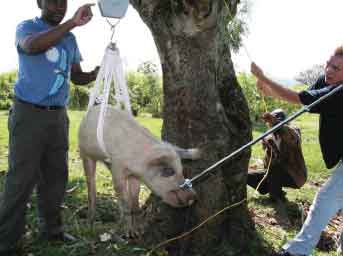
Each research team consisted of one veterinarian, a local research assistant who can read and write in English but can also conduct the interview in the local language, a local livestock officer who can find the farms, and the driver who drove us to the villages. We walked to each farm and then the livestock officer introduced the project and team. Once the farmer agreed to participate, the research assistant completed the questionnaire with the farmer while the rest of us weighed, tagged, and measured the pig, took a blood sample, and treated the pig for lice. The device used to weigh pigs was a hook in a tree attached to a pulley with a spring scale on one end. Small pigs were placed in a basketball net which was hooked to the scale, whereas large pigs were suspended off the ground using a horse girth attached to the scale.
Francis Muturi (left) and Peter Dewey (right) weighing an adult pig for a Kenyan farmer (center).
|
All field research has complications, but there were some I had not experienced before. On some farms, the pig had run off. One pig was clever enough to come when it was called to eat, but hid in the sugar cane field when we were ready for him. The ear tags were a big hit and farmers who were not selected for the study wanted their pigs tagged. They would walk with their pig on the end of its tether to wherever we were working to plead with me to include their pig. Although we did not interview these farmers, I did give each pig an ear tag and treated it for lice. One day we were set to go to the field but our driver was very ill - he had both malaria and typhoid. We had to wait in town until another driver could be sent the 8 hours from Nairobi. Despite these setbacks, field work in Kenya is rewarding.
June was harvest season. In almost every compound there was maize, millet, or both drying on the ground in the sun. People were eating sugar cane and small children clutched soft bits of pumpkin or sweet potato in their fists. The research team was given boiled or roasted maize on the cob when we visited farms at noon. But these are subsistence farmers. They will sell the maize, millet, and sugar cane to pay to grind their corn for their staple diet which is ugali (cooked ground corn and water), pay for school fees, and purchase seed for the next harvest. Next February, or sooner, there will be little food to feed the family, and even less for the pigs. Hopefully, this research will in some small way improve the lives of these people.
Reference
1. Dewey C. Leaving the ivory tower [editorial]. J Swine Health Prod. 2006;14:125.