
Original research |
Peer reviewed |
Effects of farrowing induction on suckling piglet performance
Efectos de la inducción de parto en el desempeño de lechones lactantes
Effets de l’induction de la mise-bas sur les performances zootechniques des porcelets à la mamelle
R. E. Gunvaldsen; C. Waldner, DVM, PhD; J. C. Harding, DVM, MSc
Department of Large Animal Clinical Sciences, Western College of Veterinary Medicine, University of Saskatchewan, Saskatoon, Saskatchewan, Canada. Corresponding author: Dr J. C. Harding, Department of Large Animal Clinical Sciences, Western College of Veterinary Medicine, University of Saskatchewan, 52 Campus Drive, Saskatoon, Saskatchewan, Canada S7N 5B4; Tel: 306-966-7070; Fax: 306-966-7159; E-mail: john.harding@usask.ca
Cite as: Gunvaldsen RE, Waldner C, Harding JC. Effects of farrowing induction on suckling piglet performance. J Swine Health Prod. 2007;15(2):84–91.
Also available as a PDF.
SummaryObjectives: To compare growth performance and survivability in piglets of induced sows and in gestational-age-matched piglets of noninduced sows; to evaluate a novel intra-abdominal injection site; and to determine the incidence of adverse reactions to cloprostenol. Materials and methods: The 122 sows in this study were allocated to two treatment groups or served as controls. Treatments consisted of two 1-mL (87.5-μg) injections of cloprostenol administered at a 6-hour interval on gestation day 114, either vulvomucosally (VM) or intra-abdominally (AB) into the external abdominal oblique muscle. Controls received two 1-mL injections of sterile saline administered at a 6-hour interval. Results: Average gestation length in noninduced and induced sows was 117.0 and 115.1 days, respectively (P < .001), with no differences between the VM and AB groups. For every day of gestation, piglet growth rate increased 26 g per day (P < .01). Body weights at 16 days of age were 576 grams lower (P < .01), and the relative risk of morbidity was 2.0 times higher (P < .01), in piglets of induced sows. There was a tendency towards higher mortality during lactation in piglets of induced sows. Implications: Piglets born to sows induced 2 days before the herd’s average gestation length grew more slowly and suffered higher risk of morbidity during lactation compared to piglets of noninduced sows. It is important to understand the objectives of a farrowing induction program and the average gestation length of specific sow subpopulations in herds to avoid production loss associated with premature farrowings. | ResumenObjetivos: Comparar el desempeño de crecimiento y la supervivencia en lechones de hembras inducidas y en lechones de la misma edad de gestación de hembras no inducidas; evaluar un nuevo sitio de inyección intra-abdominal; y determinar la incidencia de reacciones adversas al cloprostenol. Materiales y métodos: Las 122 hembras en este estudio se asignaron a dos grupos de tratamiento o sirvieron como control. Los tratamientos consistieron de dos inyecciones de 1 mL (87.5 μg) de cloprostenol administradas con 6 horas de intervalo en el día 114 de la gestación, ya fuera vulvomucosamente (VM por sus siglas en inglés) o intra-abdominalmente (AB por sus siglas en inglés) en el músculo oblicuo abdominal externo. Las hembras en el grupo control recibieron dos inyecciones de 1 mL de solución salina estéril administradas con un intervalo de 6 horas. Resultados: La duración promedio de gestación en hembras no inducidas e inducidas fue de 117.0 y 115.1 días, respectivamente (P < .001), sin diferencias entre los grupos VM y AB. Por cada día de la gestación, se incrementó el índice de crecimiento 26 g por día (P < .01). Los pesos corporales a los 16 días de edad fueron 576 g más bajos (P < .01), y el riesgo relativo de morbilidad fue 2.0 veces más alto (P < .01), en lechones de hembras inducidas. Hubo una tendencia hacia una mortalidad más alta durante la lactancia en lechones de hembras inducidas. Implicaciones: Los lechones nacidos de hembras inducidas 2 días antes de la duración de gestación promedio de la piara crecieron más lentamente y presentaron un riesgo más alto de morbilidad durante la lactancia comparado con lechones de hembras no inducidas. Es importante entender los objetivos de un programa de inducción de partos y la duración de gestación promedio de subpoblaciones de hembras en las piaras para evitar la pérdida de producción asociada con partos prematuros. | ResuméObjectifs: Comparer les performances de croissance et de survie de porcelets issues de truies induites à celles de porcelets de même âge gestationnel provenant de truies non-induites; évaluer un nouveau site d’injection intra-abdominale; et déterminer l’incidence de réactions adverses au cloprostenol. Matériels et méthodes: Les 122 truies incluses dans l’étude ont été attribuées à deux groupes de traitement ou ont servi de témoins. Les traitements consistaient en deux injections de 1 mL (87.5 μg) de cloprostenol administrées à 6 heures d’intervalles au jour 114 de gestation, soit au niveau de la muqueuse vulvaire (VM) ou par voie intra-abdominale (AB) dans le muscle abdominal oblique externe. Les témoins ont reçu deux injections de 1 mL de saline stérile à 6 heures d’intervalle. Résultats: La durée de gestation moyenne chez les truies non-induites et induites étaient respectivement de 117.0 et 115.1 jours (P < .001), sans toutefois de différence entre les groupes VM et AB. Pour chaque jour de gestation, le taux de croissance augmenta de 26 g par jour P < .01). Les poids corporels à 16 jours d’âge étaient inférieurs de 576 g (P < .01), et le risque relatif de morbidité était deux fois plus élevé (P < .01), chez les porcelets issus de truies induites. Il y avait également une tendance à avoir plus de mortalités chez les porcelets provenant de truies induites lors de la période de lactation. Implications: Les porcelets nés de truies induites deux jours avant la durée de gestation moyenne du troupeau se sont développés plus lentement et présentaient un plus grand risque de morbidité durant la lactation comparativement aux porcelets provenant de truies non-induites. Il est important de comprendre les objectifs d’un programme d’induction de la parturition et la durée moyenne de la gestation de sous-populations spécifiques de truies dans les troupeaux afin d’éviter des pertes de production associées avec des mises bas prématurées. |
Keywords: swine, farrowing
induction, piglet performance, cloprostenol, prostaglandin F2-alpha
Search the AASV web site
for pages with similar keywords.
Received: December
1, 2005
Accepted: June
1, 2006
Synchronizing parturition may have many benefits, such as allowing staff to supervise farrowing, minimizing holiday and weekend work, and facilitating cross-fostering.1 In a batch farrowing system, farrowings could extend over 10 days due to a variability of 4 to 8 days in commencement of postweaning estrus.1,2 Inducing sows to farrow on the “text-book” gestation length of 114 days, or inducing the “tail-end” sows earlier, will result in premature delivery of some piglets, especially in herds where the natural gestation length is 115 to 116 days (J. C. Harding, unpublished data). King et al1 found that piglets born 3 days earlier than noninduced control piglets had lower birth and 21-day weights than noninduced controls. In addition to lower birth weights, increased neonatal loss in the premature group has been reported by many authors,2-5 as has a higher incidence of splaylegs.6 Farrowing induction enhances piglet survival if it is associated with improved supervision and neonatal care.7 However, if the piglets saved are of low birth weight and viability, lower survivability and growth performance in the nursery and grow-finish may result.5
The route of hormone administration for inducing sows varies from barn to barn. Many producers in Western Canada prefer to use the perianal route, although studies show that lower doses of cloprostenol given perianally are not as effective as intramuscular (IM) or vulvomucosal (VM) administration.8 Anecdotal reports from farrowing technicians also link VM administration with development of marked postadministration vulvar swellings. Thus, alternative routes of administration are needed that ensure effectiveness (response time), ease of administration, and the safety of the operator and patient.
The objectives of this study were to evaluate differences in performance of piglets born to induced and noninduced sows; to determine the effectiveness of a novel injection site for administration of cloprostenol; and to determine the incidence of adverse injection-site and behavioral reactions following administration of cloprostenol.
Materials and methods
Animals and facilities
The study was conducted at the Prairie Swine Centre Inc (Floral, Saskatchewan, Canada), a 300-sow research farm associated with the University of Saskatchewan, over a 15-week period commencing May 2005. The farm operates on a weekly batch system, farrowing approximately 12 to 14 sows per week. All sows farrow in rooms that operate on an all-in, all-out weekly basis. Because gilts farrow in a separate farrowing room that operates continuous flow, they were not included in the study. All procedures were conducted in accordance with the Canadian Council for Animal Care, under the University of Saskatchewan’s Assurance of Animal Care Protocol #20050005.
Study design
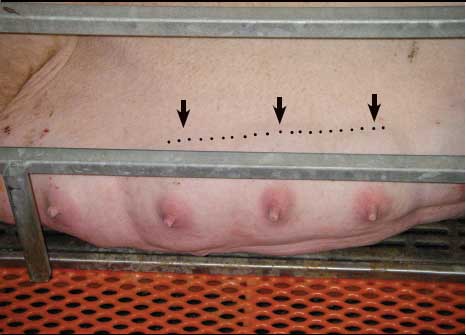
One hundred and twenty-two (122) PIC mixed-parity sows were used in this study. Sows were included in the study if they were in good health and body condition prior to farrowing. They were blocked by parity and randomly allocated to two treatments or served as controls. Sows in each treatment group were injected with 1 mL (87.5 μg) of cloprostenol (Planate; Schering-Plough Animal Health, Pointe Claire, Quebec, Canada) by either the VM or intra-abdominal (AB) route, at 8:00 am and 2:00 pm on day 114 of gestation. Day of gestation was calculated from the first day of breeding post weaning. Control sows received two 1-mL injections of sterile saline on day 114 of gestation, either VM (50% of sows) or AB (50% of sows). Intra-abdominal injections were made midway along the mammary chain, dorsal to the mammary gland and directed dorsomedially into the external abdominal oblique muscle (Figure 1), using a new 20-gauge, 0.5-inch needle and a new 3-mL syringe.
| Figure 1: Sow in right lateral recumbency showing
the location of the intra-abdominal injection site for cloprostenol, in
the external abdominal oblique muscle.
|
Behavioral and injection-site reactions
At the time of the first injection, the sow’s behavioral response to the injection was categorized as none, minimal, or moderate. A minimal reaction consisted of one or more of flinching, tail wag (for VM injections), and vocalization. A moderate reaction consisted of one or more of those behaviours plus a movement (forward, backward, or jumping). Twenty-four hours after the first cloprostenol injection, the injection site was evaluated visually and by palpation for signs of tissue reaction, such as redness, swelling, or heat. Due to the nature of these observations, blinding was not used for behavioral response and injection-site reaction.
Farrowing supervision
Heat lamps were turned on the evening before the anticipated farrowing, or sooner if behavioral signs of impending farrowing were observed. At farrowing, sows were observed frequently for progress and dystocia as per standard barn procedures, but were not under continuous (24-hour) supervision. However, monitoring farrowing was made a priority in order to minimize the consequences of dystocia and to enhance neonatal care and colostrum consumption, even though the farrowing staff had daily responsibilities in other areas of the barn.
Farrowing response measurements
The farrowing date and the time of first piglet observation were recorded and categorized as early (8 to 24 hours after first injection), on time (25 to 32 hours after first injection), late (33 to 48 hours after first injection), or nonresponse (> 48 hours after first injection). These time intervals were used because they corresponded with the regular working hours and because they had been used in several earlier studies investigating farrowing response to cloprostenol.8,9 Sows farrowing 0 to 7 hours after the first injection were considered to have already physiologically begun the process of parturition before being injected8 and were excluded from the trial analysis. Farrowing sows were not treated with oxytocin prior to the appearance of the first piglet unless they appeared to be actively straining and in discomfort for at least 30 minutes. Oxytocin was administered to sows after the first piglet appeared if more than 30 minutes had elapsed between expelled piglets.
Postfarrowing procedures and cross-fostering
The numbers of liveborn, stillborn, and mummified piglets were recorded for each sow, and the lungs of each stillborn were dissected and floated to ensure accurate categorization. On the day of birth, all piglets were notched with individual IDs as per the standard barn ear-notching protocol, and the birth weights of all live and stillborn piglets were measured. Judicious cross-fostering was encouraged, but only within the first 2 days of farrowing and only among sows farrowing in the same weekly batch. Cross-fostering was conducted among sows regardless of treatment group to even out piglet size and number, with the ultimate goal of providing the best suckling environment possible, thus enabling each piglet to express its phenotypic potential. This also indirectly blinded the farrowing staff to treatment group because each suckling litter was of mixed origin, and cross-referencing an individual piglet to its biological dam was possible only by reading an ear notch. Limiting cross-fostering to treatment group was not feasible because of the small number of sows farrowing each day and would have adversely impacted piglet performance, adding considerable bias to the study. On the day of birth (Day 0), all piglets had their teeth clipped; on Day 3, piglets received 200 mg iron dextran IM (Iron Dextran; Dominion Veterinary Laboratories Ltd, Winnipeg, Manitoba, Canada), and had their tails docked, and the male piglets were castrated. Piglets did not receive prophylactic antimicrobial therapy at any time prior to weaning.
Mortality and growth measurements
Piglets that died during lactation were recorded, including the date, weight, and the reason assigned by the farrowing staff. At Day 16, all surviving suckling piglets were weighed and the average daily gain (ADG) from birth to 16 days of age was calculated for each piglet.
Financial impact of farrowing induction
The financial impact of farrowing induction was estimated on the basis of the difference in Day 16 weights between the progeny of induced and noninduced sows, the relationship between weaning weight and subsequent growth rate, and assuming Canadian grading system and pricing. The linear relationship between weaning weight and subsequent growth rate was previously established at the research farm using the same genotype and similar management10 and showed that 1 kg greater body weight at weaning resulted in an additional 4.2 kg at day 140.
Statistical analysis
The outcome data for each treatment group was examined descriptively at the level of the sow or for piglets within litters as appropriate. Generalized linear models were used to estimate the difference in outcome measures across treatment groups (SAS for Windows version 8.2; SAS Institute Inc, Cary, North Carolina). Outcomes examined using a binomial distribution and logit link function included sows exhibiting a severe response to injection; injection-site reactions; proportion of sows farrowing early, on time, late, or nonresponders; proportion of stillborn piglets delivered for each sow; and risk of morbidity and preweaning mortality (starvation, crushed by sow, savaged) for each piglet. Sow parity, total born, proportion of mummies, and number of sows farrowed were examined to determine the baseline comparability among treatment groups. Count variables were examined using a Poisson distribution and included total born and total number of mummies per litter, and total liveborn and total stillbirths per litter (as outcomes potentially related to treatment). Continuous outcomes examined using a normal distribution included gestation length, birth weight, and average daily growth rate between birth and 16 days of age. Estimates of differences in binomial outcomes measured for each piglet were adjusted for clustering within litter using generalized estimating equations (PROC GENMOD), and estimates for continuous piglet outcomes were adjusted for clustering within litter by including a random intercept for litter in the model (PROC MIXED). Other factors considered potential confounding variables in the analysis included those outlined in Table 1. Potentially important biological or management risk factors were retained in the final model if they changed the regression coefficient for the treatment variable by more than 10% or if they were statistically significant (P < .05). Factors that might be affected by cloprostenol treatment and might potentially act as intermediate variables were not corrected for in the analysis. The significance of biologically reasonable first-order interaction effects was assessed in any analysis where two or more variables were significant in the final model. All differences between treatment groups were considered statistically significant where P < .05. With a sample size of 40 per group, the study should be able to detect an approximately 7% difference in daily piglet growth rate between treatment groups, assuming a standard deviation of 0.04 kg per day.
Table 1: Cofactors investigated in the statistical model used to evaluate the impact of cloprostenol induction on farrowing and lactation performance*
* 111 sows were included in the statistical analysis. On gestation day 114, control sows (n = 36) received two 1-mL injections of sterile saline and treatment sows received two 1-mL injections of cloprostenol, either vulvomucosally (n = 39) or in the external abdominal oblique muscle (n= 36). Estimates of differences in binomial outcomes measured for each piglet born were adjusted for clustering within litter using generalized estimating equations (PROC GENMOD), and estimates for continuous piglet outcomes were adjusted for clustering within litter by including a random intercept for litter in the model (PROC MIXED). For all analyses, P < .05 was considered statistically significant. † Considered separately from the effect of cloprostenol treatment, as treatment was expected to affect gestation length. |
Results
In total, 122 sows were assigned to the study, but eight sows farrowed prior to their first injection. Three additional sows farrowed < 8 hours after their first injection. All analyses included 111 sows or the piglets from the sows that farrowed > 8 hours after their first injection, except for the analysis pertaining to behavioural responses and injection-site reactions. The analyses examining behavioural responses to the injection included 102 sows. Excluded from the behavioural response analysis were the eight sows that farrowed prior to their first injection, 11 sows farrowing in week 1 (when observations were not made), and one sow with “missing” observations. The analysis examining injection-site reactions included 112 sows. Excluded from the injection site analysis were the eight sows that farrowed prior to their first injection and two sows with “missing” observations.
The average gestation length (117.0 days in noninduced sows and 115.1 days in induced sows) was significantly shorter (95% CI, 1.6-2.3 days; P < .001) in the 75 cloprostenol-treated sows than in the 36 saline-treated control sows. There was no difference (P > .05) between the AB and VM groups in the effect of cloprostenol on inducing parturition when administered at gestation day 114 (Table 2). Across all groups, 60% of the induced sows began farrowing at night. The odds of farrowing within specific time periods post induction are shown in Table 3.
Table 2: Influence of route of administration on farrowing response of sows treated parenterally with cloprostenol*
* Cloprostenol administered at 87.5 μg/sow (1 mL), twice at 8 am and 2 pm on gestation day 114, either vulvomucosally (VM) or intra-abdominally (AB) into the external abdominal oblique muscle. Controls received 1 mL of saline VM (18 sows) or AB (18 sows) on the same schedule. |
Table 3: Odds of a sow farrowing within specific time periods after induction of parturition or no induction among groups of sows treated and responding as described*
* Treatment groups and responses post induction described in Table 2. † CI = confidence intervals. Proportions of sows farrowing early, on-time, or late were examined in a generalized linear model, with differences between treatment groups considered statistically significant where P < .05. |
||||||||||||||||||||||
Injection-site reactions were noted in only 10 of 112 sows (9%), whereas mild and moderate behavioural reactions were noted in 52 of 102 sows (51%) and 17 of 102 sows (17%), respectively. There were no differences across treatment groups in the number or severity of behavioural reactions, or in the number or severity of injection-site reactions (P > .05). However, older sows (parity ≥ 4) were 2.3 times more likely to react behaviourally to the injection than young sows (P = .04; 95% CI, 1.03-5.12).
There was no significant group difference in total born, liveborn, stillborn, or mummified pigs (Table 4). After controlling for litter size, birth weight was significantly lower in piglets of VM-treated sows than in piglets of control sows (113 g; 95% CI, 11-214 g; P = .03), and was numerically lower in the AB-treated sows than in the controls (77 g; 95% CI, -27-181g; P = .15).
Table 4: Simple performance data (mean ± SD) of sows either induced to farrow with cloprostenol* or noninduced
* Cloprostenol was administered by injection either intramuscularly into the external abdominal oblique muscle (AB) or vulvomucosally (VM) on gestation day 114 in two doses of 87.5 μg (1 mL) at a 6-hour interval. Controls were injected with 1 mL of saline on the same schedule. † Calculated from the first day of breeding post weaning ab Values within a row with different superscripts are different (P < .05). Data not adjusted for significant co-relationships between variables. Generalized estimating equations were used for all statistical analysis. |
||||||||||||||||||||||||||||||||||||||||||||||||||||||||||||||||||||||||||||||||||||||||||||||||||||||||||||||||||||||||||||||||||||||||||||||||||||||||||||||||||||||||||||||||||||||||||||||||||||||||||||||||||||||||||||||||||||||||||||||||||||||
Piglet ADG was numerically lower in the cloprostenol-treated groups than in controls (P = .12 and P = .15 for AB and VM respectively). Piglet ADG was affected by gestation length: piglets born on gestation day 115 grew 26 g per day more slowly (95% CI, 6-47 g per day) than did piglets born on gestation day 117 (P = .01).
Gestation length also positively impacted Day 16 piglet weights. At 16 days of age, piglets born on gestation day 115 were 676 grams lighter than piglets born on gestation day 117 (P = .001). The estimated difference in Day 16 weights between piglets born on gestation day 115 versus day 117 was 576 grams per piglet (95% CI, 171-980 g; P < .01), after taking into account other factors that affected Day 16 weight including parity group and treatment. For example, piglets of parities 2 and 3 were 36.2 grams lighter than piglets of parity ≥ 4 sows (P = .01), and piglets treated for any reason were 733 grams lighter than untreated piglets (P < .001). On the basis of the relationship between weaning weight and subsequent growth rate,10 it was estimated that farrowing induction would result in lower live market weights of 0.386 kg per pig, valued at approximately CAD$0.464 (US$0.394) per pig sold (Figure 2). Assuming 10 pigs marketed per sow farrowed, this represents a lost opportunity, in addition to the cost of cloprostenol, of approximately CAD$4.64 (US$3.94) per sow induced, if farrowing induction is performed prematurely.
Figure 2: Predicted negative effects of gestation-day-114 farrowing induction on the slaughter weight and gross income of progeny from induced compared to noninduced sows, assuming average gestation lengths of 115 and 117 days, respectively, and average lactation lengths of 18 and 16 days, respectively. Day 16 weight disadvantage of induced progeny was calculated after controlling for parity and piglet treatment. Weaning weight disadvantage assumes that induced litters are 2 days older than noninduced litters. Average lactational growth rate was 242 g/d in induced litters. Live weight at 140 days assumes an additional 4.2 kg per additional kg at weaning,10 and equivalent carcass weight assumes 80% dressed yield (Canadian; head on, warm carcass, leaf lard in). Carcass value assumes a market price of $CAN1.50/kg dressed, with no change in carcass quality or grading, with the Canadian dollar equivalent to $US0.85.
|
The odds of a piglet being treated for any reason were 2.0 times higher (95% CI, 1.3-3.0) in cloprostenol-treated litters than in control litters (P < .01) after accounting for sow parity group. Across all groups, the major causes of treatment were diarrhea, arthritis (lameness), and trauma (including crushing and injuries).
Cloprostenol treatment was not associated with the odds of piglet mortality, although the odds of mortality tended to be higher in piglets born to AB sows than in those born to control sows (OR, 1.8; 95% CI, 1.0-3.2; P = .06). Although overall mortality was lower than the industry average,11 and the number of deaths recorded for any one reason was low, these mortality differences were usually due to crushing and savaging.
Discussion
Currently, parturition induction in swine is accomplished by administration of a luteolytic agent, usually prostaglandin F2α (PGF) or its synthetic analog, cloprostenol. Two products are licensed in Canada for inducing parturition in swine: Lutalyse, (Pfizer Animal Health, Kirkland, Quebec) and Planate (Schering-Plough Animal Health). Lutalyse contains the natural PGF, whereas Planate contains the synthetic cloprostenol. Farrowing induction is used to increase efficiency of labour, minimize weekend farrowings, and facilitate all in-all out management. One of the main reasons for inducing parturition is to enable supervision of the sow to reduce stillbirths. Ironically, in this study, stillbirths were not lower in cloprostenol-treated sows. Farrowing induction also helps to lower preweaning mortality by facilitating cross-fostering, neonatal supervision, and colostrum intake and by reducing the risk of neonatal chilling, especially of weak and low-birth-weight piglets.
We have demonstrated that the farrowing response to the novel external-abdominal oblique technique for administration of cloprostenol is similar to the traditional VM route. Label claims for luteolytic agents in swine indicate the deep intramuscular (IM) route of injection in the neck. The dose and route of administration used in this experiment were off-label, but were consistent with industry standard practices and with many studies that advocate VM administration of PGF or its analog. Lower doses administered VM are as effective as deep IM.5,8 The data in this study indicate that both the VM and AB administration of cloprostenol produces farrowing induction consistently within 8 to 32 hours of injection, which supports efficacy claims of the previous studies. Thus, AB administration is efficacious and may help to overcome the aesthetic concerns about VM administration.
Many producers prefer to use the perianal route of administration8 because the farrowing crate design restricts access to the neck for IM administration, and sows often object to vulval manipulation.5 Anecdotally, intravaginal administration has been reported to result in marked vulvar swelling that many producers find aesthetically displeasing; thus, many herdspersons are not comfortable administering intravaginal injections. The data in this study do not support this claim, as there were very few injection-site reactions and no significant differences among study groups in the number of reactions at injection sites. This study also evaluated sows’ behavioural reactions to injection and found no significant differences among groups. Because perianal administration requires higher doses than IM or VM to be effective,8 the rationale for choosing the perianal site appears to be unfounded.
Label claims for Lutalyse12 and Planate13 state that the products should not to be administered 3 days (Lutalyse) or 2 days (Planate) prior to the normal predicted farrowing, in order to prevent increases in stillborns and postnatal mortality (Lutalyse) or an increase in nonviable piglets (Planate). It is also recommended that prior to use, the “normal” gestation length be determined for individual sows on the basis of their past production histories.
Silver et al14 reported that inducing sows as early as day 105 to 106 did not affect piglet survivability when measured over a short period of time (approximately 24 hours) after farrowing. The authors also reported that the absence of a suckling reflex, rather than a low gestation age, increased preweaning mortality. By contrast, we measured postnatal health over the entire lactation period and observed higher preweaning morbidity and lower piglet growth rates in the progeny of sows induced to farrow on gestation day 114. Moreover, the effect of farrowing induction on the lactational growth rate of suckling piglets has not, to the best of our knowledge, been investigated. It was our hypothesis that if sows were induced to farrow 1 to 2 days prematurely (compared to controls), piglet growth rate would be lower, thereby negating the benefits of a longer lactation or older weaning age.
The 1.9-day shorter gestation length in the induced sows compared to the noninduced sows indicates that the normal gestation length in this farm was much longer than the traditional 114 to 115 days. This finding is consistent with field observations (J. C. Harding, unpublished data) and is supported by proven breed differences in gestation length.6 In our study, inducing sows did not lower stillbirth numbers or rate. Moreover, 60% of the induced sows began farrowing at night, and were not closely observed by the farrowing staff. Additionally, this research was conducted in the summer when the barn was hot, which is a risk factor for stillborn piglets. If reducing the number of stillborns is an underlying goal of an induction program, it is critical that the stillbirth rate in induced sows be compared to that in noninduced controls on an on-going basis to ensure that the program is effective.
The results of this study demonstrate the relationship between gestation length and lactational ADG and body weight at 16 days of age. Piglets born on gestation day 117 grew 26 g per day faster and were 576 g heavier on Day 16 than piglets born on gestation day 115. This data, combined with the downward trend in birth weight noted in cloprostenol-induced sows, confirms that induced piglets are at a significant body-weight disadvantage at weaning. If the underlying objective of a farrowing induction program is to maximize lactation length, weaning weight will be reduced in spite of higher weaning ages.
While it is somewhat unclear as to why piglets from cloprostenol-treated sows were 2.0 times more likely to be treated than piglets from control sows, there are inter-relationships among inducing parturition, prematurity, birth weight, and immune status. Furthermore, farrowing induction potentially alters the dynamics of the periparturient cortisol surge that is crucial in preparing the fetus for extra-uterine survival.14 Periparturient cortisol is essential for the physiologic maturation of fetal tissues, particularly gut, lung, and liver, and for the accumulation of glycogen, the major neonatal energy source, in muscle and the liver.15 It is plausible that shortening the gestation length by 1.9 days may have increased the rate of fetal prematurity or dysmaturity (piglets that are physiologically immature for their given gestational age), resulting in the higher morbidity and mortality noted in the induced litters. Additionally, piglets born to cloprostenol-treated sows were smaller and may have been weaker than piglets of noninduced sows, increasing the risk of trauma. This potential lack of vigor may have resulted in inadequate colostrum intake and passive immunity, thus increasing the risk of piglet treatment.
There is considerable within-litter variation in fetal and placental development throughout gestation that ultimately impacts piglet birth weight and maturity at term. Many factors alter fetal development, including breed,16 follicular development,17 ovulation rate and litter size,18,19 timing of embryonic losses,20 prenatal maternal stress,21 and nutritional status of the dam.17 Thus, prematurity in piglets cannot simply be defined as occurring on or before a given gestational day. Rather, it should be considered that piglets with a varying range of maturity are born in normal production settings. Furthermore, any event that alters fetal or placental development may adversely impact the average or within-litter variation of piglet maturity. The impact of shortening gestation length by inappropriate timing of farrowing induction is likely additive to prior intrauterine insults and ultimately increases the risk of piglet prematurity or dysmaturity or both, particularly in piglets experiencing moderate or higher levels of intrauterine growth retardation.
In conclusion, this study shows that the external abdominal oblique route of cloprostenol administration is as effective as the vulvomucosal route when two 87.5-μg doses are administered 6 hours apart. While this route of administration is off-label, it is recommended particularly in situations where herdspeople are uncomfortable with handling the vulva or access to the vulva is difficult due to farrowing crate design. Farrowing induction with cloprostenol is a very effective on-farm tool for improved management of farrowing sows and newborn litters. However, we have demonstrated several detrimental side effects of inducing sows, specifically higher piglet morbidity, lower piglet growth rate, and a tendency toward higher piglet mortality odds in AB sows. These potential side-effects must be fully understood prior to implementing an induction strategy. While there are many valid reasons for inducing parturition on some farms, altering the administration technique, the gestation day of administration, or the target population will help ensure the maximum benefit from farrowing induction.
Implications
- Farrowing response to the novel external-abdominal-oblique injection site is similar to the response to vulvomucosal administration when cloprostenol is administered on day 114 of gestation using two 87.5-μg doses at a 6-hour interval.
- Under the conditions of this study, injection-site reactions are uncommon in cloprostenol-treated sows.
- Under the conditions of this study, behavior reactions are common in cloprostenol-treated sows.
- Under the conditions of this study, the relative risk of preweaning piglet morbidity and treatment is higher in piglets from induced sows
- Under the conditions of this study, piglets born 2 days earlier than the average gestation length grew 26 g per day more slowly and were 576 grams lighter at day 16 of age.
Acknowledgements
The authors would like to acknowledge our colleagues at the Prairie Swine Centre Inc, Karen Wurtz and Crissie Auckland, and our financial supporters, Schering-Plough and the Western College of Veterinary Medicine Interprovincial Undergraduate Summer Student Awards Program.
References
1. King GJ, Robertson HA, Elliot JI. Induced parturition in swine herds. Can Vet J. 1979;20:157–160.
2. Hammond D, Matty G. A farrowing management system using cloprostenol to control the time of parturition. Vet Rec. 1980;106:72–75.
3. Holtz W, Diallo T, Spangenberg B, Rochel P, Bogner H, Smidt D, Leidl W. Induction of parturition in sows with a prostaglandin 2 alpha-analog. J Anim Sci. 1979;49:367–373.
4. Varley MA, Brooking P, McIntyre KA. Attempt to control parturition in the sow using an oral progestogen. Vet Rec. 1985;117:515–518.
5. Friendship RM, Templeton CL, Deckert AE. An evaluation of vulvomucosal injections of prostaglandins for induction of parturition in swine. Can Vet J. 1990;31:433–436.
6. Sellier P, Dando E, Dando P. Induction of parturition in the sow and incidence of splayleg syndrome in the newborn piglet. Annales de Zootechnie. 1999;48:153–161.
7. Holyoake PK, Dial GD, Trigg T, King VL. Reducing pig mortality through supervision during the perinatal period. J Anim Sci. 1995;73:3543–3551.
8. Kirkwood RN, Thacker PA, Aherne FX, Goonewardene LA. The effect of dose and route of administration of prostaglandin F2 alpha on the parturient response of sows. Swine Health Prod. 1996;4:123–126.
9. Kirkwood RN, Aherne FX. Increasing the predictability of cloprostenol-induced farrowing in sows. Swine Health Prod. 1998;6:57–59.
*10. Cooper DR, Patience JF, Gonyou HW, Zijlstra RT. Characterization of Within Pen and Within Room Variation in Pigs from Birth to Market: Variation in Body Weight and Days to Market. Saskatoon, Saskatchewan, Canada: Prairie Swine Centre Inc; October 29, 2001. Technical report (monograph). Available from: Prairie Swine Centre Inc; Tel: 306-373-9922.
*11. Farms.com. PigChamp Knowledge Software. 2004 DataShare Yearend Summary (Canada).Available at: http://www.pigchamp.com/2004YearendDatashare.htm. Accessed December 13, 2006.
*12. Lutalyse [package insert]. Kirkland, Quebec, Canada: Pfizer Animal Health; 2005.
*13. Planate [package insert]. Pointe Claire, Quebec, Canada: Schering-Plough Animal Health; 2005.
14. Silver M, Comline RS, Fowden AL. Fetal and maternal endocrine changes during the induction of parturition with the PGF analogue, cloprostenol, in chronically catheterized sows and fetuses. J Dev Physiol. 1983;5:307–321.
15. Fowden AL, Comline RS, Silver M. The effects of cortisol on the concentration of glycogen in different tissues in the chronically catheterized fetal pig. Q J Exp Physiol. 1985;70:23–35.
16. Vonnahme KA, Wilson ME, Ford SP. Conceptus competition for
uterine space: different strategies exhibited by the Meishan and
Yorkshire pig.
J Anim Sci. 2002;80:1311–1316.
17. Vinsky MD, Novak S, Dixon WT, Dyck MK, Foxcroft GR. Nutritional restriction in lactating primiparous sows selectively affects female embryo survival and overall litter development. Reprod Fertil Dev. 2006;18:347–355.
18. Town SC, Putman CT, Turchinsky NJ, Dixon WT, Foxcroft GR. Number of conceptuses in utero affects porcine fetal muscle development. Reproduction (Cambridge). 2004;128:443–454.
19. Town SC, Patterson JL, Pereira CZ, Gourley G, Foxcroft GR. Embryonic and fetal development in a commercial dam-line genotype. Anim Reprod Sci. 2005;85:301–316.
*20. Foxcroft GR, Town SC. Prenatal programming of postnatal performance – the unseen cause of variance. Proceedings Banff Pork Seminar. 2004. University of Alberta, Edmonton, Alberta. Available at: www.banffpork.ca. Accessed 16 Jan 2007.
21. Tuchscherer M, Kanitz E, Otten W, Tuchscherer A. Effects of prenatal stress on cellular and humoral immune responses in neonatal pigs. Vet Immunol Immunopathol. 2002;86:195–203.
*Non-referred references.