
AASV news
Call for papers – AASV 2008 student seminar and veterinary student scholarships
The AASV announces an opportunity for up to 15 veterinary students to make scientific presentations during the student seminar at the AASV Annual Meeting on Sunday, March 9, 2008, in San Diego, California. Interested students are invited to submit a one-page abstract of a research paper, clinical case study, or literature review for consideration. Abstracts and supplementary materials must be received by Dr Alex Ramirez by midnight on Friday, September 21, 2007 (firm deadline). Faxes are acceptable. Late abstracts will not be considered. The abstracts will be reviewed by an unbiased, professional panel consisting of a private practitioner, an academician at a school from which no students have submitted an abstract, and an industry veterinarian. Students whose papers are selected for presentation at the meeting will be notified by October 15, 2007, and will be expected to provide the complete paper or abstract for publication by November 15, 2007.
To help defray the costs of attending the AASV meeting, Alpharma Animal Health provides a $750 honorarium to the student presenter of each paper selected for the seminar.
Veterinary students whose papers are selected for presentation at the meeting will be eligible to compete for one of several veterinary student scholarships awarded through the AASV Foundation. The oral presentations will be judged to determine the amount of the scholarship awarded.
Alpharma Animal Health funds a $5000 scholarship for the student whose paper, oral presentation, and supporting information are judged best overall.
The Eli Lilly & Company Foundation, on behalf of Elanco Animal Health, has provided $20,000 in additional funding enabling the AASV Foundation to provide awards of $2500 each for 2nd through 5th place, $1500 each for 6th through 10th place, and $500 each for 11th through 15th place.
Students whose papers are not selected for oral presentation in the student seminar will be eligible to be considered for participation in a poster session at the annual meeting. Up to fifteen (15) posters will be selected through a competitive process. Alpharma funds a stipend of $250 for each student who is selected and participates in the poster presentation.
Complete information for preparing and submitting abstracts is available on the AASV website (http://www.aasv.org/annmtg/2008/studentseminar.htm). Please note: the rules for submission should be followed carefully. For more information, contact the AASV office (Tel: 515-465-5255; Fax: 515-465-3832; E-mail: aasv@aasv.org).
AASV board welcomes student delegates
The AASV Board of Directors voted during its fall meeting to approve the addition of a student delegate and an alternate to the board. The AASV’s Student Recruitment Committee developed the process to select the student delegates.
In December, a call went out to all AASV student members announcing the new positions and requesting applications from interested members. Candidates were asked to prepare a one-page summary of why they would be interested in serving as a representative of the student membership and describing their background and interest in swine medicine and production. In addition, they were also required to submit a note of recommendation from their AASV faculty advisor.
The Student Recruitment Committee received 11 applications which they reviewed and ranked on the basis of communication skills, desire for the position, interest level in swine medicine, experience in swine medicine or production, and the faculty recommendation.
The top two candidates selected, Aaron Lower and Lynda Gould, are both second-year students at the University of Illinois. Aaron will serve as student delegate for 1 year and Lynda will serve as alternate delegate this year and student delegate next year, at which time a new alternate delegate will be selected.
Aaron and Lynda represented student interests and viewpoints in a non-voting capacity during the AASV Board of Directors meeting in March, and will also participate in the fall board meeting this October. The AASV commends the Student Recruitment Committee, chaired by Sarah Probst-Miller, for its efforts to design and carry out the selection process.
Bradford establishes endowment
Dr Jim Bradford and his wife Jacquelyn have established the James and Jacquelyn Bradford Production Animal Medicine Endowment in the Michigan State University Department of Large Animal Clinical Sciences. The endowment, made possible by a donation from Jim and Jacquelyn and matched by Pfizer, will fund a scholarship for students interested in pursuing a career in food-animal veterinary medicine at MSU. In creating the endowment, the Bradfords, both raised in an agricultural community near South Bend, Indiana, expressed concern about the decline in the number of people with farm backgrounds and the resulting shortage of veterinarians interested in farm-related veterinary practice.
“The intent of our gift,” says Jim, “is to identify outstanding animal-science students who might have a leaning toward veterinary medicine.”
Jim has spent 34 years practicing food-animal veterinary medicine, the first 20 in private practices in Indiana, Wisconsin, and California. He then left practice for a career in industry first with Upjohn and most recently as the senior strategic initiatives manager for the swine and poultry business unit at Pfizer Animal Health.
Please join AASV in thanking Jim and Jacquelyn for their generosity in support of the future of food-animal veterinary medicine.
| AASV annual meeting participants wearing 3-D glasses to
view the CSF educational video
|
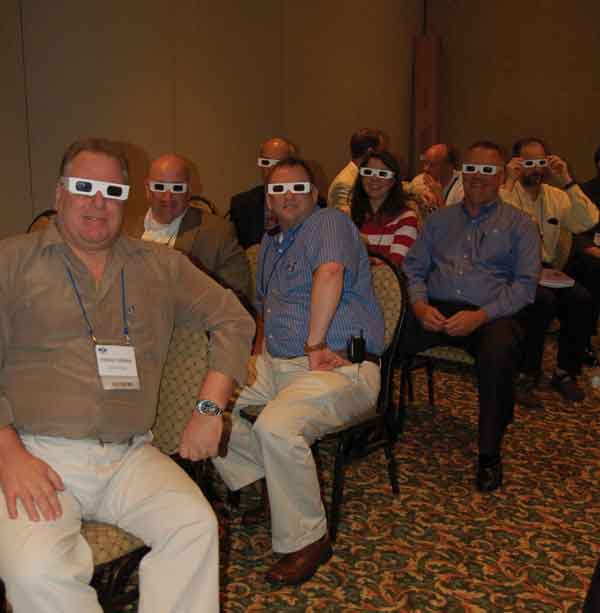
CSF video debuts at AASV
The worldwide premiere of the latest classical swine fever (CSF) educational video was held during the AASV Annual Meeting in Orlando, Florida. Next to Universal Studios was a fitting location for the premiere of the 3-D video produced through a collaborative effort involving AASV, National Pork Board, and Iowa State University. The professionally produced video, funded by a cooperative grant from USDA, is part of an educational effort to remind veterinarians and veterinary students to consider CSF as a differential when diagnosing septicemic conditions in pigs.
The video takes the viewer through a realistic scenario illustrating how CSF could be introduced into the US swine herd and the nondescript clinical signs associated with mildly virulent strains of the virus. Clinically, infection with the most common CSF viruses circulating today resembles endemic diseases commonly seen in most swine herds in the United States and could be easily misdiagnosed.
Classical swine fever was eradicated from the United States in 1978, but is endemic in many parts of Latin America and Europe. Morbidity rates are generally very high, but mortality rates and clinical signs are highly variable depending on the strain involved. The USDA has instituted a CSF surveillance program to routinely monitor laboratory submissions for the possible introduction of the virus by targeting 18 high-risk states. This program routinely tests tonsils, tonsil scrapings, and nasal swabs submitted to one of the National Animal Health Laboratory Network laboratories and rewards the submitting veterinarian with a $50 credit towards future diagnostic testing.
The video was filmed in 3-D in part to add a sense of realism to the experience, but also because some research suggests that information viewed in 3-D may be retained longer than that produced in a more traditional manner. The video was viewed by over 100 veterinarians during its debut and is now going on the road to six veterinary colleges as part of the CSF Educational Road Show. One thing’s for certain, 100 veterinarians in silly glasses is an experience you won’t soon forget!