
Case study |
Peer reviewed |
Effect on total pigs weaned of herd closure for elimination of porcine reproductive and respiratory syndrome virus
Efecto en el total de cerdos destetados debido al cierre de granja para la eliminación del virus del síndrome reproductivo y respiratorio porcino
Effet de la fermeture de troupeau pour l’élimination du virus du syndrome reproducteur et respiratoire porcin sur le nombre total de porcs sevrés
Nathan Schaefer; Robert Morrison, DVM, MBA, PhD
College of Veterinary Medicine, University of Minnesota, St Paul, Minnesota. Corresponding author: Dr Robert Morrison, 385 Animal Science/Vet Med, 1988 Fitch Avenue, St Paul, MN 55108; Tel: 612-625-9276; Fax: 612-625-1210; E-mail: bobm@umn.edu.
Cite as: Schaefer N, Morrison R. Effect on total pigs weaned of herd closure for elimination of porcine reproductive and respiratory syndrome virus. J Swine Health Prod. 2007;15(3):152–155.
Also available as a PDF.
SummaryHerd closure has been reported as a method to eliminate porcine reproductive and respiratory syndrome virus (PRRSV) from breeding herds. However, there is concern that while closing the herd to animal entries may aid in elimination of PRRSV, productivity of the herd may decrease, at least temporarily. Herd closure was conducted at 15 multiplication herds as part of a PRRSV eradication program beginning in December 2001. All herds tested positive for porcine reproductive and respiratory syndrome (PRRS) by ELISA prior to closure, and three were known to be infected. All herds were preloaded with gilts and closed for an average of 260 days. After closure, all farms tested negative for PRRSV by polymerase chain reaction and have remained negative for 4 years. The impact of closure was evaluated by comparing the number of pigs weaned during the 52 weeks prior to the day of closure to that achieved for the 52 subsequent weeks. Of the 15 herds, 13 had produced at least the same total number of weaned pigs at 52 weeks after closure. Number of services per week and change in farrowing rate accounted for 60% of the variability observed in total pigs weaned per week. | ResumenEl cierre de granja se ha reportado como un método para eliminar el virus del síndrome reproductivo y respiratorio porcino (PRRSV por sus siglas en inglés) del pie de cría. Sin embargo, existe la preocupación de que aunque el cerrar la granja a la entrada de animales puede ayudar en la eliminación del PRRSV, también puede disminuir la productividad del hato, por lo menos temporalmente. El cierre de granja se llevó a cabo en 15 granjas multiplicadores como parte de un programa de erradicación del PRRSV que inició en Diciembre del 2001. Todos los hatos salieron positivos al PRRS por ELISA antes del cierre, y se supo que tres estaban infectados. Todos los hatos habían sido previamente llenados con hembras primerizas y cerrados por un promedio de 260 días. Después del cierre, todas las granjas resultaron negativas al PRRSV por la reacción en cadena de la polimerasa y han permanecido negativas por 4 años. El impacto del cierre se evaluó comparando el número de cerdos destetados durante las 52 semanas antes del día del cierre con lo que se logró en las 52 semanas subsecuentes. De los 15 hatos, 13 produjeron por lo menos el mismo número total de cerdos destetados a las 52 semanas después del cierre. El número de servicios por semana y el cambio en el porcentaje de fertilidad constituyeron el 60% de la variabilidad observada en el total de cerdos destetados por semana. | ResuméLa fermeture de troupeau a été rapportée comme étant une méthode pour éliminer le virus du syndrome reproducteur et respiratoire porcin (PRRSV) de troupeaux reproducteurs. Toutefois, bien qu’en fermant un troupeau à l’entrée d’animaux puisse aider à éliminer le PRRSV, l’inquiétude existe que la productivité du troupeau puisse aussi diminuer, à tout le moins temporairement. La fermeture de troupeaux a été faite dans 15 troupeaux multiplicateurs dans le cadre d’un programme d’éradication du PRRSV débutant en décembre 2001. Avant la fermeture, tous les troupeaux s’étaient avérés positifs pour le PRRSV par épreuve ELISA, et trois étaient réputés être infectés. Tous les troupeaux ont été peuplés avec des cochettes et fermés pendant une moyenne de 260 jours. Après la fermeture, les animaux sur toutes les fermes se sont avérés négatifs pour la présence de PRRSV par réaction d’amplification en chaîne par la polymérase et le sont demeurés depuis 4 ans. L’impact de la fermeture a été évalué en comparant le nombre de porcs sevrés durant les 52 semaines précédant le jour de la fermeture à celui obtenu pour les 52 semaines suivantes. Parmi les 15 troupeaux, 13 ont produit au moins le même total de porcs sevrés durant les 52 semaines suivant la fermeture. Le nombre de saillies par semaine et le changement dans le taux de mise-bas sont responsables de la variabilité de 60% observée dans le nombre total de porcs sevrés par semaine. |
Keywords: swine, porcine
PRRS syndrome virus, herd closure
Search the AASV web site
for pages with similar keywords.
Received: July
26, 2006
Accepted: November
9, 2006
Porcine reproductive and respiratory syndrome (PRRS) has plagued the swine industry for the past two decades and is considered to be the most economically devastating disease of modern swine production.1 The National Pork Board estimates the annual cost of PRRS to be approximately $600 million ($US).2 Acute outbreaks of PRRS can cause fever, lethargy, and increased late-term abortions and stillbirths in pregnant sows. Young piglets and finishing pigs infected with PRRS virus (PRRSV) experience more respiratory disease, increased susceptibility to other diseases, and consequently, increased mortality.3
Common methods to control PRRSV and eradicate it from swine herds include total herd depopulation and repopulation, partial depopulation, segregated early weaning, test-and-removal, and herd closure.3 Herd closure is financially advantageous over depopulation because there is no required downtime, sows are not slaughtered, and there is no clean-up cost. The sow herd is closed to replacement animals for a recommended 6 months, but remaining females are continuously bred and sales continue.3 In some cases, closure follows a program of deliberate exposure of existing animals to the PRRSV that is resident within the herd.4 Herd closure has had a success rate above 85% for farms with segregated production, and the use of isolated three-site production can minimize the economic costs of closure.5
While herd closure has been reported to be effective, there has been little work done on its financial ramifications. A key measure of sow-herd productivity is the number of pigs weaned per week. By studying the trend in total pigs weaned across sow herds that have been temporarily closed to attempt to eliminate PRRSV, we can measure a major potential effect of herd closure.
Case description
Production records were made available from 15 multiplication sow farms in one production system that had performed herd closure for PRRSV and that had at least 52 weeks of production data before and after closure. The herds ranged in size from approximately 500 to 1200 sows per site, and the entire multiplication system was composed of approximately 10,000 sows.
All farms had good biosecurity programs. Replacement gilts were obtained from a single naive nucleus herd and boars from two company-owned studs that had been PRRSV-naive for the previous 4 years. The nucleus herd was tested weekly and boar studs were tested monthly by PRRS ELISA and pooled polymerase chain reaction (PCR). A minimum of 12 hours without pig contact was required before entering the farm. Washing, disinfection, and assisted drying of all transportation vehicles were mandatory. Each multiplication farm was located in an area of low pig density a minimum of 1.6 km from a commercial swine herd. All farms were located in areas of wooded or mountainous terrain.
During herd closure, blood samples were collected from a convenience sample of 30 to 60 weaned pigs (one pig per litter) from each multiplication herd. Samples were pooled and tested by PCR for PRRSV (five samples per pool). If two consecutive pooled PCR tests from a herd were negative, that herd was declared “stable.” Once each herd had been closed for 6 months and was producing PCR-negative weaned pigs, the farms were eligible for gilt replacement deliveries. However, these herds were closed for an additional 3 months because gilt replacements were not available.
Most samples were tested by PCR for PRRSV at Boehringer Ingelheim Vetmedica’s Health Management Center in Ames, Iowa. This test was reported to have a specificity of 99.42% (Wayne Chittick, Boehringer Ingelheim employee, written communication, 2006). Additional sampling was performed when apparently false-positive samples were identified, with emphasis on pens surrounding suspect pigs.
The dates of herd closure and opening were determined for each herd, and performance data from 52 weeks prior to closure through 52 weeks after closure were exported to an Excel spreadsheet (Microsoft Corporation, Redmond, Washington). For each herd, we calculated the number of pigs weaned for the 52 weeks prior to closure and compared that to the number of pigs weaned for the 52 weeks after closure. The preclosure and postclosure total pigs weaned for the 15 herds were compared by two-sample paired t-test.
To view the weekly change in pigs weaned after closure, the number of pigs weaned for each of the 52 weeks after closure was subtracted from the number of pigs weaned for the corresponding week before closure. For example, the number of pigs weaned week 1 after closure was subtracted from the number of pigs weaned week 52 prior to closure.
Correlation analysis and stepwise linear regression were performed in Statistix version 8.0 (Analytical Software, Tallahassee, Florida) to determine the association between four production measures and change in total pigs weaned. The four production measures were difference in total number of services for the 52 weeks before and after closure, and differences in average weekly farrowing rate, liveborn pigs per litter, and preweaning mortality. A probability of 0.2 was used as a cutoff for inclusion in the regression model. A P value of .05 was considered significant for all statistical analyses.
Production data
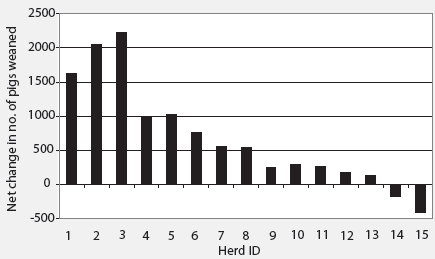
On average, 686 more pigs were weaned per herd (P < .05) during the 52-week period after closure than during the 52 weeks before closure. The change ranged from 410 fewer to 2222 additional pigs, and total pigs weaned decreased in only two herds (Table 1). No herds had a marked decrease in pigs weaned over the 52 weeks (Figure 1), and those that experienced an increase did so in a relatively constant fashion (data not shown).
Table 1: Production data for the 52 weeks before and the 52 weeks after a period of herd closure for elimination of PRRSV in 15 multiplication herds in a single production system
|
| Figure 1: Production data for 52 weeks of production
before closure for PRRS was examined in 15 multiplication sow herds in
one production system (approximately 10,000 sows total, 500 to 1200 sows
per site). For each herd, the number of pigs weaned for each of the 52
weeks after closure was subtracted from the number of pigs weaned for the
corresponding week before closure. The sum of these differences was plotted
for each farm.
|
Total services (r = 0.77, P < .01), farrowing rate (r = 0.58, P < .05), and number of liveborn pigs (r = 0.57, P < .05) were correlated with the change in number of pigs weaned. Predictor variables in the best-fit regression model were total services and farrowing rate, and these together accounted for 60% of the variability in change in total pigs weaned. Change in total services alone accounted for 57% of the variability.
Discussion
Overall, the results suggest that herd closure can be performed in sow herds similar to the ones in this study with minimal negative consequences on number of pigs weaned. The combined herds had an increase of 10,300 weaned pigs post closure. If the estimated value of one weaned pig is $35, then the system experienced $360,500 in additional annual income (all currency in $US).
Although the recommended minimum closure time is 6 months,3 these herds were closed for approximately 9 months because PRRSV-naive gilts of the desired genetic lines were unavailable. The fact that number of pigs weaned per week was maintained and even increased over this unusually long closure period is encouraging for herds that might be closed for only 6 months. The long closure period may have contributed to the success of the eradication program.
This system’s multiplication farms effectively eradicated PRRSV without negatively affecting throughput by maintaining the number of services during the period of closure. This was achieved by preloading the sow herd with gilts. Farrowing rate might increase after closure, as apparently occurred in some herds in this study, due to elimination of PRRSV, improved management, or both.
Implications
- Under the conditions in this production system, herd closure can eliminate PRRSV.
- Sow herds of approximately 500 to 1200 sows can be managed to minimize impact on number of pigs weaned per week during a period of herd closure.
- Maintaining the target number of services during herd closure will help maintain throughput.
Acknowledgements
The authors would like to thank Drs Paul Dubois, David Nolan, David Baumert, and Doug King at Cargill Inc, for their assistance throughout the project. Thank you also to the University of Minnesota’s Undergraduate Research Opportunities Program for financial support.
References
*1. Kahler SC. JAVMA News. AASV coverage. PRRS: Is elimination attainable? May 1, 2004. Available at: http://www.avma.org/onlnews/javma/may04/040501g.asp. Accessed 25 Mar 2007.
2. Neumann EJ, Kliebenstein JB, Johnson CD, Mabry JW, Bush EJ, Seitzinger AH, Green AL, Zimmerman JJ. Assessment of the economic impact of porcine reproductive and respiratory syndrome on swine production in the United States. JAVMA. 2005;227:385–392.
3. Zimmerman J, Benfield DA, Murtaugh MP, Osorio F, Stevenson GW, Torremorell M. Porcine reproductive and respiratory syndrome virus (porcine Arterivirus). In: Straw BE, Zimmerman JJ, D’Allaire S, Taylor D, eds. Diseases of Swine. 9th ed. Kansas City, Missouri: Blackwell Publishing; 2006:387–417.
4. Desrosiers R, Boutin M. An attempt to eradicate porcine reproductive and respiratory syndrome virus (PRRSV) after an outbreak in a breeding herd: eradication strategy and persistence of antibody titers in sows. J Swine Health Prod. 2002;10:23–25.
*5. Torremorell M, Henry S, Christianson WT. Eradication using herd closure. In: Zimmerman J, Yoon KI, Neumann E, eds. 2003 PRRS Compendium. National Pork Board; 2003:111–115.
*Non-refereed references.