
Brief communication |
Peer reviewed |
Prevalence and causes of inappropriate temperatures in on-farm semen storage units in Ontario
Prevalencia y causas de temperaturas inapropiadas en unidades de almacenamiento de semen en granjas en Ontario
Prévalence et causes de températures inappropriées dans les unités d’entreposage de semence à la ferme en Ontario
Beth Young, DVM, DVSc; Cate E. Dewey, DVM, MSc, PhD; Robert M. Friendship, DVM, MSc, Diplomate ABVP
BY, CED, RMF: Department of Population Medicine, University of Guelph, Guelph, Ontario, Canada. Corresponding author: Dr Beth Young, Department of Population Medicine, University of Guelph, Guelph, Ontario, Canada N1G 2W1; Tel: 519-824-4120, ext 54873; Fax: 519-763-3117; E-mail: byoung@uoguelph.ca.
Cite as: Young B, Dewey CE, Friendship RM. Prevalence and causes of inappropriate temperatures in on-farm semen storage units in Ontario. J Swine Health Prod. 2008;16(2):92–95.
Also available as a PDF.
SummaryAir temperatures were recorded inside 28 on-farm semen storage units. Inappropriate semen storage temperatures were recorded in 36% of units examined. Producer errors, including adding warm semen to the unit, poor unit maintenance, and poor temperature control, were identified as the most frequent causes of inappropriate temperatures. | ResumenSe registró la temperatura del aire dentro de 28 unidades de almacenaje de semen en granja. Se registraron temperaturas de almacenaje de semen inapropiadas en 36% de las unidades examinadas. Los errores de los productores, tales como el agregar semen caliente a la unidad, mantenimiento deficiente de la unidad, y control deficiente de la temperatura, se identificaron como las causas más frecuentes de temperaturas inapropiadas.
| ResuméLa température de l’air a été relevée à l’intérieur de 28 unités d’entreposage de semence à la ferme. Des températures inappropriées d’entreposage de la semence ont été enregistrées dans 36% des unités examinées. Des erreurs par les producteurs, incluant l’ajout de semence chaude à l’unité, un entretien déficient de l’unité, et un mauvais contrôle de la température, ont été identifiées comme étant les causes les plus fréquentes des températures inappropriées. |
Keywords: swine, semen,
temperature, storage unit
Search the AASV web site
for pages with similar keywords.
Received: September
4, 2007
Accepted: October
23, 2007
Artificial insemination (AI) using extended boar semen has become commonplace in the North American swine industry. Often, reproductive performance with AI is poorer than that achieved through natural breeding.1-3 This suboptimal performance occurs because more steps allow management errors to be made in AI procedures than in natural breeding.3 Storage and handling of boar semen is a prime example.
Producers usually store semen for 1 to 3 days prior to its use. Although information in the literature varies, the most consistently reported acceptable temperature range for storage of boar semen is 15°C to 20°C.4-6 Semen is cooled during storage to decrease the metabolic rate of the sperm. When semen is stored at temperatures > 20°C, sperm maintain a high metabolic rate with rapid energy consumption and by-product production, resulting in a short “shelf life”.6 Temperature fluctuations can also impact stored semen quality, and it has been suggested that for each 2°C to 3°C fluctuation in semen temperature, the shelf life of that semen is decreased by 1 day.7 Because boar sperm are particularly temperature sensitive, appropriate on-farm semen storage is a critical factor in achieving good AI results. To our knowledge, no studies have been published examining the ability of storage units used by producers to maintain adequate semen storage temperatures. Therefore, the objective of this study was to determine whether acceptable semen storage temperatures are being maintained in on-farm storage units used in Ontario.
Materials and methods
A convenience sample of 27 Ontario swine farms was visited between May and October of 2004. On each farm, an air-temperature-logging device (HOBO; Onset Computer Corporation, Bourne, Massachusetts), set to record air temperature at 1-minute intervals, was placed in the farm’s semen storage unit. The data logger was kept inside a heavy plastic bag to protect it from moisture, and placed in the storage unit at the same level where the semen was most frequently stored. In large units where semen was stored on multiple shelves, the data logger was placed on the middle shelf. All producers were instructed to avoid placing semen doses on the logger. They were also advised to keep the data logger in approximately the same location in the storage unit throughout the entire temperature-recording period. A log sheet was taped to each storage unit, and producers were asked to record the date, time, and reason each time the storage unit door was opened. The type of storage unit (refrigerator-type or cooler-type) was also recorded. “Refrigerator-type” storage units were refrigerators, many of which had been retrofitted with thermostats, controls, and circulation fans or heaters or both. “Cooler-type” storage units were electric plastic picnic-cooler or heater-type units, some of which had been retrofitted with thermostats and controls.
Each herd was re-visited approximately 72 hours after the initial visit. The data logger was removed from the storage unit, the recorded information was downloaded into a computer program (BoxCar 3.7; Onset Computer Corporation) for evaluation, and producer log sheets were collected.
Storage unit temperatures that fell outside the temperature range of 15°C to 20°C for ≥ 40 minutes were considered unacceptable. Storage-unit temperatures that fluctuated by ≥ 2°C for ≥ 40 minutes were also considered unacceptable. The log sheet was used to determine whether temperature changes recorded by the logger corresponded with events recorded by the producer.
Statistical analyses were conducted in Statistix Version 1.0 (Analytical Software, Tallahassee, Florida). Fisher exact tests were used to determine if storage-unit type was associated with inappropriate semen storage temperature.
Results
In one herd, semen was stored in two separate storage units, so temperature data were collected from a total of 28 storage units. Although it was impossible to determine whether the producers logged each time they opened their storage units, all producers did have information recorded on their log sheets. The average number of times the storage units were opened was 2.8 times per day, with the minimum zero times per day and the maximum eight times per day.
In two herds, the date and time were logged, but not the reasons for opening the storage unit. In total, 166 separate door-opening events were recorded for the remaining 26 storage units. The most commonly reported reason was to remove semen doses for breeding (Table 1).
Table 1: Reasons recorded by producers for opening their semen storage units, reported as a percent of 166 door-opening events*
* Results reported for 26 storage units on Ontario farms visited between May and October, 2004. Door-opening events were recorded for 72 hours. |
Unacceptable semen storage temperatures were recorded in 10 of 28 (36%) of the storage units examined. Nine of these 10 storage-unit temperatures were considered unacceptable because temperatures were outside the 15°C to 20°C range for ≥ 40 minutes. Of these, temperatures in three units exceeded 20°C, temperatures in five units fell below 15°C, and temperatures in one unit both exceeded 20°C and fell below 15°C. In eight of the nine units in which temperatures fell outside the 15°C to 20°C range, temperature fluctuations of > 2°C were also recorded. In one of the 10 problem storage units, temperature was considered unacceptable due to fluctuations of > 2°C within the acceptable range of 15°C to 20°C.
Information on the type of storage unit was collected for 25 of 28 storage units. Fifteen of 25 (60%) were the refrigerator type, while nine of 25 (36%) were the cooler type. One producer stored semen in a nonmechanized, expanded-polystyrene picnic cooler and added icepacks to regulate the temperature. The type of storage unit used was not associated with inappropriate semen storage temperature. However, the polystyrene picnic cooler performed very poorly.
In seven of the 10 problem storage units (70%), the unacceptable temperatures appeared to have been triggered by specific events recorded by the producers.
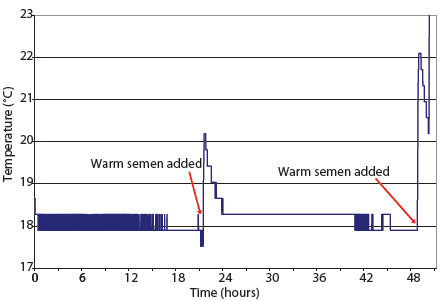
In three cases, unacceptably high temperatures occurred when warm, fresh semen doses were put into the storage unit (Figure 1).
| Figure 1: Temperatures recorded by an air-temperature-logging
device (HOBO; Onset Computer Corporation, Bourne, Massachusetts) at 1-minute
intervals in a semen storage unit in which temperatures exceeded 20°C
and fluctuated by > 2°C when warm semen was placed inside the unit.
|
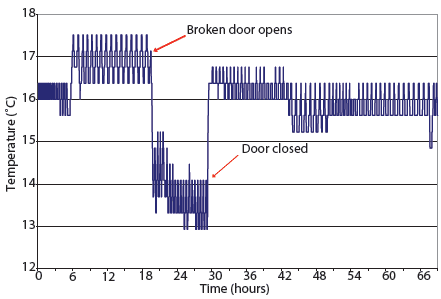
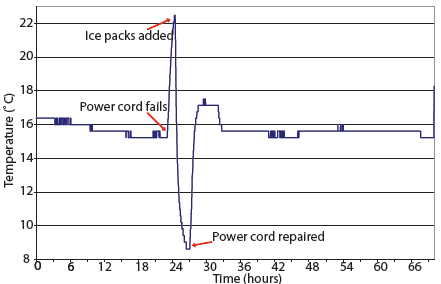
Poor maintenance of the storage unit was the cause of unacceptable storage temperatures in two cases. In one, the storage-unit door did not close properly and occasionally opened unexpectedly. This happened once during the temperature-recording period. The temperature in the storage unit fell to the air temperature of the barn (13°C to 14°C) and the temperature remained low for approximately 10 hours until the door was closed (Figure 2). In the other case of poor maintenance, a storage unit with a frayed electrical cord failed while the temperature logger was in place (Figure 3). In < 2 hours, the temperature in the storage unit rose to 22.5°C. The problem was noticed and ice packs were added to the storage unit, which caused the temperature to drop rapidly to 8.6°C. Approximately 4 hours after the storage unit first failed, a new electrical cord was installed and the temperature in the storage unit stabilized within the appropriate range.
| Figure 2: Temperatures recorded by an air-temperature-logging
device (HOBO; Onset Computer Corporation, Bourne, Massachusetts) at 1-minute
intervals in a semen storage unit in which temperatures fell below 15°C
and fluctuated by
> 2°C when a broken storage-unit door opened unexpectedly.
|
| Figure 3: Temperatures recorded by an air-temperature-logging
device (HOBO; Onset Computer Corporation, Bourne, Massachusetts) at 1-minute
intervals in a semen storage unit in which temperatures both exceeded 20°C
and fell below 15°C when a poorly maintained electrical cord failed.
|
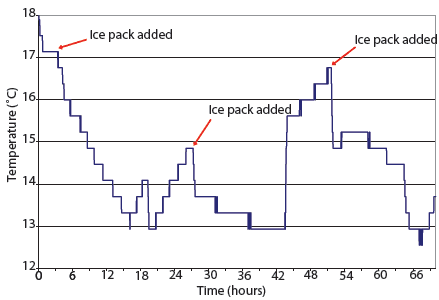
In two instances, poor temperature regulation of the unit caused unacceptable storage temperatures. In one case, the thermostat was set too high and the storage unit consistently maintained a temperature > 23°C. In the other case, a polystyrene picnic cooler with ice packs was used as a semen storage unit (Figure 4). Each time an ice pack was added, large temperature fluctuations occurred (up to 4°C), and the temperature fell below 15°C for approximately half of the temperature-recording period.
| Figure 4: Temperatures recorded by an air-temperature-logging
device (HOBO; Onset Computer Corporation, Bourne, Massachusetts) at 1-minute
intervals in a picnic cooler, used as a semen storage unit, in which temperatures
fell below 15°C and fluctuated by > 2°C when ice packs were
added.
|
Discussion
It should be noted that only air temperature was monitored in this study. Storage temperatures were not considered inappropriate until they fell out of range for ≥ 40 minutes, which should have been ample time for semen doses to equilibrate with air temperature. However, temperature of the semen would not be exactly the same as the recorded air temperature.
In this study, more problem storage units produced temperatures that were too cool than temperatures that were too warm. Boar sperm is extremely sensitive to cold shock, which is one reason the use of cryopreserved boar semen is not a practical alternative for the swine industry.4 Cooling boar semen results in changes in the organization of lipids in sperm cell membranes.8 Therefore, cold shock in boar sperm is characterized by changes in the cell membrane that cause increased permeability, altered sperm function, and sperm cell death.9
Nine of the 10 problem units experienced temperature fluctuations of > 2°C. Variation in storage temperature forces sperm to re-adjust their metabolic activity in order to adapt to changes in their thermal environment.10 This depletes nutrients and buffer in the extender and diminishes semen quality.10
Most problems with storage temperature in this study were directly attributable to the actions of the producers. This suggests that more emphasis on producer education in proper storage-unit management and maintenance is needed. Practitioners should ensure that producers know the correct boar semen-storage temperature range and understand the importance of storage temperature for maintenance of semen quality.
Thirty percent of the unacceptable storage temperatures were attributable to adding still-warm semen to the storage unit. Placing warm semen into the cooling unit is unlikely to have a negative effect on the quality of that warm semen. It is recommended that warm extended semen be gradually cooled to storage temperature to prevent cold shock.5,7 Gradual cooling is exactly what occurs in the storage unit. However, if there is cooled semen in the storage unit when the warm semen is placed inside, the higher air temperature caused by this action may have a negative impact on the quality of the cooled semen. Some means to avoid placing warm semen in the storage unit include allowing the semen to cool to below 20°C in an area of the barn cooled by a fan or air conditioner, or to have two separate units, one for cooling semen and one for storing semen once it is cooled.
Because poor maintenance was identified as a cause of unacceptable storage temperatures, producers should be encouraged to regularly maintain their storage units. Storage units should be routinely inspected and damaged parts should be repaired or replaced. Units should also be cleaned regularly to prevent dust from building up around the air circulation system, which may cause inefficient operation or overheating.7,11 Daily temperature monitoring should also be a part of routine storage-unit maintenance.7 This study used computerized data loggers to monitor temperatures, but simple high-low thermometers are an inexpensive, easy, and effective method for producers to monitor temperatures inside their semen storage units.
The type of semen storage unit used was not associated with production of inappropriate storage temperatures. Due to the wide variation in storage units used by the herds in this study, it was beyond the scope of the project to investigate other storage-unit differences that may have had an impact on temperature. Factors such as size, pre-set versus variable temperature control, and chest-style units versus upright units are other qualities that should be examined in future studies.
Implications
- Unacceptable semen storage temperature is a common problem in swine herds.
- Under the conditions of this study, unacceptable storage temperatures are associated with activities of producers, suggesting that better producer education on proper semen storage-unit management and maintenance is necessary.
- Adding warm semen to the storage unit, poor unit maintenance, and poor temperature regulation commonly cause unacceptable storage temperatures.
Acknowledgements
We appreciate the financial support given by Ontario Pork and the cooperation of the participating producers.
References
1. Elbers ARW, Guedeke TJ, van Rossem H, Hunneman WA. An observational study into herd-level risk indicators of return to oestrus more than five days after insemination in sow herds. Vet Q. 1995;17:110–112.
2. Dewey CE, Martin SW, Friendship RM, Kennedy BW, Wilson MR. Associations between litter size and specific sow-level management factors in Ontario swine. Prev Vet Med. 1995;23:101–110.
3. Flowers WL. Artificial insemination in swine. In: Youngquist RS, ed. Current Therapy in Large Animal Theriogenology. Philadelphia, Pennsylvania: W. B. Saunders Company; 1997:678–683.
4. Paulenz H, Kommisrud E, Hofmo PO. Effect of long-term storage at different temperatures on the quality of liquid boar semen. Reprod Domest Anim. 2000;35:83–87.
5. Johnson LA, Weitze KF, Fiser P, Maxwell WMC. Storage of boar semen. Anim Reprod Sci. 2000;62:143–172.
6. Zou CX, Yang ZM. Evaluation on sperm quality of freshly ejaculated boar semen during in vitro storage under different temperatures. Theriogenology. 2000;53:1477–1488.
*7. Rozeboom KJ. Quality assurance of semen. Proc Allen D. Leman Swine Conf. 2003;171–179.
8. Buhr MM, Curtis EF, Kakuda NS. Composition and behaviour of head membrane lipids of fresh and cryopreserved boar sperm. Cryobiology. 1994:31:224–238.
9. Althouse GC, Wilson ME, Kuster C, Parsley M. Characterization of lower temperature storage limitations of fresh-extended porcine semen. Theriogenology. 1998;50:535–543.
*10. Flowers WL. Semen evaluation, extension, packaging and transportation methods. Proc AASP. 1996:469–482.
*11. Questions and answers. Minitube of America newsletter. Spermnotes. 2001;5(1):6.
* Non-refereed references.