
President-elect’s message
AASV – the navigational device for swine veterinarians
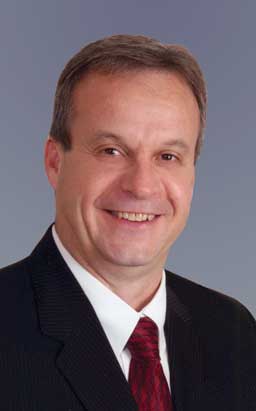
Kerry Keffaber, DVM
In 2007, I received a global positioning system (GPS) device called a TomTom (Mobility Solutions, Amsterdam, the Netherlands). During this last year, “TomTom” and I have become the best of friends as I have put the technology to work during my road travels. This palm-sized portable instrument determines where I am located. Typing on the touch screen, I enter a destination address, and directions are generated on how to travel to reach the goal, turn by turn. The screen shows where I am on a map, the current road name, surrounding road names, how far to the next turn and its name, distance until the final destination, and projected time of arrival. In addition, there is a friendly voice that guides me through the map. How neat is all that!
Using the point-of-interest (POI) feature, I can discover and be directed to the nearest Starbucks to connect my computer online, find a hotel ahead for a night’s stay, or locate a gas station to fill an urgent need. I learned at a practice-tips session how to mark the GPS coordinates of production sites and have TomTom be my guide to return the next time.
Besides being a time saver and stress reducer for me, my TomTom has become my trusted guide to where I am going. It has worked so well, three new ones were under the tree as Christmas gifts to my kids. Now their own TomToms have replaced me on the phone as their primary navigational device. It sounds like a commercial, but the purpose is to ask, “Will the AASV be the swine veterinarian’s TomTom?”
TomTom’s success depends on three key components that are the same for success in organizations guiding people:
1. Enter the correct destination address.
2. Use the right maps.
3. Have a well-designed program that effectively considers all of the options and possibilities and plans the route.
The right address is critical. If we are heading to the incorrect goal, we can get there efficiently. However, it is still the wrong destination. It may be the right state and the right city, but having even the wrong street can make the navigational device of limited value.
With this new device, I have found myself at times only listening to the guiding voice turn by turn, ignoring the outside surroundings, not really knowing where I am or how I got there. Let us all stay alert, discuss, and double check to be sure we have entered the correct destination address for the AASV.
The landscape is always changing and therefore the maps we use must be as accurate and updated as possible and evolve with the world we live in. Who will be the makers of the maps we use? Imagine how different would be the maps created by the AVMA, National Pork Producers Council, universities, or the government. Consider how varied the roads would appear in maps designed by our clients, consumers, People for the Ethical Treatment of Animals, or the Humane Society of the United States. The AASV maps must be dynamic but real, always knowing that some bridges to the future are still under construction.
The system that considers all of the options and plans the route is the most critical component. Even with a perfect system, inputs are necessary. When using my TomTom, I need to state whether to take toll roads that cost money, to take the shortest or quickest route, and to avoid congestion. It is critical for AASV to use wisdom and vision to appropriately weight each factor when choosing our priorities. Occasionally, my TomTom will create a plan including routes traveled in the past that were less than ideal. It is risky to not override these choices. Experience of AASV members with previous success and errors must be part of the route planning.
When I miss a turn and make a mistake in travel, the friendly voice on the sound feature of my TomTom may become irritating, continuing to remind me that I am heading down the wrong path and to do a u-turn as soon as possible. However, it motivates me to reconsider the road I am traveling. Likewise, this accountability is important, from AASV to its members and from the members to AASV.
There are other features on my TomTom, such as traffic monitoring, alternate route planning, and a speed indicator, that others have told me are important to them, but that I have not yet attempted to use. The AASV needs to offer services and support as unique as our members to help in their journeys.
The AASV needs to be THE navigational device for swine veterinarians. It will take all of us to ensure that we have entered the right address, are using the correct maps, and have a solid program to best evaluate the options and plan the trip. By performing these services with excellence, our members can be the TomTom guides for pork production and veterinary medicine to arrive at the right place at the right time.
-- Kerry Keffaber, DVM