
Original research |
Peer reviewed |
Influence of method of administration of prostaglandin on farrowing and relationship between gestation length and piglet performance
Influencia del método de administración de prostaglandina al parto y la relación entre la duración de la gestación y el desempeño del lechón
Influence du mode d’adminis-tration de prostaglandine sur la mise-bas et la relation entre la durée de la gestation et les performances des porcelets
Barbara Straw, DVM, PhD; Ronald Bates, MS, PhD; Gerald May, MS
BS: Department of Large Animal Clinical Sciences, College of
Veterinary Medicine, Michigan State University, East Lansing,
Michigan. RB: Department of Animal Sciences, Michigan State University,
East Lansing, Michigan. GM: Michigan Extension Service, East Central Extension Office,
Ithaca, Michigan. Corresponding author: Dr Barbara Straw, Department of
Large Animal Clinical Sciences, Michigan State University, A201
Veterinary Medical Center, East Lansing, MI 48824-1314;
Tel: 517-432-5199; Fax: 517-432-3450; E-mail: straw@cvm.msu.edu.
Cite as: Straw B, Bates R, May G. Influence of method of administration of prostaglandin on farrowing and relationship between gestation length and piglet performance. J Swine Health Prod. 2008;16(3):138–143..
Also available as a PDF.
SummaryObjectives: To compare stillbirth rates for litters born during or after the work day; to compare effectiveness of single or split doses of prostaglandin F2α (PGF) administered by injection or topically to induce farrowing; and to determine whether gestational age of the piglet at birth affects its preweaning performance. Materials and methods: Prostaglandin F2α was administered to sows 113 days after the last insemination, either by intravulval injection or vaginal mucosal application and either in a single 5-mg dose or two half-doses given at a 6-hour interval. Control sows were not treated. Time of parturition and litter performance were recorded. Results: Approximately 17% to 54% of treated sows and 17% of controls farrowed during the work day on gestation day 114. The single-dose mucosal application of PGF was less effective in inducing parturition during working hours of day 114 than the other three methods of administration, which produced comparable results. Number of stillborns per litter did not differ in treated sows and controls, nor in litters farrowed at night compared to those farrowed during the work day. Shorter gestation length was associated with lighter birth weight, but birth weights and weights 122 days after the last insemination and at 12 days of age did not differ among piglets of treated and control sows. Implications:. Administration of PGF by split-dose topical mucosal application or single or split-dose intravulval injection are equally effective at inducing parturition. Induction and shortening of gestation length do not adversely affect gain in piglets. | ResumenObjetivos: Comparar el porcentaje de nacidos muertos en camadas nacidas durante o después de las horas de trabajo; comparar la eficacia de una dosis única o dividida de prostaglandina F2α (PGF por sus siglas en inglés) administrada por inyección o de manera tópica para inducir el parto; y determinar si la longitud gestacional del lechón al nacer afecta su desempeño pre destete. Materiales y métodos: Se administró la prostaglandina F2α a hembras 113 días después de la última inseminación, ya sea por inyección intravulvar o por aplicación en mucosa vaginal y en una dosis única de 5 mg o dos medias dosis aplicadas a un intervalo de 6 horas. Las hembras control no fueron tratadas. Se registraron el tiempo del parto y el desempeño de la camada. Resultados: Aproximadamente del 17% al 54% de las hembras tratadas y el 17% de los controles parieron durante el horario de trabajo en el día 114 de la gestación. La aplicación de la dosis única de PGF en la mucosa fue menos efectiva en la inducción del parto durante las horas de trabajo del día 114 que los otros tres métodos de administración, los cuales produjeron resultados similares. El número de nacidos muertos por camada no difirió en hembras tratadas y controles, ni en las camadas paridas en la noche comparadas con las paridas durante las horas de trabajo. La gestación más corta se asoció con pesos de nacimiento más ligeros, pero los pesos de nacimiento y los pesos 122 días después de la última inseminación y a los 12 días de edad no difirieron entre los lechones de las hembras tratadas y los controles. Implicaciones: La administración de PGF con aplicación tópica en la mucosa en dosis dividida o única o inyección intravulvar en dosis dividida son igualmente efectivas en la inducción del parto. La inducción o la reducción de la duración de la gestación no afectan de manera negativa la ganancia en lechones. | ResuméObjectifs: Comparer les taux de mort-nés pour les portées nées durant ou après les heures de travail; comparer l’efficacité d’une dose unique ou séparée de prostaglandine F2α (PGF) administrée par injection ou de manière topique à induire la mise-bas; et de déterminer si l’âge de gestation des porcelets à la naissance affectent ses performances pré-sevrage. Matériels et méthodes: La PGF2α été administrée aux truies 113 jours après la dernière insémination, soit par injection intra-vulvaire ou application sur la muqueuse vaginale d’une dose unique de 5 mg ou de deux demi-doses données à des intervalles de 6 heures. Les truies témoins n’étaient pas traitées. L’heure de la mise-bas et les performances des animaux de la portée étaient enregistrées. Résultats: Environ 17% à 54% des truies traitées et 17% des témoins ont mis bas durant la journée de travail au jour 114 de gestation. L’application unique de PGF sur la muqueuse était moins efficace que les trois autres méthodes d’administration à déclencher la mise-bas durant la journée de travail au jour 114. Ces dernières donnaient des résultats similaires. Le nombre de mort-nés par portée ne différait pas entre les truies traitées et les truies témoins, non plus que chez les portées nées durant la nuit comparativement à celles nées durant la journée de travail. Des temps de gestation plus court étaient associés avec un poids à la naissance plus élevé, mais les gains de poids et le poids 122 jours après la dernière insémination et à 12 jours d’âge ne différaient pas entre les porcelets nés de truies traitées ou truies témoins. Implications: L’administration de PGF donnée en doses séparées par application topique sur la muqueuse ou par injection intra-vulvaire d’une dose unique ou de doses séparées sont aussi efficaces à induire la parturition. L’induction et un raccourcissement de la durée de gestation n’ont pas affecté négativement le gain chez les porcelets. |
Keywords: swine, prostaglandin, induced farrowing
Search the AASV web site
for pages with similar keywords.
Received: May 3, 2007
Accepted: January 23, 2008
On many farms, the objective of induced farrowing is to allow optimal supervision of piglet delivery to improve neonatal survival.1 In other instances, the objective is to avoid weekend farrowings or to synchronize farrowing with a predetermined weaning day in order to wean piglets by a specified age.
To induce parturition, manufacturers recommend that a single dose of prostaglandin F2α (PGF) be injected intramuscularly (IM) up to 2 days before the herd median due date. Guthrie2 reported that when this protocol was used, approximately 50% to 60% of sows farrowed within a day of treatment. The cost of PGF treatment can be reduced if 25% to 50% of the label dose is injected into the vulva (extra-label use).3,4 The likelihood of farrowing during the next 10-hour working day was increased when two IM injections of PGF were administered at a 6-hour interval (split dose).5
Avoidance of unnecessary injections is an objective in modern swine production. Sows that have received numerous injections react poorly on welfare assessments. It is known that many drugs are well absorbed after deposition onto mucosal membranes, and in fact, the PGF label warns that absorption through intact skin is a concern for women of childbearing age and persons with respiratory problems.6 Therefore, application of PGF on the vaginal mucosa may be an alternative to injection (Dr R. N. Kirkwood, personal communication, 2005).
In some herds, management requires piglets to attain a predetermined age prior to weaning at a fixed date. In order for piglets to achieve this age, all sows must farrow by a certain date. Sows that farrow early in the week are not induced, but on a predetermined day, any sow that has not farrowed is induced in order for her piglets to be “old enough” at weaning. Herds that use this strategy tend to have more splay-legged pigs and higher preweaning mortality that is not offset by the ability to cross-foster and give additional nursing care to induced litters.7,8 It is common to wean piglets at 18 days of age, and nursery rations are designed for the digestive capability of pigs weaned at this age. However, it might be questioned whether a piglet born after 112 days of gestation and allowed 18 days of nursing (130 days since conception) is as mature and viable as one allowed 115 days of gestation and 15 days of nursing (130 days since conception). Furthermore, early termination of gestation is associated with lower fat content of colostrum.8
The objectives of this study were to compare stillbirth rates for litters born either during the work day (with personnel present) or during other hours of the day; to compare the effectiveness of different methods of administering PGF to induce farrowing within 23 to 31 hours; and to determine whether gestational age of a piglet at birth affects its weight at 122 days post insemination and at 12 days of age.
Methods
This study was conducted over a 5-week period during the summer in a 2500-sow commercial herd with mean gestation length of 115 days. At the time of movement into the farrowing house, 508 sows were allotted into treatment groups. Sows were randomly allocated within parity to five farrowing management protocols for administration of PGF (Lutalyse; Pharmacia and Upjohn, Kalamazoo, Michigan) on day 113 of gestation (Table 1). The label dose of PGF in swine is 10 mg administered once IM within 72 hours before parturition. Intravulvar injections were made using a 3-mL syringe and a 21-gauge, 1.5-inch needle. One lip of the vulva was grasped and everted so that the injection could be made into the vulva from the mucosal side. Mucosal administration was made using a catheter attached to a 3-mL syringe. The catheter was inserted 15 cm into the vagina and the syringe slowly emptied onto the mucosa. Administrations were given at 8 am for single doses and at 8 am and 2 pm for split doses.
Table 1: Treatment groups in a study of method and route of administration of prostaglandin F2α (PGF*) used to induce farrowing in a group of 508 sows in a 2500-sow commercial herd
* Sows were treated with PGF (Lutalyse; Pharmacia and Upjohn, Kalamazoo, Michigan) on day 113 of gestation. The label direction to induce farrowing is a single 10-mg dose administered intramuscularly 72 hours before the predicted due date. † Single dose: 5 mg of PGF administered at 8 am; split dose: 2.5 mg of PGF administered at 8 am and 2 pm. NA = not applicable. |
Sows were not treated with oxytocin prior to parturition. Farrowings were recorded as working day (occurring between 7 am and 3 pm) or night (occurring between 3 pm and 7 am). The time of farrowing was recorded as the time of the birth of the first pig. However, if one or two pigs were discovered with the sow at the morning check and others quickly followed, that farrowing was recorded as a day-time farrowing because all sows could not be examined exactly at 7 am. Total born, mummified, stillborn per litter, and live-born litter sizes were recorded. Pigs were considered stillborn if they had periople on their hooves and if they were found in the immediate proximity of the caudal area of the sow. Piglets were ear-tagged and weighed at birth and were weighed again at 122 days after the last insemination (usually 5 to 7 days after birth with conception defined as the day of the last insemination of the conception service) and at 12 days after birth. Cross-fostering was performed within treatment group within the first 24 hours in order to equalize numbers of pigs per litter. Effect of gestation length was examined in piglets from sows that farrowed at ≤ 113 days and ≥ 116 days of gestation.
Animals were housed and managed with due regard for their welfare according to the guidelines provided by National Pork Board. Regular farrowing-house personnel were responsible for feeding sows twice a day, cleaning up after farrowing (eg, disposing of afterbirth), processing piglets (cutting teeth and tails, giving iron injections and castrating), maintaining records, and general oversight and determination and administration of sow treatments. While performing their regular duties, they observed sows as they farrowed and assisted if a sow appeared to have dystocia.
Statistical analysis
Within each treatment group, only data from sows that had not yet farrowed prior to administration of treatment were used in analysis. This included 413 of the 508 sows assigned to treatment groups. Number of pigs born per litter, number born alive per litter, number of mummies per litter, number of stillborns per litter, and gestation length were compared using a least squares analysis of variance (SAS Version 8; SAS Institute, Cary, North Carolina). Terms in the model included the fixed effects of treatment, parity (classified as 1, 2, 3, 4 to 6, or ≥ 7), and portion of the day when born (day or night as defined for this study), and their interactions. The main effects and their interactions were tested for significance using F tests. Interactions were not significant. Categorical traits (number of pigs born per litter, number born alive per litter, number of mummies per litter, number of stillborns per litter) were transformed using a natural log transformation. Total number of pigs that died (mummies plus stillborns per litter) was compared between treatments using chi-square analysis. Piglet weights (at birth, at 122 days after last insemination, and at 12 days of age) were compared using a least squares analysis of variance mixed model including the fixed effects of treatment, parity, portion of the day when born (as previously defined), and their interactions. Sow was the random effect. Terms in the model were tested for significance by F tests. Interactions were not significant. Sow was the random effect. The influence of parity on portion of the day when farrowing occurred was examined using logistic regression analysis and a model that included the fixed effects of parity and treatment. The interaction was tested and was not significant. An orthogonal comparison was estimated, comparing parity 1 and 2 sows with parity 3 and older sows. The level of significance for all statistical analyses was set at P < .05.
Results
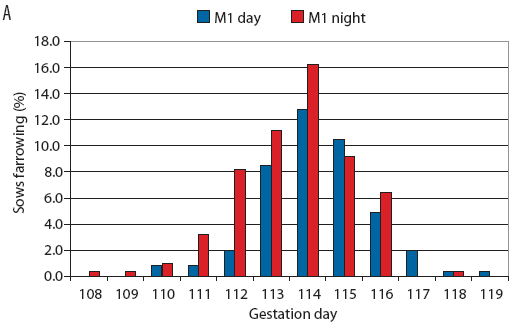
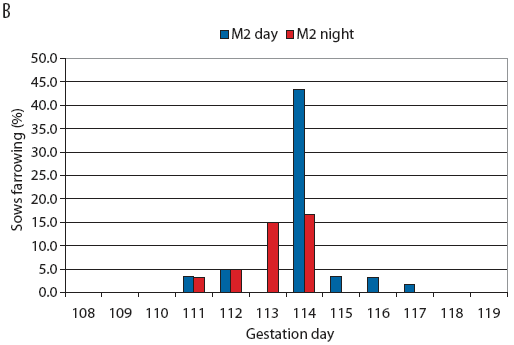
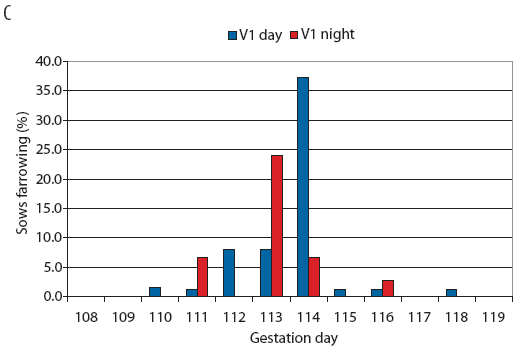
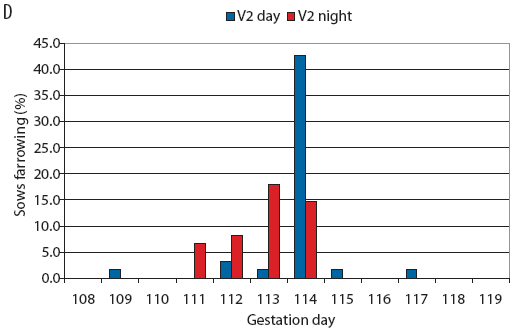
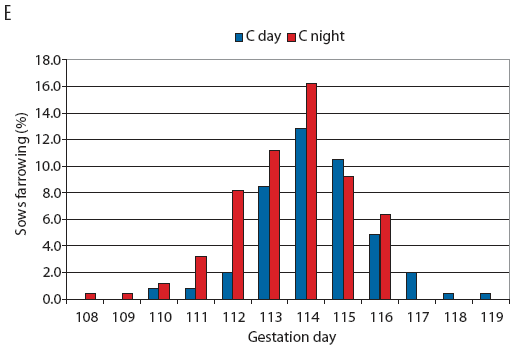
Between 17% and 54% of sows in the four groups treated with PGF and 17% of controls farrowed during the work day on gestation day 114. Overall, 43.1% of controls and 52.3% to 60.1% of sows in the PGF protocols farrowed during the work day (Figure 1).
| Figure 1: Times of farrowing by day of gestation and time
period within the day for 413 sows (treatment groups described in
Table 1). Sows were randomly allocated within parity to the
farrowing management protocols. Day = 7 am to 3 pm; night = 3 pm to
7 am. Prostaglandin F2α was less effective when applied
topically to the mucosa as a single dose (Figure 1A; P <
.05; ANOVA), but otherwise produced the same result whether applied
to the mucosa as a split dose or injected either as a single or
split dose (Figures 1B, 1C, and 1D; P > .05).
|
Approximately 35% of control sows of parities 1 and 2 farrowed during the work day, whereas approximately 50% of third-parity and older control sows farrowed during the work day (Table 2). While the work day represents only a third of the 24-hour day, half of the older sows farrowed during this time.
Table 2: Percent by parity (mean ± SE) of noninduced sows in a commercial herd that farrowed during the 8-hour work day (7 am to 3 pm)
ab Values with different superscripts differ (P < .01; orthogonal contrast). |
Prostaglandin2α applied to the mucosa as a single dose (Figure 1A) was less effective than the other three methods of administration at inducing parturition during the next working day (P < .05), but otherwise produced the same result whether it was applied to the mucosa or injected, and whether it was given in one dose or as a split dose (P > .05; Figure 1B, 1C, and 1D).
For the 413 sows that farrowed after treatment, farrowing performance did not differ (P > .05) among the five treatments in terms of total pigs per litter (range 11.7 to 12.6), total born alive per litter (range 10.5 to 11.5), number of mummified pigs per litter (range 0.2 to 0.3), number of stillborns (range 0.9 to 1.2; 7.3% to 8.7%), or total number of pigs that died (range 0.7 to 1.4). Number of stillborns per litter in the five treatment groups ranged from 0.7 to 1.2 in litters born during the day and from 0.7 to 1.1 for litters born during the night, with an average of 1.1 stillborns per litter born during the day and 0.9 born during the night (P > .05). The number of stillborns per litter did not differ by treatment group (P > .05) whether sows farrowed during the work day or at night.
At 122 days after the last insemination and at 12 days after birth, weights of piglets did not differ by treatment group (P > .05) whether or not dams had been induced to farrow. At 122 days after the last insemination, weight (mean ± SE) of males (3.28 ± 0.07 kg) did not differ from that of females (3.21 ± 0.07 kg), and weight of piglets nursing gilts (3.01 ± 0.07 kg) did not differ from weight of those nursing older sows (3.20 ± 0.08 kg) (P > .05).
When the 86 litters with gestation length ≤ 113 days were compared to the 76 litters with gestation length ≥ 116 days, shorter gestation length was associated with lighter birth weight. Piglets born at ≤ 113 days (mean birth weight 1.46 ± 0.04 kg) were 8.4% lighter at birth than piglets born at ≥ 116 days (mean birth weight 1.59 ± 0.03 kg; P < .05). Mean birth weight of pigs born on days 114 and 115 of gestation (1.55 ± 0.04 kg) was significantly greater than that of pigs born on day 113 (P < .05), but did not differ from that of pigs born on day 116.
Discussion
Measures of farrowing performance did not differ between sows that were induced and those not induced, or between sows that farrowed during the day and those that farrowed at night. This farm, like most commercial farms, did not employ a designated parturition attendant, as was the case in many studies that investigated the use of prostaglandin to induce farrowings in the 1980’s, for example, the study of Jainudeen and Brandenburg.9
In these earlier studies, additional labor beyond the regular farrowing-house personnel was used to supervise farrowings. It is commonplace in today’s industry to assume that as long as farrowings occur during the work day, farrowing-house personnel will be able to recognize problem farrowings and provide assistance while they perform their regular duties. Because of the additional labor required, this farm did not employ a system of recording the time of birth of each piglet so that intervention could be initiated when time between deliveries exceeded 15 minutes, as in other studies.1,10 Similar to findings of Holyoake et al,1 farrowing performance, (litter size, stillbirth rate, early pre-weaning mortality) did not differ between induced and control sows. In both studies, induction without utilization of a dedicated parturition attendant was not associated with lower stillbirth rate or higher survival rate.
A single administration of 5 mg PGF applied on the mucosa was not as effective as the other methods of application, which did not produce different results, ie, approximately 50% of the sows farrowed during the intended period. This was comparable to results of other studies.1,2,4 In this study, the likelihood of farrowing the next working day was not greater when two injections of PGF were administered 6 hours apart, as was reported by Kirkwood and Aherne.5
In this study, induced sows farrowed, on average, 1 day earlier than non-induced sows. With this small gestational age difference in induced and control pigs, it was not surprising that their weights did not differ at 122 days after the last insemination and 12 days after birth, although induced pigs were smaller at birth as observed in other studies.10
An interesting finding of this study was the propensity of sows to farrow during the day when people were present. Few reports document the time of day when parturition occurs in domestic animals. Rossdale and Short11 observed 501 mares 24 hours a day, without interacting with them, and recorded 86% of foalings between 7 pm and 7 am, with the maximal incidence between 11 pm and midnight. Similar results were reported by Zwolinski and Siudinski,12 who also observed that as nights became shorter in the summer, the frequency of foalings per hour of darkness increased. Husbandry factors were thought to influence the time of parturition in 13 mares in which students were in close attendance prior to foaling.12 Under these conditions, the circadian rhythm was abolished and more mares foaled by day than by night.
Few reports exist of researchers watching sows 24 hours a day and recording farrowing time. Much of the literature assumes that sows farrow at night, or at least during the time when not attended. If sows farrowed randomly, it would be expected that about a third of them would farrow during the work day (8 of 24 hours or one-third of the 24-hour day) and two-thirds would farrow during the other 16 hours. In this study, older sows tended to farrow during the day more frequently than expected (approximately 50% of sows instead of 33%). Possibly the presence of people has the same influence on farrowing as it has on foaling, as reported by Rossdale and Short.11
Implications
- Under the conditions of this study, administration of prostaglandin by single-dose mucosal application is less effective at inducing farrowing than split-dose mucosal application or either single- or split-dose intravulval injection.
- Body weights at 12 days of age may not differ in piglets born early due to induction and in those born at a greater gestational age.
- Time of day when farrowings occur should be determined in each herd in order to best schedule farrowing assistance.
Acknowledgement
The authors gratefully acknowledge the cooperation and assistance of Circle K Family Farms of Muir, Michigan.
References
1. Holyoake PK, Dial GD, Trigg T, King VL. Reducing pig mortality through supervision during the perinatal period. J Anim Sci. 1995;73:3543–3551.
2. Guthrie HD. Control of time of parturition in pigs. J Reprod Fertil. 1985;33(Suppl):229–244.
*3. Perestrelo H, Perestrelo R. Synchronization of parturition in intensive pig herds by administration of reduced doses of prostaglandin F2 alpha (clinprost) by the intravulvosubmucosa. Proc IPVS. Barcelona, Spain 1986;63.
4. Friendship RM, Templeton CL, Deckert AE. An evaluation of vulvomucosal injections of prostaglandins for induction of parturition in swine. Can Vet J. 1990;31:433–436.
5. Kirkwood RN, Aherne FX. Increasing the predictability of cloprostenol-induced farrowing in sows. Swine Health Prod. 1998;6:57–59.
6. Lutalyse [package insert]. Kalamazoo, Michigan: Pharmacia and Upjohn.
*7. Straw BE, Gemus M. Diagnostic Investigation of Challenging Problems in Production and Disease. Swine Health Management Certification Seminar Series. February 1996.
8. Jackson JR, Hurley WL, Easter RA, Jensen AH, Odle J. Effects of induced or delayed parturition and supplemental dietary fat on colostrum and milk composition in sows. J Anim Sci. 1995;73:1906–1913.
9. Jainudeen MR, Brandenburg AC. Induction of parturition in crossbred sows with cloprostenol, an analogue of prostaglandin F2α. Anim Reprod Sci. 1980;3:161.
10. De Rensis F, Sottocorona M, Kirkwood RN. Effect of prostaglandin on farrowing and piglet growth. Vet Rec. 2002;151:330–331.
11. Rossdale RD, Short RV. The time of foaling of Thoroughbred mares. J Repro Fertil. 1967:13:341–343.
*12. Zwolinski J, Siudinski S. The distribution of foalings in mares during the 24-hour day [in Polish][abstract]. Medycyna weterynaryna. 1965:21:614–616.
* Non-refereed references.