
What's your interpretation? |
 This histogram shows the distribution of average birth weights of liveborn
pigs recorded from 1216 litters. Average birth weights were derived by dividing
litter birth weights by numbers of live born pigs. The minimum value
in this distribution is 0.59 kg (1.3 lb) and the maximum is 3.18
kg (7.0 lb).
This histogram shows the distribution of average birth weights of liveborn
pigs recorded from 1216 litters. Average birth weights were derived by dividing
litter birth weights by numbers of live born pigs. The minimum value
in this distribution is 0.59 kg (1.3 lb) and the maximum is 3.18
kg (7.0 lb).
Given this information, what is your estimate of the mean birth weight per pig in this herd? Looking at the shape of this distribution, would you expect the median value to be more or less than the mean value?
 This histogram on the front cover (shown
here as Figure 1) represents data from 1216 litters for which birth weights
were recorded. The mean (or average) birth weight per pig is 1.63
kg (3.59 lb). The median (value of the 608th observation) is 1.55
kg (3.40 lb) The median is less than the mean, which is to be expected in
skewed distributions having longer and/or thicker tails on the right hand
side. Another measure of central tendency, the mode or most common
value observed in this distribution is 1.5 kg (3.3 lb)
This histogram on the front cover (shown
here as Figure 1) represents data from 1216 litters for which birth weights
were recorded. The mean (or average) birth weight per pig is 1.63
kg (3.59 lb). The median (value of the 608th observation) is 1.55
kg (3.40 lb) The median is less than the mean, which is to be expected in
skewed distributions having longer and/or thicker tails on the right hand
side. Another measure of central tendency, the mode or most common
value observed in this distribution is 1.5 kg (3.3 lb)
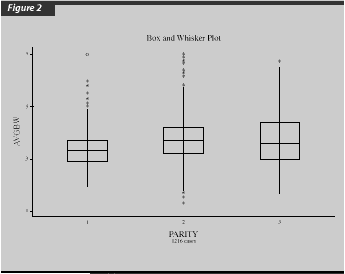 Inspection of the box and whisker plot (Figure 2) suggests that there
may be differences in mean birth weight per pig among litters born to breeding
females of parities one, two, and three. The appropriate statistical test
to address this question is the one-way analysis of variance or one-way
ANOVA. This test is a slightly more complex version of the Students's
t-test that we used to compare the means of two groups in an earlier example
in this series (see Swine Health and
Production 5(1):43, January and February, 1997).
Inspection of the box and whisker plot (Figure 2) suggests that there
may be differences in mean birth weight per pig among litters born to breeding
females of parities one, two, and three. The appropriate statistical test
to address this question is the one-way analysis of variance or one-way
ANOVA. This test is a slightly more complex version of the Students's
t-test that we used to compare the means of two groups in an earlier example
in this series (see Swine Health and
Production 5(1):43, January and February, 1997).
 Student's t-test is only applicable when comparing two groups. Where
there are three or more groups to be compared, the ANOVA test must be used.
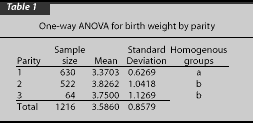
A simplified table of results of the ANOVA output is shown in Table 1.
Student's t-test is only applicable when comparing two groups. Where
there are three or more groups to be compared, the ANOVA test must be used.
A simplified table of results of the ANOVA output is shown in Table 1.
Having tested all possible pairwise comparisons (parity one versus parity two; parity one versus parity three; and parity two versus parity three), the ANOVA output indicates that there are two groups in which the means are not significantly different from each other. A common convention for identifying such groups is to use lowercase letters as superscripts to means in the body of the table. In this case, the ANOVA detected no significant difference between parities two and three (group "b".) However, pigs born to parity-one females (group "a") were significantly (P >.05) lighter than those born to multiparous females--on average 0.18-0.23 kg (0.4- 0.5 lb) per pig.
Do you observe similar differences in herds that you work with? Are lower birth weights in pigs born to parity-one females economically important? If so, what can you do to influence them positively?