
What's your interpretation? |
Weaning-to-estrus interval and reproductive performance of the sow
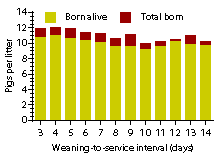 Data in this are from a breeding herd with 300 sows. The x-axis shows
previous-weaning-to-service interval (days), and the y-axis shows number
of pigs per litter at birth. As you can see, total born and born-alive litter
sizes change along with the PWSI. Numerically, the largest litter sizes
were ovwervedin sows with 3- to 5-day previous weaning-to-service intervals.
Litter sizes decreased from day 6 and then increased again after day 11.
What else can you tell regarding weaning-to-service intervals?
Data in this are from a breeding herd with 300 sows. The x-axis shows
previous-weaning-to-service interval (days), and the y-axis shows number
of pigs per litter at birth. As you can see, total born and born-alive litter
sizes change along with the PWSI. Numerically, the largest litter sizes
were ovwervedin sows with 3- to 5-day previous weaning-to-service intervals.
Litter sizes decreased from day 6 and then increased again after day 11.
What else can you tell regarding weaning-to-service intervals?
Phenomenon
The interval between weaning and the rst observed estrus (PWEI) varies widely in the sow. Under commercial conditions, approximately 80% of sows return to estrus within 6 days after weaning and about 88% of sows return to estrus within 10 days postweaning.
Previous-weaning-to-estrus interval is related to subsequent reproductive performance. In a large data set, smaller litter sizes and a lower farrowing rate were observed in sows that returned to estrus from 7-10 days postweaning than in sows that returned to estrus either from 3-6 days or 11-14 days postweaning (Figure 1).1
Mechanisms
The reason sows with a previous-weaning-to-estrus interval (PWEI) of 7-10 days may have lower subsequent performance has not yet been thoroughly studied. Investigators have made two observations related to PWEI.
- The duration of estrus is shorter in sows with longer PWEIs (Table 1).2 Estradiol is elevated earlier in sows with shorter PWEIs, indicating that follicular development begins earlier after weaning in sows with shorter PWEIs. Preweaning estradiol concentrations do not differ between sows with short and long PWEI. The number of pigs weaned per litter and sow body weight loss during lactation may be factors in the phenomenon.
- The interval from onset of estrus to ovulation decreases with increasing PWEI (Figure 2).3 Fertilization results have been observed to be dependent on the moment of insemination relative to ovulation, regardless of PWEI. Insemination either 24 hours before ovulation or 24 hours after ovulation resulted in a low farrowing rate and litter size.
Implications
Although there is no direct evidence that sows with 7- to 11-day PWEI are less fertile, these sows should be bred sooner after estrus is detected. The optimal time to breed sows is 0-24 hours before ovulation.
References
2. Rojkittikhun T, Sterning M, Rydhmer L, Einarsson S. Estrous symptoms and plasma levels of estradiol-17[beta] in relation to the interval from weaning to estrus in primiparous sows. Proc IPVS Cong. the Hague, Netherlands. 1992;P485
3. Kemp B, Soede NM. Relationship of weaning-to-estrus interval to timing of ovulation and fertilization in sows. J Anim Sci. 1996;74:944-949