
What's your interpretation |
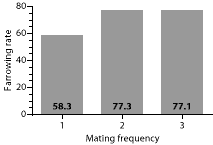 Data shown in this figure were from a newly established breeding herd.
All females were gilts from the same genetic line. Artificial insemination
was used for all matings. Semen used for each insemination was from boars
of the same genetic line. Gilts received one, two, or three inseminations
during a single estrus period. Farrowing rate was 58.3% for single matings,
77.3% for double matings, and 77.1% for triple matings. Do you believe that
the association of farrowing rate with mating frequency observed in this
herd can be generalized to other breeding farms?
Data shown in this figure were from a newly established breeding herd.
All females were gilts from the same genetic line. Artificial insemination
was used for all matings. Semen used for each insemination was from boars
of the same genetic line. Gilts received one, two, or three inseminations
during a single estrus period. Farrowing rate was 58.3% for single matings,
77.3% for double matings, and 77.1% for triple matings. Do you believe that
the association of farrowing rate with mating frequency observed in this
herd can be generalized to other breeding farms?
Phenomenon: Multiple matings are commonly used in breeding herds with either natural service or artificial insemination (AI). Multiple matings are widely believed to improve farrowing rate and litter size. The breeding records of commercial farms frequently reveal some sows that are bred four, five, six, and even seven times during a single estrus period, particularly in herds using AI. But do more matings equal better performance?
We conducted a retrospective study using multiple farm data and found that double-mated gilts had a higher farrowing rate and larger litter size compared with single-mated gilts. There were no differences in farrowing rate and litter size between single- and double-mated sows. In both gilts and sows, farrowing rate and litter size did not differ between double and triple matings.1 All farms used natural service.
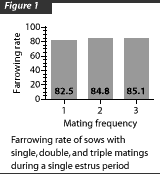
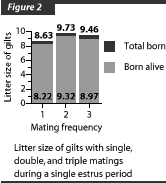
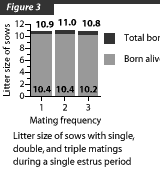
To verify the results from the retrospective study, we conducted a prospective study.2 An experiment was carried out in a commercial breeding herd with natural service. Gilts and sows were systematically assigned to single, double, and triple mating groups. Boars were also systematically assigned to each breeding event. Heat detection was conducted once a day. The intervals between double matings were 24 hours and for triple matings were either 24-12 hours or 12-24 hours. Farrowing rates of sows were 82.5% for single-mated groups, 84.8% for double-mated groups, and 85.1% for triple-mated groups (Figure 1). No statistical difference (P<.05) was detected between the matings. Double-mated gilts had larger (P<.05) litter size (total born and born alive) than single-mated gilts (Figure 2). There were no differences in litter size between double- and triple-mated gilts. Litter size did not differ among sows that received single, double, and triple matings (Figure 3). We also analyzed breeding data from five Minnesota herds that use AI and found the same results as the above. In addition, we found that farrowing rate and litter size were decreased as females received more than three matings. This suggests that double mating should be used for gilts and single mating for sows. There is no benefit to breeding females three times under commercial farm conditions, and it can be detrimental to breed females more than three times. |
   |
Mechanisms: A successful mating requires sperm and eggs to meet at the oviduct at the right time. To achieve high fertilization results, the optimal time to inseminate is within 24 hours before ovulation. If a sow is inseminated at the optimal time just once, fertilization will be successful. The reason that the success of single-mating in gilts differs from that in sows is not known. Possible explanations include immature body, inexperience with breeding, and a relatively short duration of estrus. Nonbeneficial triple matings and the detrimental effects of four or more matings are probably the result of conducting the third or fourth+ matings in late estrus or metestrus. Rozeboom, et al.,3 demonstrated that fertility and litter size decline when the last of multiple inseminations during one estrus cycle is performed during late or metestrus.
Insemination and fertilization is an inflammatory procedure. Excess semen and inflammatory products must be eliminated from the uterus. The quality and interval of estrus detection and interval of multiple breeding are important.
Implications
- Double breeding for gilts.
- Single breeding for sows if a qualified breeding is guaranteed.
- Don't breed animals more than three times.
References
2. Xue JL, Dial GD, Trigg T, Davies P, King V. Influence of mating frequency on sow reproductive performance. Submitted to J Anim Sci. 1998 (In Press).
3. Rozeboom KJ, Troedsson MHT, Shurson GC, Hawton JD, Crabo BG. Late estrus or metestrus insemination after estrual inseminations decreases farrowing rate and litter size in swine. J Anim Sci. 1997;75:2323-2327.