
 WHAT'S YOUR INTERPRETATION?
What proportion of the feed grown and purchased by your clients is actually consumed by pigs?
Monitoring feed disappearance: The missing
$40,000 profit
Will Marsh, FarmWise Systems, Inc.
Over the past 4 years, the National Pork Producers Council (NPPC) Joint Committee on Pork Industry Production and Financial Standards has developed uniform methods and standardized definitions for calculating financial and production information. Standard measures have been applied to existing data to develop sample farm case studies. Case studies are an important component in the delivery of educational programs designed to train participants to use production and financial information systems in the internal management of pork production businesses.
When historic production record system data and corresponding accrual financial data for the case study farm were combined in accordance with NPPC Standards measures, it was revealed that the average daily finisher feed disappearance per pig in the finisher production stage during the calendar year 1997 was 6.61 lb (3.0 kg). Pigs entered the finisher production stage at an average weight of 64 lb (29.0 kg) and were sold at an average weight of 262.9 lb (119.3 kg). Thus, the average pig in the finisher pig production stage would have weighed (262.9 + 64) / 2 = 163.5 lb (74.1 kg). The ratio of finisher feed:live weight gain is calculated as 3.58. Therefore, it is likely that the finisher pigs did not eat a significant portion of the finisher feed paid for during the period. It is possible that some feed may have been paid for but never delivered to the farm. Further feed disappearance may be explained by "inventory shrinkage," or some finisher feed may have been fed to other classes of pigs. However, it is likely that inefficiencies in the feed delivery system at the finisher site, such as poorly adjusted or broken feeders, are a source of feed wastage.
 Monitoring is the process of watching or checking.
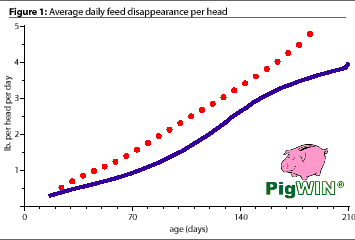
The Feed Disappearance Monitor (Figure 1) has two components.
The solid line is the Expected Daily Feed Disappearance Curve
for pigs in a wean-to-finish system. The dots (points) show the
actual daily feed disappearance over the life of a group of pigs.
The points on the graph are updated automatically every few days
as Feed In or Feed Inventory events are entered in each group's
record. As we can see from Figure 1, the actual average daily
feed disappearance exceeded the expected throughout the entire
growth period. Had the manager of this sample farm been monitoring
the feed disappearance in this group, the discrepancy could have
been identified and investigated early in the life of the group
and before the economic losses became serious.
Monitoring is the process of watching or checking.
The Feed Disappearance Monitor (Figure 1) has two components.
The solid line is the Expected Daily Feed Disappearance Curve
for pigs in a wean-to-finish system. The dots (points) show the
actual daily feed disappearance over the life of a group of pigs.
The points on the graph are updated automatically every few days
as Feed In or Feed Inventory events are entered in each group's
record. As we can see from Figure 1, the actual average daily
feed disappearance exceeded the expected throughout the entire
growth period. Had the manager of this sample farm been monitoring
the feed disappearance in this group, the discrepancy could have
been identified and investigated early in the life of the group
and before the economic losses became serious.
PigGAIN provides a set of industry standard performance curves against which to measure a herd's current performance. Once you have sufficient growing data from your own herd, you can re-calibrate the performance curves based on your own data. You can select multiple closed groups on which to base the re-calibration, or you may wish to select one particular group that performed well for this purpose (PigGain user manual, p. 132).
What is this simple monitoring tool worth to a pork producer? Production records show that there were 529,566 finisher pig days in the herd during 1997. Finisher feed cost was 7.27 cents per lb. Reducing finisher feed disappearance by 1lb (0.45 kg) per head per day to 5.61 lb (2.55 kg) would have saved this 300-sow farrow-to-finish farm business $38,450 in feed expenses over the course of the year, probably with no effect of the growth rate of the pigs.
Will Marsh, President of FarmWise Systems, Inc., St. Paul, Minnesota, is a recovering academic. In his new life he consults on production and financial standards for agribusiness. Other services provided by FarmWise Systems include economic analysis and decision support for animal health and food production, and sales and support of the PigWIN(R) management information system. Will can be contacted by phone at 651-765-8240 or by email at wemarsh@farmwise.com.