
Diagnostic notes |
Non refereed |
Pre-harvest food safety diagnostics for Salmonella
serovars.
Part 1: Microbiological culture
Julie Funk, DVM, MS, PhD
Department of Veterinary Preventive Medicine, College of Veterinary Medicine, Ohio State University, 1900 Coffey Road, Columbus, OH 43210; Tel: 614-247-6635; Fax: 614-292-4142; E-mail: funk.74@osu.edu.
Funk J. Pre-harvest food safety diagnostics for Salmonella serovars. Part 1: Microbiological culture.
J Swine Health Prod. 2003;11(2):87-90.This article is the first of a two-part series. Part 2 will appear in the May/June issue, 2003.
Nearly 1.5 million cases of human salmonellosis occur yearly in the United States, and 95% of these are foodborne.1 Salmonella serovars rank second only to Campylobacter species in annual cases of bacterial foodborne disease, and are responsible for the largest proportion (30%) of deaths attributable to bacterial foodborne agents.1
Although recent reports suggest that only 3% of human Salmonella outbreaks of known etiology were attributable to pork products,2 Salmonella serovars represent the bacterial foodborne pathogens of most importance for contamination of pork. This is a consequence of not only the risk to domestic public health and consumer confidence, but of competitiveness in export markets.
In response to large-scale foodborne outbreaks of salmonellosis associated with pork, both Denmark,3,4 the major competitor of the United States for pork export markets, and other European Union (EU) pork producers have implemented "farm to table" Salmonella control programs. Demonstration of efficacious Salmonella control measures that reduce the contamination of pork products will be crucial for maintaining market share,5,6 yet wholesale adoption of EU control programs may not be practical in the United States due to differences in production systems, industry structure, and regulatory organization.
In the United States, the approach to decreasing the risk of Salmonella contamination of meats has been focused on control measures during slaughter and processing. The Hazard Analysis Critical Control Point (HACCP)/Pathogen Reduction Act7 established performance standards for Salmonella at slaughter and processing plants, which has resulted in decreased product contamination. It is expected that the salmonella standards at slaughter and processing will become more stringent, creating pressure from packers and processors for on-farm interventions to reduce the pre-harvest prevalence of Salmonella-positive swine.
A current challenge for Salmonella pre-harvest food safety is identification of a diagnostic tool that not only has desirable tests characteristics (eg, precision and accuracy, diagnostic sensitivity and specificity), but also reflects the risk of contamination of pork during slaughter and processing. In the United States, microbiological culture of feces or tissues has been the predominant diagnostic tool to establish Salmonella status of farms. This is most likely a combination of factors: microbiological culture is the "gold standard" diagnostic test for Salmonella serovars; regulatory monitoring at slaughter is based on microbiological culture; and there is an intuitive appeal to the idea that shedding of Salmonella organisms near the time of marketing contributes to the risk of contamination of carcasses during slaughter and processing.
In determining the status of Salmonella serovars (or that of any other infection) at the herd level, herd-level sensitivity depends on actual herd prevalence as well as on the sensitivity and specificity of the individual diagnostic tool, the herd-to-herd variability of sensitivity and specificity, and the number of animals tested.8 Therefore, inherent characteristics of the diagnostic test and sampling strategies, and the investigator's understanding of the epidemiology of Salmonella serovars will both have an impact on interpretation of herd level diagnostic test results.
Epidemiology of Salmonella serovars
It has long been recognized that swine9-18 can be asymptomatic carriers of Salmonella serovars. In the United States, the frequency of the number of farms positive for Salmonella organisms ranges from 38.2 to 83.0%, and the frequency of the number of positive pigs ranges from 6.0 to 24.6%.19,20
Since microbiological culture of pathogenic salmonellae from the feces of swine depends on their shedding status, temporal variability of fecal shedding of salmonellae affects the herd-level test sensitivity. This variability may be extreme, both within a group of pigs and between marketing groups within the same farm. Funk et al21 have reported significant changes in prevalence during the growing phase of pork production. Lo Fo Wong22 reported that of 32 herds monitored longitudinally for 2 years, 62% changed their Salmonella status (categorized as positive or negative) at least once during the study. Gibson et al23 also reported temporal variability in prevalence within US herds, estimated by lymph node culture. Current epidemiological investigations have been predominantly based on point-in-time evaluation of Salmonella prevalence, usually near the time of marketing (if sampled ante-mortem on farm) or at slaughter. Although it is attractive to believe that the Salmonella status of a group of pigs close to the time of slaughter most closely reflects the risk of carcass contamination (and subsequent risk to human health), there is little data to suggest whether this accurately reflects the risk of contamination.
Another component of the epidemiology of salmonella shedding on swine farms that may be important to interpretation of diagnostic tests is that shedding of multiple serotypes (serovars) within a group of pigs is common.21,24 A few studies have reported that individual pigs were shedding multiple serotypes simultaneously.25 There does seem to be a certain group of Salmonella serotypes that are the "usual suspects" isolated from cases of foodborne disease in humans: Salmonella Enteriditis and Salmonella Typhimurium are the serovars most commonly isolated from human clinical cases.26 Under the current HACCP/Pathogen Reduction Act standards, all pathogenic Salmonella isolates are considered of equal risk regardless of serotype. There is some evidence in the literature that different isolation methods may favor isolation of certain serotypes in samples containing more than one Salmonella serotype.27
Salmonella organisms are rapidly disseminated after ingestion or inhalation. Reports suggest that salmonellae may be isolated from the cecum, ileum, lymph nodes, and feces of a pig within 30 minutes of oral exposure.28 In the same investigation, all exposed pigs were Salmonella-positive by 6 hours post exposure to contaminated slurry. Fedorka-Cray et al29 reported isolating salmonellae from the colons of pigs 3 hours after intranasal inoculation. The evidence for rapid infection is important, as lairrage (holding) pre-slaughter time is typically 2 to 3 hours in the United States, which does not include the time for transport from the farm to the slaughter facility. The implications are that exposure to salmonella during transport, lairrage, or both may result in an infection detectable by microbiologic culture at slaughter, but this may not reflect the Salmonella situation at the farm. This has obvious implications for the utilization of microbiological culture for Salmonella diagnosis. If the status of Salmonella serovars on the farm is the outcome of interest, pigs must be sampled on-farm if microbiological culture is the diagnostic test utilized.
Diagnosis of salmonellosis using fecal culture (the imperfect gold standard)
Fecal culture has the advantage of being available ante mortem, fecal samples are relatively easy to collect, and a Salmonella isolate is available for further identification (by serotype, phage type, genotype, or antibiogram, for example). Because a bacterial isolate can be definitively identified, microbiologic culture is assumed to have perfect specificity (no false positive results). Its weaknesses are well known: it is costly, time-consuming, and has poor sensitivity. False-negative results are common, ranging from 10 to 80%.30-32 Fecal culture is also susceptible to sampling error if collection of samples does not coincide temporally with periods of shedding. As samples must be collected on-farm due to the risks of infection during transport and lairrage, fecal culture is disadvantageous from the standpoint of increasing biosecurity risk, as it requires on-farm visits and increasing costs of travel and labor expenses compared to sampling at a central location (eg, a slaughter facility).
Numerous studies have compared microbiologic techniques for isolating salmonella from a range of sources,33 including swine feces.32,34-39 In contrast to diagnosis of clinical salmonellosis, in which direct plating is often sufficient,40 diagnosis of sub-clinical shedding typically requires specialized culture methods with several steps of selective enrichment. Two selective enrichment methods predominate in most epidemiological investigations of swine (Figure 1).38 For Method 1, 10 g or more of feces is usually initially diluted in buffered peptone water (BPW). In Method 2, a 1-g sample of feces is initially diluted in tetrathionate broth. In a comparison of these two methods, Davies et al38 found no statistical difference in the sensitivity for salmonella detection despite the differences in initial fecal sample weight. Funk et al25 compared different fecal sample size (rectal swab, 1 g, 10 g, and 25 g) for the initial dilution in BPW for Method 1, and found increasing sensitivity with increasing fecal sample size. To the best of the author's knowledge, no one has published the effect of fecal sample size using Method 2.
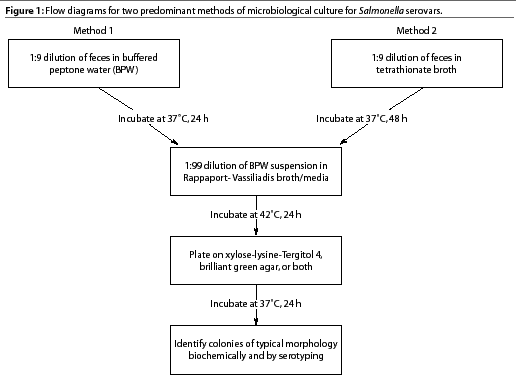
Increased sensitivity has been achieved by using delayed secondary enrichment (DSE), which entails allowing one of the enrichment steps, usually Rappaport-Vassiliadis (RV) broth, to be stored at room temperature for several days, then aliquoting this inoculated broth at a 1:99 dilution in fresh RV and processing as before. Increases in sensitivity of approximately 25% have been described.38
From a practical standpoint of the effect of handling and storage of feces prior to culture, refrigeration for 6 days did not significantly reduce the sensitivity of culture compared to same-day processing of fecal samples, but freezing of fecal samples at -15°C for 14 days resulted in statistically significant decreases in Salmonella isolation rates.37
Implications for sampling strategies on farm
Given the challenges associated with the epidemiology of salmonellae, the limited sensitivity of fecal culture, and the balancing of economic limitations for investigative efforts, on-farm sampling strategies must take into account the diagnostic goal. In many epidemiologic investigations, estimation of group prevalence, as well as identification of the serotypes present on the farm, are important. Criteria for determining the proportion of the herd to sample for epidemiological studies of Salmonella serovars usually do not consider the likely presence of more than one serovar in a herd, let alone in an individual animal. However, if the objective of a study is to characterize the prevalence and serovars of Salmonella in herds, some consideration is warranted. Various approaches for identifying the presence of multiple serotypes (serovars) in samples have been discussed.41 Some possibilities at the herd level include serotyping multiple isolates per plate, use of multiple enrichment broths (and time and temperature of enrichment) and plating media, culturing multiple samples per pig, or sampling more animals per herd. In an investigation by Funk et al,25 sampling more animals per group, which maximizes the diversity of the source material while providing the benefit of more accurate estimation of prevalence, was the more efficient approach compared to serotyping more colonies per positive fecal sample. In addition, as suggested by investigation of the dynamics of bacterial growth in selective enrichment broths,27 selective enrichment may result in asynchronous growth curves due to differing susceptibilities among serotypes to the restrictive components of the media. Therefore, selection of more than one colony for serotyping may not be as efficient as sampling more animals or utilizing delayed secondary enrichment techniques.36,37,41
In situations where only the herd level status is important (positive or negative) and the expected salmonella prevalence is low, pooling individual fecal samples for microbiological testing increases the herd level sensitivity of the test,42 while potentially decreasing the cost of sampling and microbiological methods. However, this method may underestimate the number of serotypes present on a farm, and is not beneficial if on-farm prevalence is much higher than 5%.
The one consistent aspect of a review of the literature involving sampling and diagnostic strategies for Salmonella serovars is that increased effort, either through more intensive sampling or the use of multiple microbiological broths or plating media, increases the sensitivity of fecal culture methods.33,38,41 Balancing the benefits of different sampling strategies and microbiological methods with economic limitations, while still meeting the diagnostic goal, is a challenge for epidemiological monitoring of salmonellae on farms.
References - refereed
1. Mead PS, Slutsker L, Dietz V, McCaig LF, Bresee JS, Shapiro C, Griffin PM, Tauxe RV. Food-related illness and death in the United States. Emerg Inf Dis. [serial online]1999; 5(5). Available at: http://www.cdc.gov/ncidod/eid/index.htm. Accessed December 6, 2002.
3. Alban L, Stege H, Dahl J. The new classification system for slaughter pig herds in the Danish Salmonella surveillance program. Prev Vet Med. 2002;53:133-146.
4. Mousing J, Jensen PT, Halgaard C, Bager F, Feld N, Nielsen B, Nielsen JP, Bech-Nielsen S. Nation-wide Salmonella Enterica surveillance and control in Danish slaughter swine herds. Prev Vet Med. 1997;29:247-261.
5. D'Aoust JY. Salmonella and the international food trade. Int J Food Microbiol. 1994;24:11-31.
6. Davies PR. Food safety and its impact on domestic and export markets. Swine Health Prod. 1997;5:13-20.
8. Martin SW, Shoukri M, Thorburn MA. Evaluating the health status of herds based on tests applied to individuals. Prev Vet Med. 1992;14:33-43.
9. Ghosh AC. An epidemiological study of the incidence of Salmonellas in pigs. J Hyg Camb. 1972;70:151-160.
10. Guinee PAM, Kampelmacher EH, Hofstra K, van Keulen A. Salmonellae in young piglets in the Netherlands. Zbl Vet Med B. 1964;12:250-256.
11. Harvey RWS, Price TH, Morgan J. Salmonella surveillance with reference to pigs - Cardiff abattoir, 1968-1975. J Hyg Camb. 1977;78:439-448.
12. Kampelmacher EH, Guinee PAM, Hofstra K, van Keulen A. Studies on Salmonella in slaughter-houses. Zbl Vet Med B. 1961;8:1025-1041.
13. Lee JA, Ghosh AC, Mann PG, Tee GH. Salmonella on pig farms and in abbattoirs. J Hyg Camb. 1972;70:141-150.
14. McDonagh VP, Smith HG. The significance of the abattoir in Salmonella infection in Bradford. J Hyg. 1958;56:271-279.
15. Newell KW, McClarin R, Murdock CR, MacDonald WN, Hutchinson HL. Salmonellosis in Northern Ireland, with special reference to pigs and Salmonella contaminated pig meal. J Hyg Camb. 1959;57:92-105.
16. Oosterom J, Notermans S. Further research into the possibility of Salmonella-free fattening and slaughter pigs. J Hyg Camb. 1983;91:59-69.
17. Williams LP Jr, Newell KW. Sources of Salmonellas in market swine. J Hyg Camb. 1968;66:281-293.
18. Williams DR, Hunter D, Binde J, Hough E. Observations on the occurrence of Salmonella Choleraesuis and other Salmonellas in two herds of feeder pigs. J Hyg Camb. 1981;86:369-377.
20. Davies PR, Morrow WEM, Jones FT, Deen J, Fedorka-Cray PJ, Harris IT. Prevalence of Salmonella in finishing swine raised in different production systems in North Carolina, USA. Epidemiol Infect. 1997;119:237-244.
21. Funk JA, Davies PR, Nichols MA. Longitudinal study of Salmonella Enterica in two, three-site production systems. Vet Microbiol. 2001;83;45-60.
24. Davies PR, Bovie FGEM, Funk JA, Morrow WEM, Jones FT, Deen J. Isolation of Salmonella serotypes from feces of pigs raised in a multiple-site production system. JAVMA. 1998;212:1925-1929
25. Funk JA, Davies PR, Nichols MA. The effect of fecal sample weight on detection of Salmonella Enterica in swine feces. J Vet Diagn Invest. 2000;12:412-418.
27. Jameson JE. A discussion of the dynamics of Salmonella enrichment. J Hyg Camb. 1962;60:193-207.
29. Fedorka-Cray PJ, Kelley LC, Stabel TJ, Gray JT, Laufer JA. Alternate routes of invasion may affect pathogenesis of Salmonella Typhimurium in swine. Infect Immun. 1995;63:2658-2664.
30. Baggesen DL, Wegener HC, Bager F, Stege H, Christensen J. Herd prevalence of Salmonella Enterica infections in Danish slaughter pigs determined by microbiological testing. Prev Vet Med. 1996;26:201-213.
33. D'Aoust JY. Salmonella. In: Doyle MP, ed. Bacterial Food borne Pathogens. New York: Marcel Dekker; 1989:327-445.
34. Bager F, Petersen J. Sensitivity and specificity of different methods of isolation of Salmonella from pigs. Acta Vet Scand. 1991;32:473-481.
35. Cherrington CA, Huis in't Veld JH. Comparison of classical isolation protocols with a 24 hour screen to detect viable salmonella in feces. J Appl Bact. 1993;75:65-68.
36. Nietfeld JC, Kelly B, Dritz SS, Feder I, Galland JC. Comparison of conventional and delayed secondary enrichment for isolation of Salmonella spp. from swine samples. J Vet Diagn Invest. 1998;10:285-287.
37. O'Carroll JM, Davies PR, Correa MT, Slenning BD. Effects of sample storage and delayed secondary enrichment on detection of Salmonella spp. in swine feces. Am J Vet Res. 1999;60:359-362.
38. Davies PR, Turkson PK, Funk JA, Nichols MA, Ladely SR, Fedorka-Cray PJ. Comparison of methods for isolating Salmonella bacteria from faeces of naturally infected pigs. J Appl Microbiol. 2000;89:169-177.
40. Schwartz KJ. Salmonellosis In: Straw BE, D'Allaire S, Mengeling WL, Taylor DJ, eds. Diseases of Swine. 8th ed. Ames, Iowa: Iowa State University Press; 1999:535-551.
41. Harvey RWS, Price TH. The examination of samples infected with multiple Salmonella serotypes. J Hyg Camb. 1967;65:423-434.
42 .Christensen J, Gardner I. Herd-level interpretation of test results for epidemiological studies of animal diseases. Prev Vet Med. 2000; 45:83-106.
References - non refereed
2. Hedberg CW. The role of pork as a vehicle for confirmed foodborne disease outbreaks in the United States, 1990-1997. Proc Pork Quality Safety Summit. 2002;159-166.
7. Pathogen reduction; hazard analysis and critical control point (HACCP) systems; final rule. Federal Register 1996; 61:38805-38855.
19. Shedding of Salmonella by finisher hogs in the U.S. Info Sheet N223.196, United States Department of Agriculture, Animal and Plant Inspection Service, Veterinary Services, National Animal Health Monitoring System, 1997.
22. Lo Fo Wong DMA. Epidemiology and control options of Salmonella in European pig herds [PhD thesis]. Copenhagen, Denmark: Royal Veterinary and Agricultural University; 2001.
23. Gibson K, Ritter L, Blaha T, Carlson A, Szaszak A, Maes D, Grass J, Harris-Turney I. Monitoring the dynamics of Salmonella prevalence in commercial swine herds. Proc 4th Int Sym Epidemiol Control Salmonella other Food Path Pork. 2001;274-280.
26. 2000 Annual Report, CDC's Emerging Infections Program, National Antimicrobial Resistance Monitoring System: Enteric Bacteria. Available at: http://www.cdc.gov/narms/annual/2000/narms_2000_annual_a.htm. Accessed November 20, 2002.
28. Hurd HS, McKean JD, Griffith RW, Wesley IV, Rostagno MH. Estimation of the on-farm Salmonella Enterica prevalence in market swine. Proc 4th Int Sym Epidemiol Control Salmonella other Food Path Pork. 2001; 521- 523.
31. Enøe C, Andersen S, Wachmann H, Sørensen LL. Estimation of sensitivity and specificity of an indirect enzyme linked immunosorbent assay (ELISA) for detection of antibodies against Salmonella Enterica in meat juice and of microbiological examination of caecal content and mesenteric lymph nodes for Salmonella Enterica. Proc 4th Int Sym Epidemiol Control Salmonella other Food Path Pork. 2001; 518-520.
32. Hurd HS, Stabel TJ, Carlson S. Sensitivity of various fecal sample collection techniques for detection of Salmonella typhimurium in finish hogs. Proc Third Int Sym Epidemiol Control Salmonella Pork. August 1999;63-64.
39. Hurd HS, Gailey JK, McKean JD, Rostagno MH. Experimental rapid infection in market swine following exposure to a Salmonella contaminated environment. Proc 4th Int Sym Epidemiol Control Salmonella other Food Path Pork. 2001;462-464.